



The hybrid model of CX
Artificial intelligence is transforming how organizations deliver customer support. But even as automation quickly evolves, customer experience has to feel fundamentally human.
Business leaders are no longer debating whether to adopt AI, but how to scale it and drive measurable ROI. The answer lies in a hybrid model powered by agentic orchestration, in which AI and human agents can work together across channels and workflows to deliver consistent, connected experiences at scale.
Human vs. AI customer service
Human and AI agents are often framed as being in competition. But in practice, the two work best hand-in-hand in a strategic partnership.
Customers want immediate answers for simple customer inquiries, but also expect meaningful engagement for complex or sensitive issues. They’re comparing every interaction with the best experiences they’ve ever had. They expect speed and consistency, along with emotional intelligence and creative answers. That’s best delivered by AI and human agents working closely together.
Organizations that treat AI and people as complementary rather than in competition are better positioned to meet rising customer expectations.
What AI does best in customer experience
AI excels in environments that demand speed and scale. It can consistently handle high volumes of customer interactions at a pace that would be difficult for human teams to match.
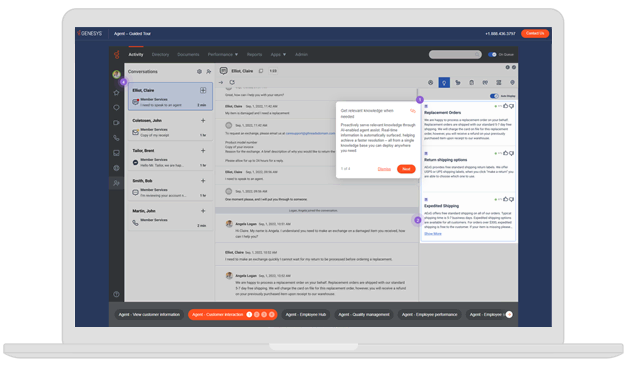
Modern AI tools can handle routine customer inquiries, analyze large datasets to uncover patterns and use natural language understanding to detect customer intent in real time. Other types of AI tools enhance agent performance by surfacing relevant knowledge and automating repetitive administrative tasks.
Agentic virtual agents — which can reason, adapt and take action across systems, unlike earlier chatbots — extend AI beyond scripted responses, enabling more dynamic interactions and, when necessary, making escalation to human agents more seamless.
What distinguishes agentic virtual agents from other AI automation tools is their ability to go beyond static workflows. They can evaluate context, orchestrate actions across systems and pursue specific outcomes on their own. Instead of waiting for customers to reach out, systems can anticipate needs and initiate interactions proactively.
The risks of improperly implementing automation in customer service
AI has evolved rapidly from basic chatbots and scripted workflows to more adaptive technologies like agentic virtual agents. As organizations accelerate adoption, the challenge is no longer whether to use AI, but how to deliver it in a connected, coordinated way.
Many organizations still rely on multiple point solutions across channels, workflows and departments. While these tools may solve individual problems, they can also create fragmented experiences when systems fail to share data and context. Customers may need to repeat information between channels, receive inconsistent responses or encounter disconnected interactions that feel impersonal and inefficient.
AI can only perform to its full potential when it has a strong foundation of unified data, orchestration and governance. Without a connected CX ecosystem, organizations risk siloed customer insights, limited visibility across the customer journey and interactions that lack continuity. And without governance built into the foundation, organizations risk inconsistent AI decision-making, compliance gaps, unmanaged escalation paths, inaccurate outputs and reduced customer trust.
A unified platform helps solve these challenges by connecting AI and human support across channels and touchpoints. This creates a more seamless experience where context follows the customer, enabling faster resolutions, more personalized engagement and stronger customer relationships.
Where human agents add the most value
But AI cannot do the job alone. Human customer service agents have to play a role in delivering high-quality, loyalty-building experiences.
When customers face complicated problems or emotionally charged situations, human interaction becomes essential. Agents can adapt their communication style, interpret subtle cues and build rapport in ways AI cannot fully replicate. The value of human support becomes most apparent in situations that require empathy, nuance or complex decision-making beyond predefined rules.
The risks of relying too heavily on human agents
At the same time, a purely human-driven model isn’t sustainable in today’s market. As demand grows, costs and the risk of operational inefficiencies increase. Response times and wait times can grow, service quality can vary and agents spend too much time handling repetitive tasks. This not only impacts customer satisfaction but also contributes to employee burnout.
Additionally, human agents need breaks and time off, which necessitates workload management and planning to ensure coverage at all times. Without multiple contact centers spread around the world, it’s not possible to have 24/7 coverage. With AI support, it’s possible to have a level of coverage all day, every day.
AI offloads routine work and enables agents to focus on higher-value interactions. This decreases workload and allows human agents to focus on their strengths while AI handles the rest.
How to balance AI and human support in customer service
Delivering exceptional CX and achieving desired outcomes requires a deliberate strategy. It’s not about assigning fixed roles to AI or human agents, but dynamically aligning capabilities with customer needs.
Bots, agentic virtual agents and human agents all have their parts to play. Bots can handle routine queries that don’t require thinking. Virtual agents handle complex or messy work that requires more sophisticated action. And when the work is sensitive and most complex, or where empathy is required, that’s when the human agent is the right choice for the job.
In a hybrid model, AI and human agents operate as part of a unified system rather than as separate layers. A typical hybrid interaction may begin with a virtual agent that understands intent, gathers context and resolves straightforward issues. If the situation requires more empathetic service, the interaction is seamlessly transferred to a human agent with that full context preserved. AI copilots then provide agents with real-time guidance, helping them respond effectively.
AI must support human agent performance by providing context and recommendations as needed. It can surface relevant knowledge much faster than a person can, and connect disparate data from across the enterprise, allowing human agents to focus on the customer. Continuous optimization is also critical. By analyzing customer interactions and outcomes, organizations can refine how AI and humans interact across the customer journey.
This model reflects a shift from basic automation to intelligent orchestration, where AI and humans collaborate continuously rather than operating in isolation.
Using data and customer journey orchestration to connect AI and human interactions
Customers expect every interaction to feel connected, regardless of whether they engage through voice, chat, email or social media. Delivering that continuity requires more than deploying AI across multiple channels. It requires customer journey orchestration that can unify data, workflows and decision-making in real time.
Many organizations still operate with fragmented CX ecosystems where CRM systems, contact center platforms, ticketing tools and digital engagement channels function independently. This leads to siloed customer data and incomplete interaction context, forcing customers to repeat information as they move between AI systems and human agents.
Solving this requires a shared operational layer across the customer experience ecosystem. Orchestration platforms continuously ingest and analyze signals such as customer identity, interaction history, sentiment analysis, journey stage, channel behavior and agent availability. This allows AI systems and customer service agents to operate from the same real-time context.
For example, an agentic virtual agent handling a billing issue can access prior conversations, evaluate customer sentiment and trigger automated workflows across backend systems. If escalation is needed, the orchestration layer transfers the interaction to a human agent with the full conversation history and customer data already attached.
This approach also enables more advanced routing and decisioning. AI-powered orchestration engines can prioritize interactions based on predictive factors such as customer lifetime value, likelihood to churn or probability of first-contact resolution (FCR), rather than relying only on queue availability.
As organizations adopt more advanced AI capabilities, orchestration becomes critical for maintaining consistency, governance and operational control. With unified orchestration, organizations can deliver adaptive, personalized experiences where AI and humans work together seamlessly across the entire customer journey.
Real-world examples of AI and human collaboration in customer experience
Organizations across industries are already applying hybrid models to improve both efficiency and experience quality. Here are a few examples from businesses that employ the Genesys Cloud platform.
Charles Sturt University
By combining AI-powered self-service with connected human support on Genesys Cloud CX, Charles Sturt University improved student engagement while reducing operational costs by 13% and lowering cost to serve by nearly 11%. The university created faster, more personalized support experiences for a growing digital-first student population.
Eir
Irish telecommunications provider Eir used AI copilots and digital engagement tools to streamline customer support operations and reduce agent workload. Auto-summarization and intelligent wrap-up capabilities save agents up to one minute per call, while customer effort scores improved by 63%.
Best Buy Canada
Best Buy Canada modernized customer engagement with AI, automation and real-time operational insights on a unified platform. The retailer reduced operating costs by 20%, lowered average handle time by 19% and cut call transfers by 40%, helping create more connected customer experiences across channels.
Aterian
Aterian simplified customer support operations by combining AI-driven agent assistance with human expertise. AI copilots help agents resolve inquiries faster across thousands of products by recommending next-best actions and automating post-interaction work, contributing to a 65% reduction in technology total cost of ownership (TCO).
Oldenburgische Landesbank
OLB transformed from a branch-focused institution into an omnichannel digital bank using AI-powered predictive routing, workforce management and digital engagement channels. The bank reduced wait times by 15%, improved transactional net promoter score and increased operational efficiency while delivering more personalized customer service.
These examples highlight a consistent pattern. AI manages scale and speed, while humans focus on value and connection.
Measuring success: improving efficiency, response times and customer satisfaction
To evaluate AI and human collaboration, organizations must track both operational and experiential metrics.
Efficiency improvements can be seen in reduced handle times and increased automation rates. Response times often improve as AI responds to inquiries instantly. At the same time, customer satisfaction and customer effort scores reveal whether experiences are improving.
AI also enables deeper analysis by evaluating every agent interaction, rather than just a sampling — and by performing that analysis more quickly than humans can. This provides more detailed and comprehensive insights that help organizations continuously refine CX at all levels.
The future of AI and human collaboration in customer experience
As AI adoption accelerates, competitive differentiation will increasingly depend on how well organizations operationalize AI across the entire customer experience ecosystem.
The next generation of CX strategies will focus less on isolated automation use cases and more on creating adaptive operating models that connect AI, employees, data and workflows in real time. Agentic virtual agents will play a growing role in executing tasks, coordinating workflows and supporting decision-making across both customer-facing and back-office operations.
This shift will also change the role of customer service agents. Instead of spending most of their time managing repetitive tasks, agents will increasingly focus on exception handling, relationship management and high-value interactions that require critical thinking and emotional intelligence.
At the organizational level, success will depend on building the right foundation for orchestration. Companies with unified data architectures, integrated platforms and clear governance models will be better positioned to scale AI capabilities while maintaining consistency, transparency and operational control.
Over time, the distinction between AI-driven and human-driven interactions will become less visible to customers. What will matter most is whether the experience feels connected, efficient and personalized from start to finish. This is what builds customer loyalty and maximizes lifetime value.
Frequently asked questions about AI and human customer service
AI versus human agents: when should each handle customer interactions?
AI should handle high-volume, repeatable customer inquiries where speed and consistency are critical. Human agents should prioritize problem-solving, emotional intelligence or nuanced interactions.
What is a hybrid customer service model?
A hybrid customer service model integrates AI support and human agents into a single, connected operating environment. Instead of functioning as separate layers, AI systems and human teams work together through orchestrated workflows that share customer data, interaction history, decisioning logic and real-time context.
In this model, AI handles high-volume and repetitive customer inquiries such as order tracking, appointment scheduling, authentication and account updates. More advanced tools can also manage increasingly complex workflows by analyzing intent, accessing backend systems and adapting interactions dynamically within defined guardrails.
When interactions require empathy, critical thinking or exception handling, the conversation transitions seamlessly to a human agent. Because the orchestration layer preserves context across systems and channels, agents receive the full interaction history, customer sentiment insights and AI-generated recommendations in real time.
How does AI improve customer experience without losing the human touch?
AI in customer experience enhances speed, personalization and consistency. Agentic virtual agents add adaptability and context awareness. When combined with human oversight and clear escalation paths, AI enables more meaningful interactions while keeping human ingenuity and empathy in the equation.
How to get started with a hybrid AI and human customer experience strategy
Organizations should start by evaluating how AI fits into their broader CX architecture, not just individual use cases. From there, organizations can identify high-impact opportunities for automation and augmentation. Adopt AI capabilities within a unified platform designed for orchestration from the start. This creates a shared foundation where customer data, interaction history, workflows and decisioning engines remain connected across channels and systems.
As AI systems become more autonomous, governance becomes equally important. Organizations need clear controls around data access, escalation paths, compliance and human oversight to ensure AI operates responsibly and consistently. Building governance directly into the orchestration layer helps organizations scale AI safely while maintaining trust and accountability.
Success ultimately depends on combining the right AI capabilities with the right operational foundation. Organizations that unify AI, data and workflows within a single orchestrated platform will be better positioned to deliver scalable, personalized and connected customer experiences while maintaining the flexibility to evolve as AI capabilities continue to mature.