Intelligent orchestration at scale
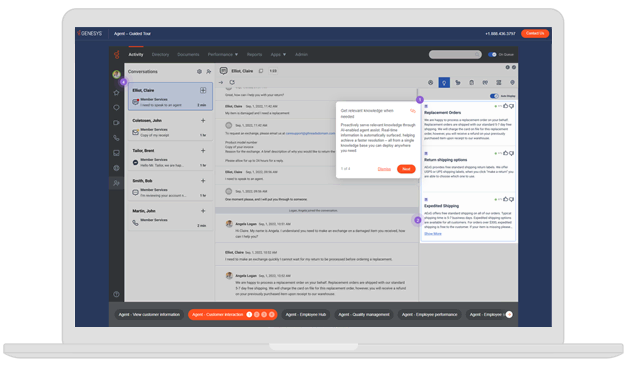
The university’s implementation of Genesys Cloud was foundational to reinventing its student support. The result is a seamless, omnichannel experience where context flows effortlessly across end-to-end journeys. If a conversation starts with a chatbot and moves to a voice call, the agent receives the full history, eliminating repetitive explanations — a common frustration in traditional support environments.
AI insights now fuel continuous optimization. Topic spotting identifies new trends, intent mining surfaces emerging student needs, and performance data feeds into university-wide reporting systems for stronger governance and decision-making.
“Using topic and intent mining gives us a deep understanding of where our traffic is and what our top inquiries are,” said Buttsworth. “Using those data points, we’re identifying where and when we should implement our AI Guides.”
The AI Guides-powered agentic virtual agents CSU has implemented so far are delivering more efficient, empathetic interactions for students. They’re getting answers faster, even to more complex inquiries.
For example, after hours a student can ask the AI Guides powered virtual agent about withdrawing from a course. Rather than simply outlining the process, the agent explores what is driving the question. If the student is experiencing financial pressure or competing life commitments, the agent can suggest relevant options, such as support to help manage cost of living pressures, information about scholarships, or reducing study load to better balance work, family and study.
“Students want a conversational bot, and the virtual agents powered by agentic AI are very conversational,” said Drake.
“It makes interactions more empathetic, and students are more trusting of the responses because they’ve had a conversation rather than the previous ‘one question, one answer’ interaction,” added Peters.
Crucially, CSU built its new support capabilities internally because Genesys Cloud is so easy to use. This self-reliance has allowed the team to grow from two to five specialists, promoting from within, minimizing the use of external consultants and establishing a long-term innovation engine.
“One key benefit of Genesys Cloud is that it supports a more business-led approach within agreed governance,” said Buttsworth. “Previously, updates were heavily dependent on IT processes, which made it harder for the business to iterate at pace.”
“Within a two-week period, we were able to migrate our knowledge to the Knowledge Workbench within Genesys Cloud and launch our first digital bots,” added Drake. “Almost overnight, we saw a 20% reduction in our inbound chat volumes.”
With AI Guides, agentic virtual agent development is also more accessible. Instead of relying on specialized technical skills or complex back-end configuration, staff across the business can now use natural language to quickly build comprehensive, fully functional virtual agents. This makes it easier for teams to iterate, refine and expand conversational experiences without needing deep technical knowledge.
When the university started using agentic virtual agents, one concern was having appropriate guardrails. Another was using the right tone of voice, one that would be consistent with its digital chatbots.
“After using the AI Guides and configuring the agentic virtual agents, the guardrails have been strong,” said Drake. “They’ve given us confidence in how the virtual agents behave in production.”