Ivr hero image hidef

Interactive voice response

Simplify interactions with IVR solutions and customer self-service

Give customers and employees effortless experiences

Smooth out the customer journey with smart interactive voice response (IVR) capabilities. Remove the burden of repetitive requests from human agents, and give your customers the ability to self-serve at any time, day or night.

Connect customers anytime

With cloud IVR solutions, customers can reach out how they want, 24/7. And they’ll always receive personalized support.

Reduce agent workloads

Automate routine requests so your agents can focus on what matters most — meaningful conversations.

Eliminate disjointed conversations

From self-service to live support, each handoff is easy. Customers never have to repeat themselves, and agents know the full story.

Take the effort out of self-service

Delivering great customer experiences is about simplifying and personalizing engagements, from IVR to the human agent and beyond. Respond to customers faster and more proactively, while tailoring every interaction to customer preferences.

Enhance natural interactions with conversational IVR solutions

Use artificial intelligence (AI) to combine speech recognition, dual-tone multi-frequency input and natural language understanding (NLU) to recognize intent and respond. Context transfers seamlessly for fast, personalized service.

Elevate self-service customer interactions

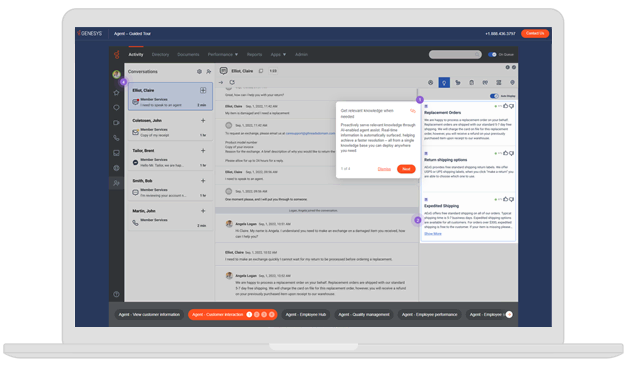
Carry over conversation context in real time, giving your customer support team the tools to do their jobs and improving customer and employee experience alike.

Design IVR and self-service journeys with ease

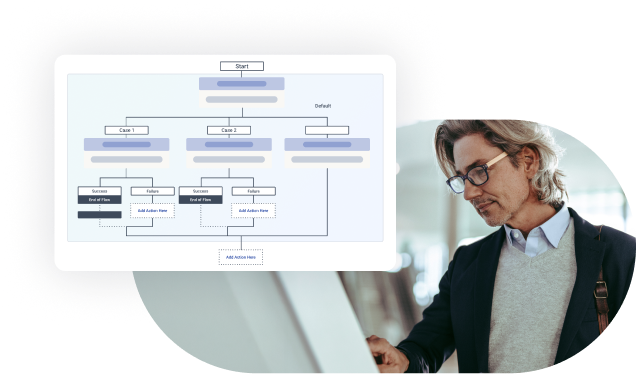
Configure, design and manage self-service journeys with a visual drag-and-drop builder. Sophisticated tools personalize the experience for quick customer identification and resolution.

Leverage powerful prebuilt apps

Create solutions using prebuilt, multilingual apps — all natively available from your contact center solution. Add new apps and bot technologies as needed without rethinking your business logic.

Make every self-service interaction feel personal

Customers feel understood and valued when interactions are more conversational. Genesys provides NLU and predictive AI capabilities that create experiences customers love — meaning IVR is just the beginning of what you can provide a customer in need.

Build modern cloud IVR and self-service strategies around customer needs

You know your customers better than anyone. That’s why Genesys Cloud™ IVR allows you to customize flows, routing and integrations to give you the ability to build the journeys your customers need.

Drag-and-drop flow builder

You know your customers better than anyone. That’s why Genesys Cloud™ IVR allows you to customize flows, routing and integrations to give you the ability to build the journeys your customers need.

Omnichannel virtual agent support

The solution supports both voice and digital channels and enables context and conversation history to be carried through when interactions escalate to a human agent.

Speech enablement

Use automatic voice recognition technology for menus so customers can navigate easily, or use native and third-party NLU to increase accuracy.

Customer identification

Ensure your customers never have to repeat themselves, even when transferred from self-service to a live agent. Improve customer satisfaction and reduce agent call time.

Personalized routing

Easily orchestrate interactions based on the customer. Optimize interactions over time based on self-service preferences, and provide agents with context to personalize each interaction.

Open APIs

Leveraging public APIs lets you better manage call flows, audio prompts and other data. Use a variety of flexible tools and integrations to create solutions that fit your needs.

Automated attendant and basic IVR

Configure basic IVR voice options and IVR applications if that’s all you need. Use touch-tone and speech prompts. Pass data to your ACD. Get the advanced IVR reports needed.

Adaptive IVR

Build self-service applications that adapt to a customer’s journey. Resume existing transactions or trigger personalized sales, collections or retention campaigns in real time.

Empower customers with automated self-service tools

Customers want to learn and solve problems on their own. Give them convenient ways to get customer support anytime, on any channel. Self-service improves customer satisfaction as well as interaction routing and quality. Request a demo to see how the Genesys Cloud platform makes IVR easy.

Thank you for your interest.

We’ll contact you directly to set up a date and time that works with your schedule.

Frequently asked questions about IVR

What is an example of interactive voice response?

Interactive voice response (IVR) is a telephony technology that allows customers to interact with a company’s phone system via voice or touch-tone dialing. An example of IVR could be when a customer calls a bank and is greeted by an automated voice menu that says, “Press 1 for account balance; Press 2 for credit card services; Press 3 to speak with a customer service representative,” and so on.

What is another term for interactive voice response?

Another term for an interactive voice response system can be “automated voice system” or “voice response unit” (VRU).

What are the advantages of interactive voice response?

IVR systems provide several advantages. They can handle high call volumes, route callers to the appropriate department or agent, provide information 24/7, and help reduce operational costs by automating routine customer inquiries – allowing agents to handle more complex issues.

What is cloud IVR?

Like any other type of IVR, cloud IVR allows a customer to interact with your phone system via voice or their keypad, without a human agent’s involvement. The primary difference is that it’s hosted on the cloud, rather than on an on-premises computer system. Hosting an IVR instance on the cloud allows for greater flexibility — as your business scales, you won’t need to purchase new hardware and equipment to scale your IVR instance along with it.

What is the difference between a virtual agent and IVR?

The main difference between an IVR system and a virtual agent is complexity. A standard IVR system is much simpler — it has a set of questions programmed in, and a set of answers to those questions. It asks those questions and, based on the answers, moves a customer through a workflow. But it doesn’t tend to adapt on the fly, and if it’s asked a question that it can’t answer, it simply passes the customer on to a human agent.

On the other hand, a virtual agent is a bit more adaptive and agile. A standard virtual agent has the ability to use AI to respond to questions that aren’t in the question tree, and to find answers that aren’t programmed in by a person. It’s not all-knowing, and like IVR a virtual agent will hand off an interaction to a person if things get outside its ability to answer. But a virtual agent simulates a conversation with a person in a much more natural way.

What is the difference between IVR and conversational IVR?

Conversational IVR sits between typical IVR and a virtual agent on the spectrum of complexity that it can handle. While normal IVR can only handle questions, answers and a customer journey that are pre-programmed, conversational IVR can go a bit farther. It uses conversational AI, machine learning and natural language processing or understanding to identify and comprehend new questions.

Conversational IVR may struggle more than a virtual agent to answer new questions, though. While both are AI-powered options, a virtual agent is infused with a bit more intelligence to fully simulate a person — where conversational IVR is just a more agile phone tree.

What industries most commonly use interactive voice response (IVR) systems?

Interactive voice response systems are widely used across industries that manage large volumes of customer interactions. Telecommunications companies rely on IVR to route calls, handle account inquiries and troubleshoot common issues. Banks and financial institutions use IVR for secure balance checks, payments and fraud alerts, helping customers access information quickly without waiting for an agent.

In healthcare, IVR supports appointment scheduling, prescription refills, patient reminders and more. Retailers and eCommerce businesses use it to track orders, manage returns and offer 24/7 customer support. Utilities like power, water and internet providers use IVR to report outages, process payments and deliver service updates.

Overall, industries that need efficient, automated communication and high service availability depend heavily on IVR systems.


What features should I look for when choosing an IVR solution?

Look for tools that make the experience smooth for both customers and your team. A good system should offer easy customization, allowing you to build call flows, update menus and add new options without complex coding. Speech recognition and natural language understanding can make interactions feel more intuitive, letting callers speak naturally instead of navigating long numeric menus.

You should also prioritize integration capabilities, ensuring the IVR connects with your CRM software, ticketing tools and other business systems. This helps deliver personalized service and reduces manual work. Analytics and reporting are equally important, giving you visibility into call patterns, drop-off points and customer behavior.

Finally, look for strong scalability and reliability, so the IVR can handle peak volumes without interruptions. Choosing a system with these features will help you create a more efficient and customer-friendly experience.