

Xperience is Sep 1 – 3: Don’t miss the CX+AI event of the year
Xperience is Sep 1 – 3
Watch for free

Genesys Cloud CX vs NiCE CXone Comparison

Genesys Cloud CX and NiCE CXone are two of the most widely deployed enterprise contact center platforms. This comparison covers their AI capabilities, workforce management depth, omnichannel architecture and real user reviews so you can evaluate which platform fits your operation best.

More than 8,000

organizations worldwide

4.4/5

on G2

Real customers, real results

Genesys enables organizations to deliver exceptional customer experiences, drive measurable outcomes and scale seamlessly.

Overview: Genesys Cloud CX vs NiCE CXone


In this Genesys Cloud CX vs NiCE CXone comparison, both platforms are mature, enterprise-grade platforms with strong user bases. Genesys Cloud CX differentiates on AI depth and native orchestration; NiCE CXone edges ahead on quality of support and meeting requirements. The right choice depends on whether you want AI and orchestration capabilities included in your platform, or as add-ons.

Genesys Cloud CX NiCE CXone
Overall Rating 4.4 / 5 4.3 / 5
Ease of Use 8.9 / 10 8.7 / 10
Quality of Support 8.2 / 10 8.3 / 10
Ease of Setup 8.4 / 10 8.0 / 10
Meets Requirements 8.6 / 10 8.7 / 10
Product direction (% positive) 8.7 / 10 8.2 / 10

Source: G2 user reviews.

Feature-by-feature comparison: Genesys Cloud CX vs. NiCE CXone

Genesys Cloud CX strengths and honest limitations

AI-native architecture: Genesys AI runs natively across routing, self-service, agent support and workforce tools, with built-in governance and explainability controls so your team stays in charge.

AI agents that act, not just answer. Agentic AI in the Genesys Cloud™ platform execute tasks and coordinates across systems and hand-offs intelligently — with the guardrails enterprise teams require.

Connects to what you already use. Hundreds of pre-built integrations are available via the AppFoundry™ Marketplace, plus native connections to Salesforce and ServiceNow — no custom bridging required.

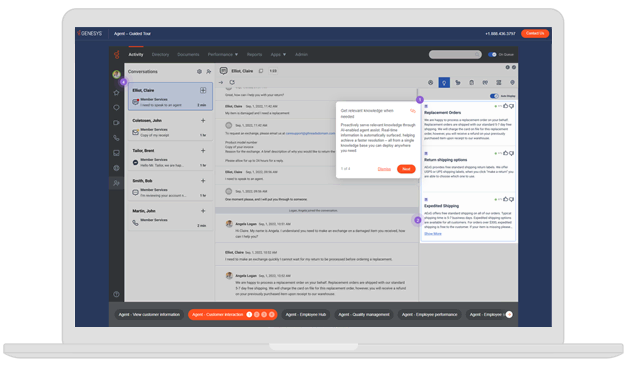
Easy for agents and admins to use. Genesys Cloud Copilots surface real-time guidance, automate call summaries and suggest next steps. It’s available out of the box, no development work needed.

True cloud-native architecture. A true multi-tenant cloud platform with continuous updates.

Advanced reporting takes more work. According to G2 reviews, highly customized reporting can require API work or a third-party tool.

NiCE CX strengths and honest limitations

Workforce management. Forecasting, scheduling, real-time adherence and intraday adjustments are mature and well-regarded.

AI requires a top-tier plan: AI agents are only included in the Ultimate Suite ($249/agent/month). On every lower plan, they’re paid add-ons.

AI architecture is not natively embedded: AI capabilities are not built into routing; these are integrated solutions.

Deep reporting for operations teams. Granular analytics, sentiment analysis and pre-built dashboards give ops-focused teams a lot to work with.

Capability Genesys Cloud CX NiCE CXone
Agentic AI ~
Native AI Copilots
Predictive Routing ~
Virtual Agent / Conversational AI
AI Governance & Explainability ×
Omnichannel (30+ native channels)
Customer Journey Analytics ~
Native WFM (forecasting + scheduling) ~
AppFoundry / Open Marketplace ×
Salesforce Integration (native)
ServiceNow Integration (native) ~

✓ Full supported natively   ~ Supported with limitations, add-ons, or partial capability   × Not supported natively

The two platforms are strong in different areas. Genesys Cloud CX leads on AI depth, governance and end-to-end orchestration in a native platform. NiCE CXone leads in workforce management and reporting depth. The right choice depends on what your operation needs most, and where it needs to go next.

What customers say: Genesys Cloud CX and NiCE CXone reviews

Genesys Cloud CX

Complex customer journeys (G2): “Architect is a standout feature, allowing us to design complex customer journeys.”

Robust cloud-native platform (G2): “It offers strong omnichannel capabilities with a unified interaction and data model.”

Human-centric CX (G2): “Genesys gave us the structure to scale efficiently while still designing experiences that feel human.”

Omnichannel excellence (G2): “Users value the platform’s scalability, dependable performance, and the regular introduction of innovative features.”

AI and orchestration (G2): “Native AI capabilities that make customer interactions more efficient and intelligent.”

Complete CX solution (TrustRadius): “We wanted to move to Genesys Cloud CX to have a one-stop shop.”

CCaaS leader in modern AI (TrustRadius): “Our idle time for agents decreased by up to 30% compared to the previous system.”

Intuitive interface (TrustRadius): “We selected Genesys for its intuitive interface and significantly lower administrative overhead.”

Omnichannel platform (TrustRadius): “It really allows you to use the omni channel functionality very well.”

NiCE CX

Ease of use (G2): “The NICE CXone Mpower is fast, responsive, and easy to use program.”

Team visibility (G2): “I like being able to see the full team and their current availability.”

Authentication complexity (G2): “There is a long process to update the redirect URL for authentication of Agent SDK.” 

Internet dependency (G2): CXone has been much easier to use than several of our previous applications.” 

Platform flexibility (G2): “I wish the platform was more flexible, and that patterns did not use FC allocations.” 

Reporting (TrustRadius): “Where I struggle with NiCE is the reporting.” 

Pricing (TrustRadius): “Overall, it’s a great platform, though the cost seems quite high.” 

Missing features (TrustRadius): “So far experience is ok and not that great and lots of small features are missing.” 

Technical complexity (TrustRadius): “While the interface is easy to do, it does not fare so well on the technical side.” 

Body img ai powered

Switching from NiCE CXone to Genesys: What to expect

Platform migrations are complex, and the decision to switch deserves careful evaluation. What we hear most from organizations evaluating a move from NiCE to Genesys is that the real concern isn’t technical — it’s operational risk. Will things break? Will agents struggle? Will customers notice? Here’s what a structured migration actually involves.

What happens to your historical data

Your historical data doesn’t disappear, but not every format migrates cleanly between platforms. Audit your NiCE CXone data exports early and align on what needs to be preserved, rebuilt or archived. Genesys takes a structured, prescriptive approach to migration with proven tooling and best practices built to reduce risk and accelerate time to value.

Integration continuity (CRM & tech stack)

The Genesys Cloud™ platform connects natively to Salesforce and ServiceNow, so core agent workflows carry forward. Any custom-built integrations from your NiCE environment will require individual evaluation — factor that into your project timeline. The AppFoundry™ Marketplace covers the broader tech stack across pre-built integrations.

Training and onboarding timeline

The Genesys Cloud™ platform is built for business users, not just IT — with interfaces for agents and admins designed to reduce ramp time. Training, certification and professional services support your team through every stage of the transition.

Downtime risk and business continuity

Migration projects run in parallel — your existing environment stays live until your team is ready to cut over. The Genesys Cloud™ platform runs on a resilient, multi-region cloud architecture with TLS and AES-256 encryption, external penetration testing and attack defence automation built in. (Genesys Cloud CX)

Resources hub

See how Genesys Cloud CX compares to NiCE CXone

Genesys Cloud CX and NiCE CXone are both enterprise-grade platforms with strong bases, but in different areas. Genesys Cloud CX leads on AI depth, governance and end-to-end orchestration. AI is built into the platform from the ground up, not unlocked through higher pricing tiers. NiCE CXone leads on native workforce management and reporting.

Genesys is the stronger fit if you need AI, omnichannel and workforce tools in one platform, without paying extra. It’s especially well-suited for organizations replacing NiCE inContact or a legacy on-premises system, looking to modernize at scale.

If workforce management depth is your primary requirement and AI orchestration is secondary, NiCE CXone warrants consideration.

NiCE CXone isn’t the only platform enterprises evaluate alongside Genesys. If you’re running a broader comparison, these resources cover the other shortlist contenders.

  • Avaya: Legacy infrastructure, end-of-life risk and limited native AI make it a common migration trigger. See how the platforms stack up: Genesys vs Avaya.
  • Five9: A capable cloud platform for mid-market, but narrower in AI depth and enterprise scale. See the full breakdown: Genesys vs Five9.
  • Zendesk: Strong in ticketing and support workflows, but built for a different use case than enterprise contact center orchestration. See how they compare: Zendesk Suite vs Genesys Cloud CX.
  • Exploring all options: If you’re evaluating beyond NiCE CXone, see the full list of alternatives: NiCE CXone Alternatives.

Frequently asked questions about Genesys Cloud CX and NiCE CXone

What is the difference between NiCE inContact and NiCE CXone?

NiCE inContact was the original cloud contact center product. NiCE CXone is its successor. It’s a broader platform that consolidated inContact with NiCE’s workforce management, analytics and AI capabilities.

What does Genesys Cloud CX do?

The Genesys Cloud™ platform orchestrates customer and employee experiences across voice, digital and messaging channels, with AI, workforce engagement management and conversational intelligence built in natively on the same platform without additional tier costs.

How do I migrate from NiCE CXone to Genesys Cloud CX?

Genesys uses a structured, prescriptive migration approach designed to reduce risk and minimize disruption. Your existing environment stays live until your team is ready to cut over. 

How long does it take to implement Genesys Cloud CX?

Implementation timelines vary based on organization size, complexity and the integrations required. The Genesys Cloud™ platform is cloud-native with ready-to-deploy interfaces, which reduces setup time compared to on-premises migrations. Professional services and training resources are available to support every stage.

Does Genesys Cloud CX integrate with Salesforce and ServiceNow?

Yes. The Genesys Cloud™ platform offers native integrations with both Salesforce and ServiceNow. The Genesys and Salesforce integration is co-built, and the AppFoundry™ Marketplace extends connectivity across hundreds of additional tools.