Your Genesys Blog Subscription has been confirmed!
Please add genesys@email.genesys.com to your safe sender list to ensure you receive the weekly blog notifications.
Subscribe to our free newsletter and get blog updates in your inbox
Don't Show This Again.

Insurance customer experiences rarely exist in a single system.
In today’s experience economy, exceptional customer outcomes start with inspired, empowered employees. But keeping CX teams energized and engaged is becoming more complex as artificial intelligence (AI) takes on a larger role in everyday work.
What does effective CX leadership look like in this environment? And how can leaders help employees embrace AI without losing sight of the human qualities that ultimately shape customer experiences?
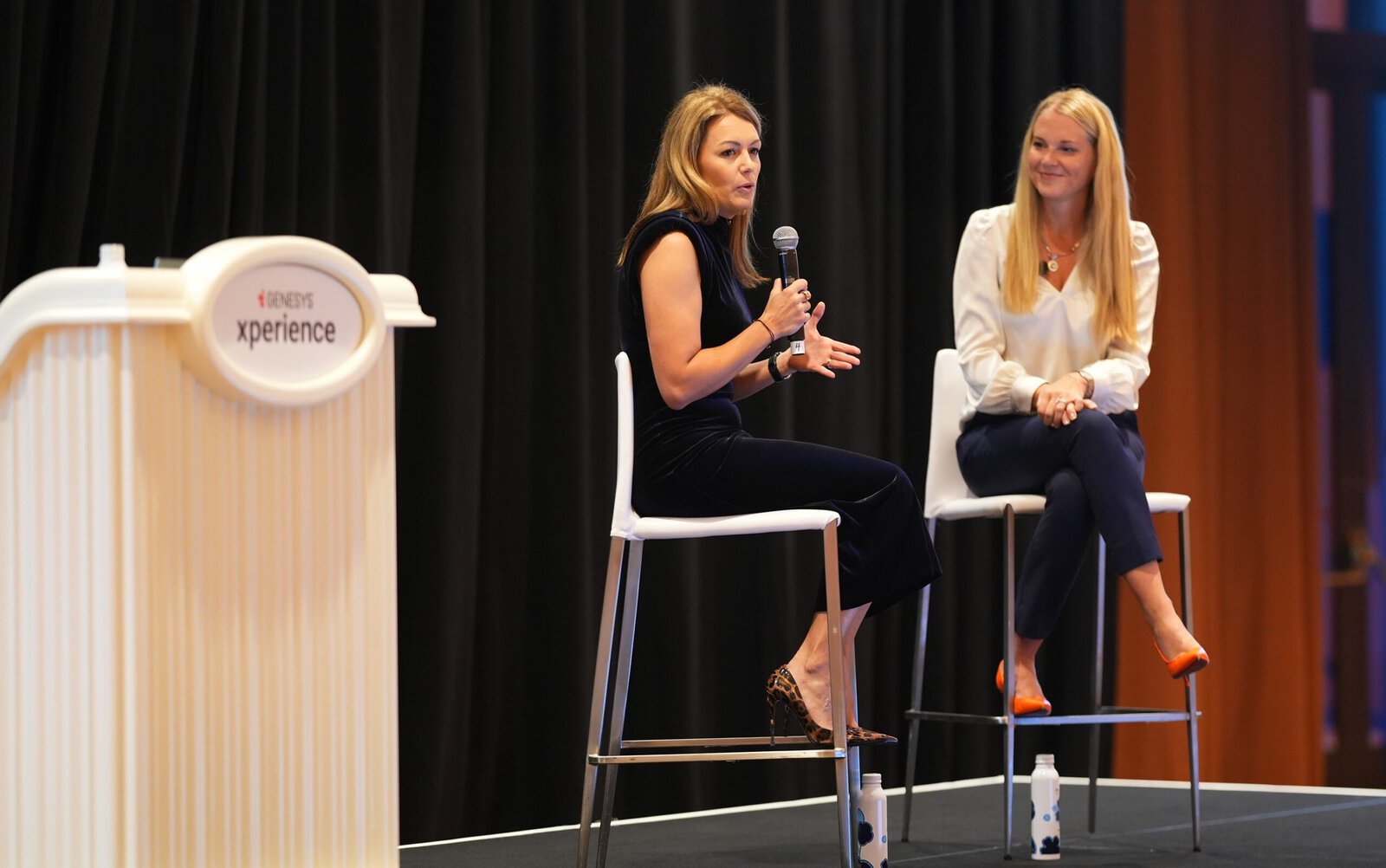
At Xperience 2026 in Las Vegas, Lori Lovric, Director of Customer Experience at Trademark Global, hosted a panel discussion with two other Genesys Orchestrators Innovation Award winners — Vijay Narsapur, SVP and Global Head of the Customer Experience Independent Unit at Infosys BPM, and Rachel Papka, Chief Innovation Officer at SDMI — to explore those questions.
The Genesys Orchestrators Innovation Awards recognize industry‑leading organizations and individuals redefining customer and employee experience excellence.
Narsapur, the winner of the 2026 Orchestrator of the Year/C-Suite award, leads an organization of roughly 13,000 employees distributed across 30 centers in 10 countries. Papka, the 2025 C-Suite winner, works much closer to the frontline, overseeing a contact center of about 120 agents in the highly specialized field of radiology. Lovric, a 2026 Maestro and Orchestrator of the Year/CX Leader finalist, brought yet another perspective from retail.
Their environments might be different, but their conversation surfaced several shared principles for leading through change: Listen to employees, give them clarity and a voice, keep people at the center of AI decisions and never confuse engagement with entertainment.
Rachel Papka: AI is another tool within the toolbox for my employees.
Vijay Narsapur: I agree with that, but the nature of this particular tool is very different, especially in customer service. I treat AI with a lot of caution and a lot of respect in my day-to-day work.
Technology can change how work gets done, but it shouldn’t become a substitute for people. Customer service is fundamentally about human connection. The goal should be to give repetitive, error-prone and unenjoyable work to machines, so employees have more opportunities to listen to customers, understand them and connect with them.
Papka: It’s easy to engage employees when everything is going well. The harder question is what you do when it gets really ugly; when the problem is difficult, uncomfortable or outside their control. Your employees often have great ideas about what would help.
Recently, one of our teams was handling difficult patient interactions driven by circumstances the contact center itself couldn’t control. Employees suggested shutting down a queue for one hour each day so they could have time away from the phones. We had never done that before, but we listened and we’ve seen the benefits of taking action.
In another situation, patients were frustrated about delays in receiving imaging results. We couldn’t solve the underlying shortage of radiologists from within the contact center, but we could give employees an escalation path for particularly difficult interactions.
Narsapur: One of the biggest issues in the contact center industry is that engagement is often confused with entertainment.
With 30,000 colleagues across countries, clients and lines of business, engagement can’t depend on lunches, events or perks. Employees need total clarity about what’s expected of them. Leaders also need to be candid about what they’re willing — and not willing — to do for employees and what they expect in return.
When those expectations are aligned, meaningful engagement becomes possible.
Narsapur: Traditional surveys, skip-level meetings and other mechanisms give you only part of the picture. You also look at the metrics, but you need to look beyond the metrics. Look at behavior.
Are employees doing what needs to be done without constantly being told? Look at absenteeism, schedule adherence and, ultimately, how they treat customers.
And sometimes you can see engagement before you measure it. If I walk into a town hall and see a room full of glassy-eyed people, I know there’s trouble. If people challenge me and there are noisy discussions, there still might be problems, but I know there’s trust and we have a good chance of solving them.
Papka: Traditional KPIs might be good for the business, but they don’t necessarily measure the pulse of your team.
You need to consider whether employees still speak up and challenge you. People also want to believe they’re part of something bigger. Do your employees understand and believe in what the organization represents? That sense of belonging and trust matters.
Narsapur: When I was young, I blamed my bad backhand on my tennis racket. My coach told me the racket wasn’t the problem — my backhand was.
The racket can never be a substitute for the backhand.
Technology works the same way. AI and automation can help, but customer service is ultimately about people. Employees are the ones who connect with customers.
Automate the work people shouldn’t have to spend their time doing. Then create opportunities for your best employees to truly hear customers.
And when you listen to employees, don’t do it simply with the intention of responding. Truly listen.
Papka: And make sure customers have somewhere to tell you when things aren’t working. Do you know where your negative feedback goes? Do you have a pipeline that lets customers provide constructive criticism? Understanding the negative feedback is just as important as understanding the positive.
Papka: Our virtual agent, Emma, has probably taught us as much from what went wrong as what went right.
When we first went live, the implementation didn’t go well. Patients told us: “Emma didn’t listen. Emma didn’t hear me. Emma didn’t understand.”
Today, Emma isn’t perfect, but she has grown. We’ve worked on elements such as tone, pitch and speed, and we continue to improve the experience.
Most importantly, we aren’t using Emma to replace humans. If patients want self-service, Emma can help. If they want a person, Emma can get them there. And if they need information in the middle of the night, Emma can provide it when a human isn’t available.
Lovric: We’ve had a similar experience at Trademark Global with our virtual agent, Ginger. When teams help create these experiences, there can be real pride in them. But that also means you have to be willing to test what you’ve built.
Papka: Exactly. Have you listened to your own routing?
We ask new contact center employees to do that. They might discover that the system doesn’t understand their accent or that a route sends them somewhere it shouldn’t. If you don’t know what your own experience is like, how can you expect to understand what it feels like for your customer?
Narsapur: And don’t look for a magic bullet. There isn’t one tool or technique that suddenly fixes customer service.
An improvement mindset will serve you better than a perfection mindset. If something is 95% good and 5% bad, work on that 5%. Make it 4.5%, then 4%. Keep improving.
Narsapur: Be “level blind.” If you’re in a room with agents or mid-level employees, hierarchy shouldn’t prevent meaningful conversation.
Be an incredibly good listener — and act on what you hear. If you make commitments to employees, follow through.
And when you don’t know something, say, “I don’t know.” If you make a mistake, acknowledge it and apologize.
These aren’t new leadership principles. Good leaders have practiced them for thousands of years, and AI isn’t going to change them.
Papka: One comment from an employee that has always stuck with me is: “That’s stupid.”
Why? Because that employee was willing to push back about a technology and ask why something worked the way it did.
Another employee once told me, “I see your vision and I’m jumping on the bus.” Those comments sound very different, but both come back to the same points: trust, alignment and a common vision.
Lovric: Mine would be: “No, but here’s why.”
You don’t have to agree with me. Tell me why. Then let’s fix it together.
When frontline employees are part of building something, there’s pride in what they create and more openness to feedback when something goes wrong. That’s why I want them involved in the process.
Papka: Be willing to try. My approach is that if something won’t bring the system down, won’t harm the patient and won’t prevent us from answering the phones, let’s give it a try.
Narsapur: And be clear about the outcomes. Ultimately, outcomes are what allow you to justify continuing the work.
Lovric: There’s some beauty in that combination: experimentation alongside clarity about what you’re trying to achieve.
The technology available to CX teams might be changing quickly, but this conversation made one thing clear: The fundamentals of leadership aren’t being replaced.
Give employees clarity. Invite them to challenge you. Listen when they do. Let them help shape the technology they’ll use. Automate work where technology genuinely makes the experience better, but protect the human connection that makes service meaningful.
Or, as Narsapur put it, the racket can help — but it can’t replace the backhand.
 Ginger Conlon
 is an award-winning content and customer marketing executive who transforms complex technology into strategic storytelling. As director of customer stories at Genesys, she partners across the organization to...
Subscribe to our free newsletter and get blog updates in your inbox.