Your Genesys Blog Subscription has been confirmed!
Please add genesys@email.genesys.com to your safe sender list to ensure you receive the weekly blog notifications.
Subscribe to our free newsletter and get blog updates in your inbox
Don't Show This Again.
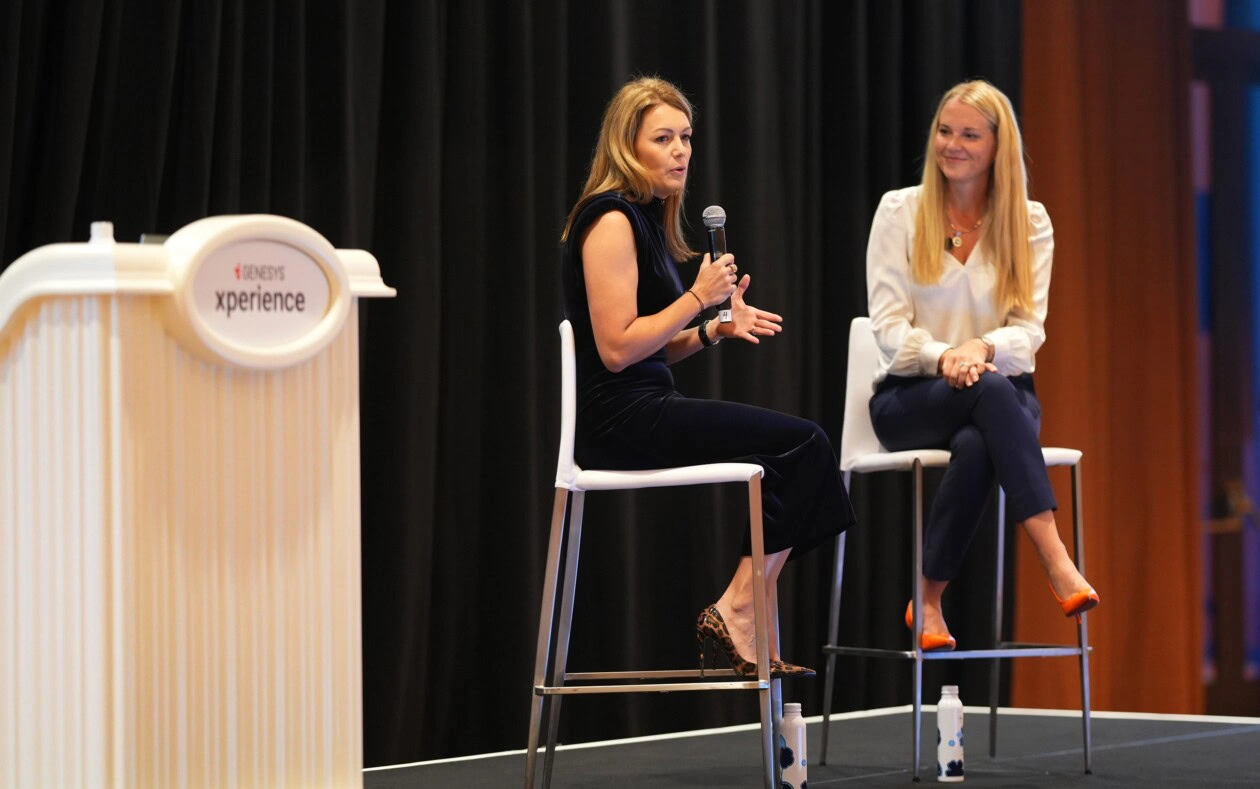
Careers in customer experience rarely follow a straight line. And the roles that shape the strongest leaders don’t always come with big titles. Often, it’s the experiences along the way — serving customers, solving problems and learning from others — that teach the lessons leaders carry with them.
Rebecca Mequin’s journey is a case in point. Before reaching her current role as Head of Customer Experience at Ferrari, she worked across a wide range of roles and environments that offered different perspectives on people, service and leadership. Mequin sees each of those experiences as part of what made her the leader she is today.
In a conversation during the “Women Leading in an AI-Driven World” session at Xperience 2026 in Las Vegas, Mequin shared what that path has taught her about leadership: why leaders need to learn from the people around them, why staying attuned to customers and opportunities matters even when everything is running smoothly, and why admitting you don’t have all the answers is a strength.
Here, in her own words, are six leadership lessons she’s learned along the way.
There wasn’t a single person or moment that defined who I am as a leader. I was shaped by having and learning from lots of different experiences.
I started with gymnastics, became a coach, worked at McDonald’s and as a cashier, and then worked in retail and service at an auto dealership before eventually joining Ferrari. From the moment I started at gymnastics through every experience since, I’ve learned something I’m still using today.
And I’ve learned from basically everyone: employees, colleagues, customers and leaders.
That mindset became particularly important when I moved into customer experience. I came from a different background. I had worked in marketing and sales.
I had an excellent team. They were incredibly talented and knew much more than I did about many aspects of the work. When I entered the role, I didn’t even know the difference between “back end” and “front end.”
My attitude was basically: “Tell me what you do, because I probably need to learn from you.”
I discovered something else, too. My team was designing tools that would be used throughout our retail network, yet they hadn’t necessarily experienced that retail environment themselves. So I sent them out into the field.
They traveled to different markets to see how people actually used the tools they’d designed. They could better understand whether the tools supported the processes as expected, but they also began seeing the differences between regions, countries and cultures.
Today, they stay in contact with the network every day. That connection with the field is incredibly important.
You don’t need to intervene only when something isn’t working. Sometimes you need to look more closely at what is working.
That’s one of the challenges of leadership: continuing to look for what could be better before a problem forces you to.
Even when everything is going well, you still need to ask where you should focus next so you’re ready for what comes next. Innovation doesn’t happen if everyone assumes that because something works today, there’s nothing left to improve.
Technology gives us new ways to work and new ways to support people. But as it becomes more capable, I think one quality becomes even more important for leaders: staying human.
That’s something that struck me when I joined the automotive industry. I heard directly from customers about the difference it made when someone personally became involved in solving their problem.
A customer might have an issue with a car and end up speaking directly with the global head of after-sales. They knew the person’s name. There was a direct connection.
Technology can help us become better. It can help people remember details, maintain relationships and use our customers’ time more effectively. But we shouldn’t forget to stay connected with the customer. The human relationship still matters.
One of the toughest things for me was actually something I had to unlearn.
When I started my career, success was based on what I could personally deliver. How much could I give? Could I meet my deadlines? Did I have good ideas? Could I perform well?
As my career evolved, success no longer depended only on me. It also depended on my team.
And that didn’t mean my team should replicate what I was doing or become copies of me. I had to start thinking about what we could accomplish using all the different talents and capabilities within the team.
It was an important shift: Leadership became less about what I could do myself and more about what we could do together.
I’m still learning and adjusting along the way. And I’m relaxed about it because I understand that a mistake you make today is a mistake you won’t make tomorrow. The important thing is to keep learning, stay nimble and try not to make the really big mistakes.
Earlier in my career, I worked as an after-sales manager overseeing vehicle repairs. There were certainly times when someone would look at me and wonder whether I really knew what I was doing.
My approach was: I’m here to do the job as well as I can, and if I don’t know about your problem, I’ll ask a technician. That attitude helped me stay calm, including in environments that were predominantly male.
There can be a lot of discussion about women in leadership, and I support opportunities and initiatives that help women — especially younger women — become leaders. But I hope we reach the point where we don’t need to specify “women leaders” anymore. What should matter is what you bring as a person.
When I think about power and leadership, I come back to the famous quote from Spider-Man: “With great power comes great responsibility.”
I started my career answering phones at a dealership. I did many jobs that weren’t considered high-level positions. I was never dreaming about having power.
Instead, in every role, I’ve tried to ask myself: What can I do to make this company better? What can I do to make this program better? What can I contribute personally to make sure the work is done well?
That still shapes how I think about leadership today. It’s not about having power; what’s important is what you’re able to do — and to give — with the power you have.
 Janelle Binder
As the Senior Vice President of Customer Engagement and Advocacy at Genesys, Janelle believes in the power of a great story and thrives in building diverse and high-performing teams. With...
Subscribe to our free newsletter and get blog updates in your inbox.