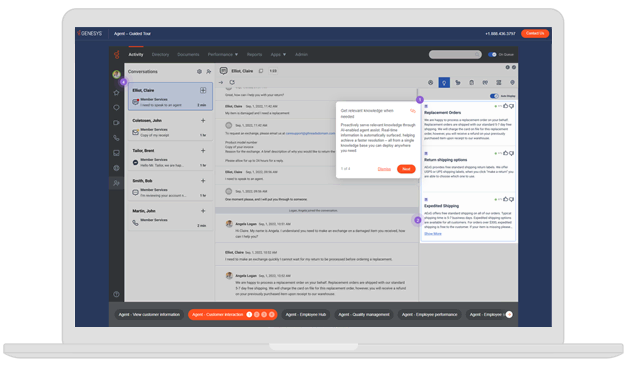
Evaluating the quality of customer interactions
Organizations need a clear way to understand how well they meet customer expectations. Customer satisfaction score surveys capture feedback after interactions across voice and digital channels. Enterprises use these insights to identify strengths, uncover friction points and improve service delivery in real time.
Improving agent performance with targeted coaching
CSAT trends reveal which interactions consistently satisfy or disappoint customers. Leaders use CSAT data to identify coaching opportunities for agents and teams. Enterprises apply this approach to reinforce positive behaviors, standardize best practices and elevate overall service quality.
Informing product and process improvements
Recurring low CSAT scores often point to issues beyond the contact center. Customer satisfaction score results provide signals about product usability, billing clarity or policy barriers. Enterprises use this feedback to prioritize improvements that reduce customer effort and strengthen long-term satisfaction.
Measuring the impact of automation and AI tools
As organizations deploy automated customer support or self-service capabilities, they must ensure these tools provide value. Customer satisfaction score helps measure whether AI-driven experiences meet customer expectations. Enterprises use CSAT results to refine bot workflows, improve knowledge content and enhance digital journeys.
Tracking customer sentiment across the lifecycle
CSAT enables organizations to evaluate satisfaction at critical points, such as onboarding, troubleshooting or renewal. Enterprises apply customer satisfaction score measurements to identify journey breakpoints and design more empathetic experiences at each stage.