Orchestrating end-to-end service workflows
Many customer requests require coordination across systems, policies and processes. Automated customer service can execute multi-step workflows by retrieving information, validating conditions, updating records and triggering downstream actions in real time and at high volumes. Enterprises apply these capabilities to streamline complex service journeys like claims processing, returns management, onboarding and account servicing while reducing operational friction and manual effort.
Resolving customer requests autonomously across channels
Enterprises are under pressure to deliver fast, seamless and personalized support experiences at scale. Autonomous customer service enables AI systems to understand customer intent, reason through requests and take action independently across voice and digital channels. Organizations use these capabilities to resolve issues such as billing disputes, subscription changes, appointment management and service troubleshooting without requiring customers to repeat information or wait for live support, reducing response times and increasing customer satisfaction.
Delivering adaptive self-service experiences
Traditional self-service offerings often rely on rigid decision trees that fail when customer needs change unexpectedly. Autonomous customer service enables more dynamic interactions that adapt to customer context, conversation flow and behavioral signals in real time. Enterprises use these experiences to guide customers through troubleshooting, product recommendations and account management with greater personalization and higher resolution rates.
Enabling proactive and contextual customer engagement
Customers increasingly expect organizations to anticipate their needs instead of reacting only after problems arise. Autonomous customer service systems can use real-time customer data, journey context and predictive insights to identify issues early and engage proactively satisfying customer expectations.
Scaling human-agent augmentation intelligently
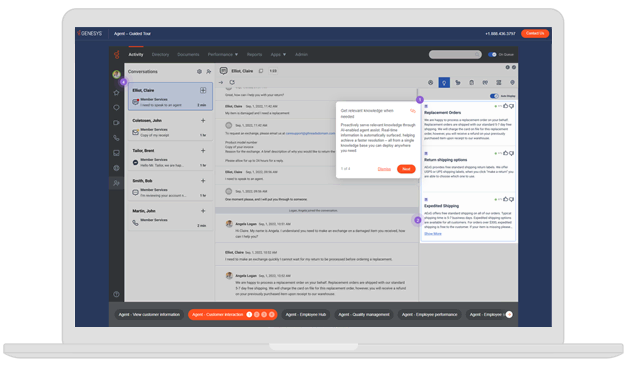
Autonomous customer service interactions don’t all have to be fully automated. Enterprises also use autonomous AI capabilities to assist human agents during live engagements by surfacing insights, recommending actions, generating responses and automating post-interaction tasks in real time. This helps organizations improve productivity, reduce cognitive load and create more consistent customer experiences while allowing agents to focus on judgment, empathy and relationship-building.