Your Genesys Blog Subscription has been confirmed!
Please add genesys@email.genesys.com to your safe sender list to ensure you receive the weekly blog notifications.
Subscribe to our free newsletter and get blog updates in your inbox
Don't Show This Again.

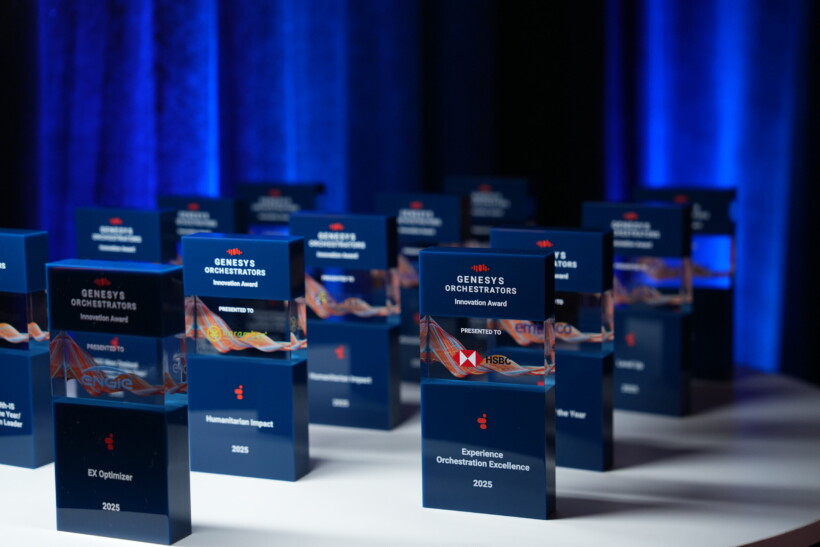
There are eight finalists in the 2026 Orchestrators Innovation Awards’ Experience Orchestration Excellence category, chosen because they best exemplify what’s possible when AI, automation, data, channels and employees come together around the customer to orchestrate connected end-to-end journeys at scale.
These organizations operate across highly regulated, high-volume and emotionally sensitive environments — from telecommunications and financial services to utilities and social services.
The 2026 Experience Orchestration Excellence finalists are:
Despite the differences in industries and business priorities, they share five best practices that offer a useful blueprint for ensuring experience orchestration excellence.
One of the clearest commonalities across the finalists is the effort to eliminate the disconnected experiences caused by siloed systems, channels, data and teams.
Several finalists described environments where voice, chat, email, self-service and back-office workflows had evolved separately over time. Customers were forced to repeat information. Employees had incomplete context. Reporting was fragmented. And operational complexity made it difficult to scale.
Rather than layering more technology onto disconnected legacy systems, these organizations focused on building unified orchestration environments that could connect customer journeys end to end — using the Genesys Cloud™ platform as their orchestration engine.
By consolidating systems and connecting channels to create seamless journeys, these finalists enabled customer context to travel across interactions and generated measurable business value.
Finalists saw results that included increases in first-contact resolution, decreases in operational complexity, streamlined routing, unified reporting and greater visibility into both the customer and employee experience.
Another shared approach among finalists is a practical and balanced approach to AI adoption.
These leading organizations are focused on using AI to remove friction, improve decision-making and give employees better tools to serve customers. And especially in emotionally sensitive journeys and complex support scenarios, finalists consistently emphasized the importance of ensuring that AI supports their focus on empathy.
Some finalists are using AI-powered routing and orchestration to connect customers with the best available resource based on context, intent or complexity. Others have implemented AI to surface context and recommendations in real time, reduce repetitive administrative work and lessen cognitive load, allowing employees to spend more time and energy on listening, problem-solving and building trust.
Several finalists linked employee enablement to stronger customer outcomes, recognizing that supported employees are better equipped to deliver consistent, personalized and empathetic service.
Many organizations talk about personalization at scale. This year’s finalists exemplify how to operationalize it.
Several redesigned journeys around customer context instead of organizational structure. Rather than pushing customers through generic service models, they use orchestration to adapt journeys dynamically based on customer needs, interaction history, product relationships or behavioral signals.
For some organizations, this means tailoring support experiences across complex multi-product relationships. For others, it means simplifying journeys during high-stress or high-emotion moments.
The most advanced organizations are using orchestration to provide personalized services experiences. For example, using insights to reduce customer effort, anticipate customer needs, deliver more proactive support, and route customers based on intent and context rather than using static queue structures. Many are using orchestration to personalize experiences by maintaining continuity across digital and human interactions during escalations.
The benefits of these approaches range from operational efficiencies to increases in customer satisfaction and loyalty.
The finalists making the biggest gains are treating experience orchestration as an enterprise capability — not just a contact center initiative.
Instead of optimizing isolated touchpoints, these organizations focused on how customers move across the entire lifecycle — from onboarding and servicing to support, retention and issue resolution.
In many cases, finalists emphasize designing experiences around moments that matter most to customers: financial stress, retirement planning, technical disruptions, account complexity or sensitive life events.
This approach can change the role of customer experience in an organization. Rather than measuring success only through operational KPIs, these leaders are influencing broader business outcomes including customer and employee retention and trust, regulatory compliance, business growth and brand differentiation.
Several finalists highlighted the importance of cross-functional alignment in the journey design and optimization elements of experience orchestration. These phases require collaboration across teams such as analytics, business leadership, IT, marketing, operations and workforce management. The benefits extend beyond customers to the organizations themselves. For example, real-time access to shared insights helps teams make more informed decisions and stay aligned on business goals.
Many framed orchestration as a way to move beyond efficiency gains to building deep operational resilience to better manage complexity, adapt to change and scale customer-centric operations.
Several organizations have navigated rapid growth, mergers, technology migrations or increasing service complexity. Others faced rising customer expectations alongside regulatory pressure and workforce challenges. In those environments, orchestration became critical for maintaining consistency at scale.
Several finalists improved agility by simplifying architecture, standardizing workflows and creating more adaptable service models. Others emphasized how experience orchestration improved visibility into operations, enabling faster decisions and more responsive customer support.
This year’s Experience Orchestration Excellence category finalists are setting a new benchmark for what modern customer and employee experience leadership looks like.
Their industries and operational models may differ, but their shared approaches to experience orchestration make it clear that:
These finalists also demonstrate that transformation does not require an overnight reinvention. Many began by solving specific operational pain points, unifying fragmented experiences or improving employee workflows. These smaller wins led to long-term impact, enabling the finalist organizations to adapt faster and serve customers more effectively, with empathy, while driving real business impact.
That’s the standard today’s experience leaders are setting — and the opportunity now facing every organization looking to compete on experience.
 Ginger Conlon
Ginger Conlon is an award-winning content and customer marketing executive who transforms complex technology into strategic storytelling. As director of customer stories at Genesys, she partners across the organization to...
Subscribe to our free newsletter and get blog updates in your inbox.