Your Genesys Blog Subscription has been confirmed!
Please add genesys@email.genesys.com to your safe sender list to ensure you receive the weekly blog notifications.
Subscribe to our free newsletter and get blog updates in your inbox
Don't Show This Again.

A customer posts a frustrated comment on your brand’s page: “I’ve been charged twice. Help.” Your team replies quickly in public (good), then asks them to move to a direct message (also good). In the DM, your agent requests the order number. Then the customer gets sent to an authenticated chat to verify their identity and gets asked again what happened. Finally, a callback is scheduled and the agent opens with, “Can you walk me through the issue?”
Nothing “went wrong” in that journey, yet the customer still experienced it as chaos. The problem isn’t the number of channels. It’s the number of times your customer has to restart the story. Continuity — preserving context as interactions move from public online spaces to private messages to owned support channels — is becoming one of the clearest signals of service quality.
Customers may forgive a handoff, but they won’t forgive feeling forgotten.
Social platforms, messaging apps and support channels keep evolving. Features shift and new entry points appear, but customer expectations have stayed steady: recognize me, remember what I said and don’t make me do extra work.
That expectation shows up in a simple way during escalations. People start in public because it’s fast and visible, then move to private because details are sensitive and finally land in an owned channel because verification and resolution often require it. The journey is normal. The “start over” moments are not.
When continuity breaks, you don’t just lose time — you lose trust. Customers start to wonder if anyone is actually in charge of their issue, or if they’ve been quietly dropped between teams. And that’s when the interaction stops being “support” and starts feeling like a runaround.
It’s tempting to treat continuity as something you’d love to have but can’t really define. In practice, it’s extremely concrete. Continuity means the next human or virtual agent can pick up the conversation with enough context to move it forward immediately.
Here’s a useful way to think about it: If a customer switches channels, what must go with them?
In most organizations, the minimum context isn’t a long transcript. It’s a handful of specifics that prevent repetition and missteps:
To keep this from becoming a checklist exercise, tie continuity to outcomes you already care about. You can measure it in plain terms:
The numbers aren’t the point — the pattern is. Continuity reduces effort and effort is one of the fastest ways to differentiate your experience.
The best handoffs don’t feel like transfers. They feel like progress.
A quick public reply might be the right start, but it’s rarely the right place to finish. Most public-to-private-to-owned-channel journeys happen for four common reasons:
When your team shares one “handoff mindset,” the customer feels it immediately. The public reply isn’t a brush-off; it’s a bridge. The DM isn’t a dead end; it’s a quick gathering of what’s needed. The owned channel isn’t a reset; it’s where the real work gets done with context intact.
Even if you carry the right facts, continuity can still break if the customer feels a tone whiplash. Social teams are often trained to be quick, friendly and brand-forward. Support teams are trained to be precise, procedural and resolution-focused. Customers don’t care which org chart owns the moment — they only feel the shift.
The fix isn’t a script for every scenario. It’s a small set of habits that make every handoff feel human. Summarize before transferring, even if it’s just a sentence or two. Open with confirmation so the customer knows you’re not starting from scratch. Close with a specific next step so momentum doesn’t evaporate.
If you want continuity to scale, make it coachable. The goal isn’t perfection — it’s consistency.
Continuity requires a dependable way to keep the customer story together even when the entry point changes. Customers can come in through a public mention, a DM, an authenticated chat or a callback, but you want the experience to feel like one continuous thread. That means three things need to be true inside your support operation.
First, there’s a single timeline that captures what matters: key messages, important attachments and decisions made. Even if the original interaction started on a social platform, the important parts shouldn’t disappear when the platform changes rules or formats.
Second, you can link identity safely over time. A social handle might connect to a known customer profile later, but only when it’s appropriate and permitted. That linkage is what lets your team pick up the thread without guessing.
Third, you record what happened and what you promised. Continuity is fragile when commitments live only in someone’s memory. It becomes strong when next steps are explicit.
This is also where channel change shows up in real life. Public review and Q&A environments like a business profile listing can be an entry point for a complaint, yet resolution often has to happen privately. Having a pattern that can handle the public-to-private move reliably is a form of future-proofing.
The best practices above are channel-agnostic. The challenge is operationalizing them, especially when social engagement and contact center support live in different tools with different processes and different visibility.
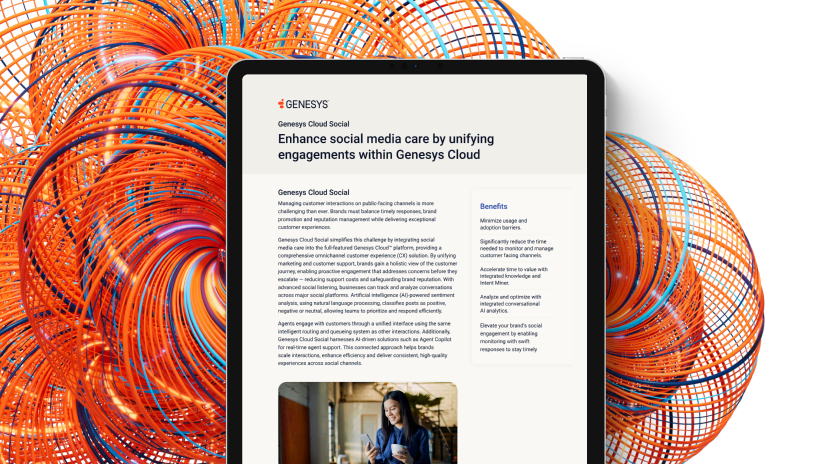
Genesys Cloud Social is designed to bring social media care into the broader experience of the Genesys Cloud™ platform so teams can unify engagement, routing and agent workflows rather than treating social as a separate world.
One workspace that supports public-to-private motion
In Genesys Cloud Social, agents can view and respond to both public posts and direct messages from supported social channels — specifically X/Twitter and Facebook — directly within the Agent Desktop. Social messages are clearly marked and the experience includes sentiment indicators to help agents gauge how a customer is feeling before responding.
This matters for continuity because the public-to-private move becomes a workflow, not a scavenger hunt. You’re not relying on screenshots, copy/paste or switching between tools to reconstruct the story. And when agents do respond, Genesys Cloud supports options like replying publicly or privately where available, with a preview step before anything goes live.
Routing that treats social like a real front door, not a side inbox
Genesys Cloud Social includes social escalation rules to route relevant social communications based on criteria defined by administrators. In practice, your organization can decide what should be escalated, when and with what priority — so social issues move into a managed support flow instead of being handled ad hoc.
AI summaries that reduce “start over” moments
Even with great routing, continuity can still fail at the human handoff, especially when a customer moves from a social thread into a longer support interaction or from one agent to another.
Genesys Cloud Agent Copilot capabilities include summarization features that deliver immediate conversation summaries after interactions. And for transfers specifically, Genesys supports transfer summaries that give receiving agents interaction context, so the next agent is positioned to continue rather than restart (support varies by transfer type). That handoff summary becomes a practical bridge: It captures what matters, shortens ramp-up time and helps teams keep their tone aligned with where the customer actually is in their journey.
 Darius Latham
Darius Latham is a Product Marketing Manager at Genesys. With a 10+ year background in B2B product marketing and strategy consulting, he focuses on shaping and executing comprehensive go-to-market strategies...
Subscribe to our free newsletter and get blog updates in your inbox.
Related capabilities: