





Key takeaways
- Banks in the top 20% for customer advocacy grow revenue 1.7x faster than peers globally.
- The fastest AI returns in banking come from four areas: virtual agents, agent copilot, predictive routing and automated QA.
- Omnichannel and multichannel are not the same thing. True omnichannel means every channel shares the same customer record, routing logic and interaction history.
- Compliance is a customer experience issue. Banks that authenticate without friction and explain their AI decisions build stronger trust and advocacy.
The banks winning on customer experience are pulling away from the pack. According to the Accenture Global Banking Consumer Study 2025, banks in the top 20% for customer advocacy grow revenue 1.7x faster than their peers globally and 2.6x faster in North America. The difference isn’t product range or pricing. It’s experience.
A good experience looks like the agent who already knows your history or the mortgage inquiry that moves from chat to phone without starting over.
Artificial intelligence (AI)-powered customer experience (CX) platforms deliver those moments at scale. They’re built specifically for financial services, where complexity, compliance and customer trust are non-negotiable.
This guide covers the AI use cases and trends reshaping banking customer experience today, what “fit for banking” looks like when evaluating a solution and proof points from banks already delivering it on the Genesys Cloud™ platform.
Banking customer experience trends in 2026: What they mean for your platform
Tracking banking customer experience trends matters most when it converts into smarter platform decisions. Most trend content tells you what’s happening. This section tells you what each shift means for the capabilities your customer experience technology must actually deliver.
#1 AI Agentic Virtual Agents are replacing IVR as the primary self-service layer
Interactive voice response (IVR) often deflects rather than resolves questions. Customers navigate rigid menus, press digits and end up frustrated. AI virtual agents work differently. The system deciphers intent through natural language understanding, they listen to what customers say, interprets their intent, and understands requests without forcing them through a menu tree. Then the virtual agent either resolves the request or can route it to the right agent with the full conversation history.
According to “The AI-Powered Bank: Rewiring for Excellence in Customer Care” article from McKinsey, banking leaders are investing heavily in voicebots and AI-powered self-service tools that promise 30 to 45% cost reductions and significant improvements in customer experience.
Platform implication: Look for a virtual agent that:
- Connects natively to core banking systems
- Handles authenticated self-service
- Transfers full context to a live agent without the customer repeating themselves
#2 Hyper-Personalization has moved from marketing to service operations
Personalization in banking used to mean targeted offers and segment-level campaigns. Now, though, according to the Accenture Global Banking Consumer Study 2025, more than 750 digital-only banks worldwide are serving 1.8 billion customers and setting a new bar for personalized service that traditional banks are still catching up to.
When a customer calls about a mortgage payment concern, the agent should already know about the disputed transaction flagged last week and the home equity application submitted recently. Customers who feel their bank knows them hold, on average, 17% more products with that institution. Getting AI personalization right at the service layer is now as important as getting it right in marketing.
Platform implication: Look for a platform that pulls customer data across channels and surfaces it to agents at the moment of interaction. Personalization that lives only in your CRM system and never reaches your contact center is incomplete.
#3 The human agent is becoming an AI-Augmented role
According to Accenture, 37% of customer service tasks in banking could be automated and 28% could be augmented by generative AI. Banks deploying agent-assist tools today are already seeing reductions in handle time, wrap-up work and escalation rates. An agent handling a fraud dispute needs the right compliance guidance in front of them immediately.
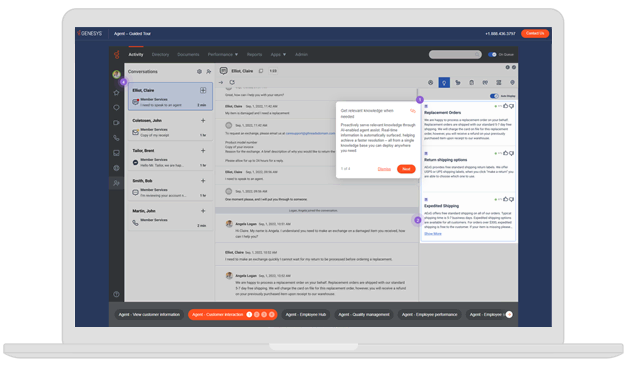
Platform implication: Agent copilot capabilities need to go beyond transcript summaries. Your platform should surface knowledge articles, next-best-action guidance and compliance prompts within the agent workspace during a live interaction. Genesys Cloud delivers this through Genesys Cloud AI capabilities, including Agent Copilot built natively into the agent experience.

#4 Context continuity is the new bar
Accenture research shows 64% of consumers fall back on the branch when digital channels fail, and then have to start over. Context continuity means every channel shares a single interaction record. When a customer moves from a chatbot to a phone call, the agent already knows what was attempted, what wasn’t resolved and what was promised.
Platform implication: Evaluate platforms on how context passes across channels natively. Ask vendors specifically how they handle an authenticated web chat session that escalates to a voice call. If context doesn’t transfer automatically and completely, the platform isn’t truly omnichannel.
#5 Proactive outreach is replacing reactive service
Customers don’t want to call to find out their payment failed or their card was flagged. The Accenture Global Banking Consumer Study 2025 identifies meeting customers where they are in their journey as one of the four key drivers of customer advocacy. A fraud alert with a one-tap callback to a specialist is a service moment. Done well, proactive outreach reduces inbound call volume, improves customer satisfaction (CSAT) and creates genuine cross-sell opportunities.
Platform implication: When a transaction triggers an alert, your platform should reach the customer immediately and connect them to a live, authenticated conversation without any extra steps.
#6 AI-Powered QA is coverage feasible
In most banking contact centers, manual quality assurance covers only a small fraction of monthly interactions. In a regulated environment where every call carries compliance exposure, that’s not enough coverage. AI-powered quality assurance changes that — automatically transcribing, scoring and flagging every voice call, chat and email for compliance risk, sentiment and script adherence.
Platform implication: Look for speech and text analytics built natively into your platform. Genesys Conversational Intelligence can analyze 100% of interactions and surface compliance risks, coaching opportunities and customer sentiment in real time.
#7 Security and compliance are becoming CX differentiators
The Accenture 2025 Global Banking Consumer Study found that 63% of Gen Z global consumers still want a physical branch to help manage their finances. Trust is the main reason. Customers who feel their data is handled carefully, who are authenticated without friction, and who understand what your AI does and doesn’t do are more likely to stay — and more likely to advocate.
Platform implication: Evaluate platforms on trust, including security certifications, data residency controls and AI explainability. Look for built-in compliance support for Payment Card Industry (PCI) and GDPR standards, and ask how those controls surface within the agent and customer experience.
| Trend | What’s changing | Platform requirement | Genesys capability |
| AI virtual agents | Conversational virtual agents replace rigid IVR menus | Native core banking integration, authenticated self-service and full context transfer on escalation | Genesys Cloud Agentic Virtual Agent, AI Studio, AppFoundry® Marketplace |
| Hyper-Personalization | Personalization moves from marketing into live service interactions | Platform surfaces unified customer data to agents at the moment of interaction | Predictive Engagement, Customer Journey Analytics, Agent Copilot |
| AI-Augmented agents | Agents need real-time guidance during live calls | Platform surfaces compliance prompts, knowledge articles and next-best-action within the agent workspace | Agent Copilot, Knowledge Management, Genesys Cloud AI Capabilities |
| Context continuity | Customers expect one continuous journey across every channel | Platform shares context across channels natively, not through third-party integration | Omnichannel routing, unified customer record, single agent workspace |
| Proactive outreach | Banks shift from reactive service to anticipatory outreach | Platform triggers outbound contacts from real-time events | Predictive Engagement, Outbound Campaigns, Journey Orchestration |
| AI-Powered QA | Regulators expect full interaction coverage, not random sampling | Speech and text analytics run natively across 100% of interactions | Genesys Conversational Intelligence, Speech and Text Analytics |
| Security as CX | Compliance architecture becomes a customer trust and brand asset | Platform surfaces PCI and GDPR controls within the agent and customer experience | Security and Compliance Controls, Data Residency, Explainable AI Routing |
AI use cases transforming customer experience in banking
Trends highlight where the industry is heading, while use cases tell you what works for banks similar to yours. Every example below comes from a bank facing the same regulatory constraints, customer expectations and operational pressures you face today.
Use case 1: AI-Powered call deflection
The challenge
Most inbound contact volume in banking is routine — balance inquiries, transaction status, password resets and card activation. These interactions are high frequency, low complexity and expensive to handle with live agents. They consume capacity and extend wait times on the calls that genuinely need a human agent:
- Fraud disputes
- Loan hardship requests
- Complaint resolution
IVR was the traditional answer. It reduced live agent contacts, but it also frustrated customers. A dead-end phone menu that still results in a hold queue doesn’t solve the interaction. It just delays it and damages trust along the way.
The approach
Conversational virtual agents replace static IVR menus. Customers speak naturally, authenticate securely and get their request resolved without speaking to an agent. When a customer needs to escalate, the virtual agent transfers the full conversation context to the live agent. The customer doesn’t repeat themselves.
In banking, this requires more than natural language understanding. Secure authentication within the self-service flow, real-time integration with core banking systems, and the ability to handle what a virtual agent can and can’t say about account status or financial products are all non-negotiable.
The outcome
Tonik, a digital-only bank in the Philippines, implemented Genesys Cloud to support its expanding customer base across digital channels and achieved a 60% reduction in customer wait times, improving service efficiency while supporting continued growth.
Genesys capability
Genesys Cloud delivers virtual agents natively, built and iterated within the same platform that runs voice, digital and workforce operations. Virtual agent flows connect directly to core banking systems through the Genesys AppFoundry Marketplace, with prebuilt integrations for CRM systems, core banking and authentication providers. There’s no separate bot platform to manage and no context lost in escalation.
Use case 2: Real-Time agent copilot
The challenge
Banking agents handle more complexity per shift than agents in almost any other industry. Fraud disputes, mortgage hardship requests, account error resolutions and regulatory disclosures can all land in the same hour. Each requires different knowledge, compliance language and a distinct conversational approach.
Legacy environments make it harder. Agents switch between a CRM system, a knowledge base, compliance references and a call script simultaneously. Every minute spent searching is a minute not spent on the customer. Handle time climbs, post-call documentation suffers and agents burn out faster.
The approach
Genesys Cloud Agent Copilot surfaces the customer’s history and account context automatically as the interaction begins. As the conversation develops, it identifies the topic in real time and pushes relevant knowledge articles, next-best-action guidance and compliance prompts directly into the agent workspace.
When the call ends, the platform generates a call summary automatically. Agents confirm rather than compose. After-call work time drops and note quality improves. In a regulated environment, the copilot also keeps agents on the right side of compliance — required disclosure language surfaces automatically when conversations move into product recommendations or collections.
The outcome
M&T Bank modernized its customer experience operations on Genesys Cloud. Before the bank introduced any AI copilot capability, that platform migration alone drove measurable gains: service bankers took approximately 100 more calls per month each, cost per call fell 11%, call transfers dropped 18%, and disconnected calls fell 80%. Building on that foundation, the bank is now extending into AI-assisted service. “We’re partnering closely with Genesys to explore new capabilities like agent assist and predictive routing while ensuring responsible AI implementation,” said Craig Stanton, Engineering Director at M&T Bank.
Genesys capability
Genesys Cloud Agent Copilot runs natively within Genesys Cloud, providing knowledge surfacing, next-best-action guidance, real-time transcription, compliance checklist support, and post-call summarization from a single platform. Because it’s built into the contact center environment, it reduces the latency and data synchronization challenges associated with third-party copilots while reducing vendor complexity and administrative overhead.
Use case 3: Predictive routing
The challenge
Skills-based routing tells you which agents can handle an interaction. It doesn’t tell you which agent is most likely to resolve it well for this specific customer. In banking, that distinction matters. A mortgage hardship call routed to an agent who is technically qualified but historically struggles with complex conversations creates risk. A high-value customer showing churn signals routed to the newest agent on the team is a retention failure in the making.
The approach
Predictive routing analyzes customer profiles, interaction history and agent performance patterns to predict which available agent is most likely to achieve the best outcome. The model improves with every resolved interaction. High-value loan conversations go to agents with a strong record of closing complex financial discussions. Customers showing churn signals go to agents with strong retention outcomes.
The outcome
Beyond Bank activated Genesys Cloud Predictive Routing across all three of its contact centers. After a two-week trial, the bank rolled out the capability across its full operation and achieved a 13% reduction in call handle times. “It was as simple as essentially flicking a switch,” said Brent Alexander, National Manager, Customer Relationship Center. ”All the capabilities were already built into Genesys Cloud — it just worked.”
Genesys capability
Genesys Cloud Predictive Routing runs natively inside Genesys Cloud. The system trains automatically on more than 100 customer, agent, and interaction data points combined and improves with every call. Custom KPIs let you optimize queues for retention, sales conversion, first-contact resolution/next-contact avoidance (NCA) or average handle time (AHT) within the same routing engine.
Use case 4: Proactive fraud intervention
The challenge
Fraud is a customer experience problem. According to the McKinsey 2025 Global Payments Report, deepfakes and synthetic fraud are growing rapidly, with AI now used to create highly convincing fake identities and transactions sophisticated enough to bypass traditional fraud detection systems.
The reactive model doesn’t work well. A customer who discovers unauthorized activity after the fact and calls to report it represents a trust failure that’s already happened.
The approach
Proactive fraud intervention connects your fraud detection system directly to your outbound contact center. When a suspicious transaction or account access event is flagged, the platform triggers immediate outreach to the customer through their preferred channel, whether it’s text, voice or in-app message.
When a customer confirms fraud, the interaction routes directly to a specialist agent with full context already transferred. Non-responses trigger automatic cross-channel escalation. Every step is logged, giving compliance teams the documented audit trail regulators expect.
The outcome
Security Bank moved from a legacy solution to Genesys Cloud to build greater flexibility and true omnichannel capability. Since going live, the bank has significantly improved its CSAT scores, enabled agent remote working and enhanced operational efficiency. Agents now handle voice, chat, text, email and social media interactions within a single real-time interface.
Genesys capability
Genesys Cloud connects with leading fraud detection systems to trigger real-time, personalized outreach the moment a suspicious event is flagged. AppFoundry Marketplace partners, including Pindrop and Smartnumbers, extend voice biometrics and real-time call risk scoring directly within the Genesys environment.
Use case 5: Omnichannel journey orchestration
The challenge
Most banking contact centers are multichannel, not omnichannel. Voice, chat, email and messaging each run on separate systems that don’t share context or customer history. A customer who starts a mortgage inquiry on live chat, follows up by phone and sends a confirmation by email tells the same story three times. Each channel resets the journey.
The approach
A single platform replaces separate channel tools and manages every interaction through unified routing, a unified agent workspace and unified reporting. Routing decisions draw on the full customer journey across all channels. An agent handling a follow-up call already sees the prior chat conversation, the email sent yesterday and the self-service steps the customer completed.
The outcome
Enity Bank Group consolidated customer journey management across Finland, Norway and Sweden onto a single Genesys Cloud instance. The bank reduced AHT by 54% and decreased inbound calls by 12% while growing its business significantly. Seven legacy systems were retired, delivering a 50% improvement in provisioning time and a 20% cost saving.
Genesys capability
Genesys Cloud manages voice, digital and back-office work items through a single routing engine, a single agent workspace and a single analytics layer. There isn’t a separate system per channel and context isn’t lost as customers move across touchpoints.
FAQs about banking customer experience
What is customer experience in banking?
Customer experience in banking covers every interaction a customer has with their financial institution, from opening an account to resolving a dispute. It spans digital channels, voice, branch and back-office processes. In our experience, banks that deliver consistent, personalized and low-effort experiences across all of those touchpoints build stronger customer loyalty and grow value faster than those that don’t.
How can AI improve banking CX?
AI improves banking customer experience in several ways. Virtual agents handle routine requests like balance inquiries, transaction status and authentication without involving a live agent. Predictive routing matches each customer to the agent best placed to help them. Genesys Cloud Agent Copilot surfaces the right information and compliance guidance during live calls, so agents spend less time searching and more time on the customer. Speech and Text Analytics monitors every interaction for quality and compliance, not just a random sample. The result is faster resolution, lower cost and better service.
What AI use cases deliver the fastest ROI in banking customer experience?
We see, the fastest returns come from four areas. Virtual agents reduce live agent volume on routine interactions from day one. Genesys Cloud Agent Copilot cuts handle time and after-call work immediately on deployment. Automated QA replaces manual sampling with full interaction coverage, reducing compliance risk without adding headcount. And predictive routing delivers measurable improvements quickly. Following a two-week pilot and subsequent rollout, Beyond Bank achieved a 13% reduction in call handle times.
How do I select the right CX software to manage banking experiences?
Start with banking-specific requirements, not generic contact center capabilities. Look for native compliance controls, real-time core banking integration, AI that operates within regulatory guardrails and an omnichannel context that works natively rather than through third-party integrations. Ask vendors for published outcomes from banks of a similar size and regulatory environment. Documented metrics matter more than reference customers.
How does Genesys Cloud CX differ from other banking CX platforms?
Genesys Cloud is built as a single unified platform, not a collection of integrated tools. AI, omnichannel routing, workforce engagement management, journey analytics and compliance monitoring all run on the same data layer. Context doesn’t get lost between systems, and every capability reinforces the others. For banks, that means purpose-built AI within compliance guardrails, prebuilt core banking and CRM system integrations through the Genesys AppFoundry Marketplace and published outcomes from financial services customers across retail banking, digital banking and collections.
Next steps: Building your banking CX roadmap with Genesys
The trends, use cases and proof points in this guide point in the same direction. Banks that invest in unified, AI-powered customer experience platforms are delivering better service, lower cost and stronger customer advocacy.
The question now is which platform is the right fit for your bank’s specific requirements, regulatory environment and growth goals. Not every platform is built for the complexity of financial services. Get a personalized Genesys Cloud demo mapped to your specific use cases, CX challenges and the outcomes covered in this guide.