

Drive compound value with the Levels of Experience Orchestration

Explore a maturity model for AI-driven experiences that can help you deepen customer loyalty, boost employee efficiency and drive business growth.

orchestration-levels-sidebar

Deliver the connected, intuitive experiences customers trust — at every level of orchestration

Experience orchestration evolves across levels, from basic customer service to more adaptive and automated journeys. As organizations progress, artificial intelligence (AI) evolves the capabilities of their systems to deliver more seamless, personalized experiences for customers and employees. Through the Levels of Experience Orchestration framework, you can assess the maturity of your operations and advance with confidence by connecting data, breaking silos and aligning your people, technology and processes around what matters most: the customer.

Explore the Levels of Experience Orchestration

To understand what full AI-Powered Experience Orchestration makes possible, it helps to start with the highest level of maturity attainable today. From there, you can see how each preceding stage evolves the capabilities and coordination needed to move your organization forward.

orchestration-level-5

Enable universal orchestration

Level 5: Universal agentic orchestration

AI agents operate with full goal-driven autonomy, managing decisions, actions and workflows across the enterprise. They operate across frontline, supervisory, administrative and back-office roles — sharing goals and context to plan, execute and manage outcomes in real time without fixed workflows. Human expertise shifts to governance, creativity and complex judgement while orchestration becomes intelligent, fluid and collaborative.

orchestration-level-4

Deploy context-aware agentic AI

Level 4: Agentic experience generation

AI systems move beyond predefined actions. They use context to plan across multiple steps, adjust their behavior dynamically and pursue objectives within human-defined boundaries. AI agents generate strategies and reason through tasks within clearly defined guardrails, while humans guide and approve critical decisions. The result is semi-autonomous orchestration that blends machine intelligence with human judgement.

orchestration-level-3

Layer in generative AI support

Level 3: System-generated conversations

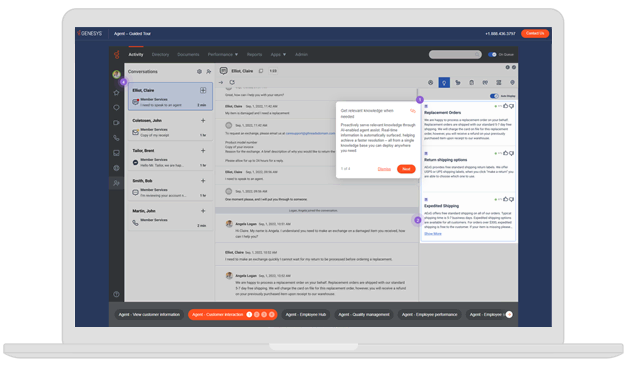
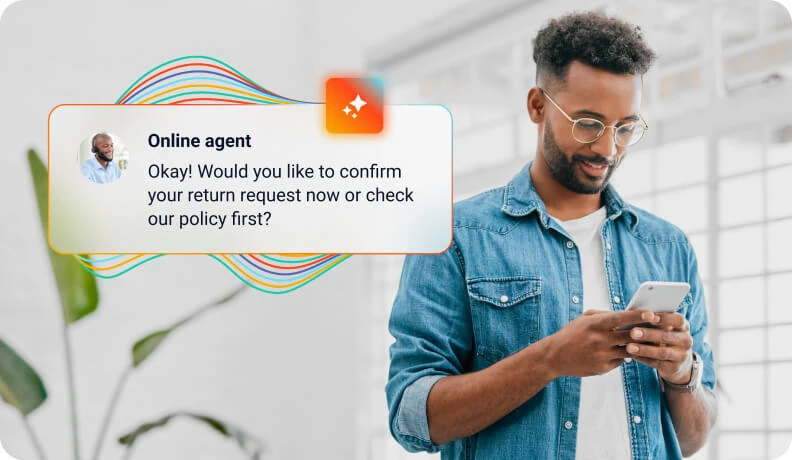
Generative AI enhances both interactions and workflows. It produces fluent, personalized content, summarizes information and automates routine tasks within configured guardrails. Predictive models improve forecasting, scheduling and workload balancing, while generative AI augments teams with insights and recommendations. Although it cannot plan or reason independently, it scales quality and consistency across service operations.

orchestration-level-2

Expand automation with predictive AI

Level 2: Predefined dialog automation

Routine tasks are automated through simple voice and text recognition that follows scripted dialogs across channels. Bots handle predictable requests using fixed flows and decision trees, and early workflow automation supports routing and straightforward tasks. Experiences remain highly structured and rules-driven, with limited adaptability and little coordination across channels or systems.

orchestration-level-1

Implement basic automation

Level 1: Menu-based navigation

Customers navigate structured menus using keypad inputs, fixed voice commands or simple on-screen selections to complete a small set of routine tasks. This reduces some demand on agents, who may see basic CRM system details to help guide conversations. Experiences remain highly structured, with no real-time context or workflow support.

orchestration-level-0

Manual effort and interactions

Level 0: Zero orchestration

Interactions are handled entirely by humans across unintegrated channels such as phone, email or basic messaging. Agents rely on siloed tools and static documentation, making service reactive and repetitive. Customers and employees face high effort because there is no shared context or coordinated support across systems.