Your Genesys Blog Subscription has been confirmed!
Please add genesys@email.genesys.com to your safe sender list to ensure you receive the weekly blog notifications.
Subscribe to our free newsletter and get blog updates in your inbox
Don't Show This Again.
As AI becomes more pervasive in all aspects of our work and personal lives, the conversation is no longer about what AI can do. It’s about how AI can be trusted, scaled responsibly and applied in ways that create meaningful human impact.
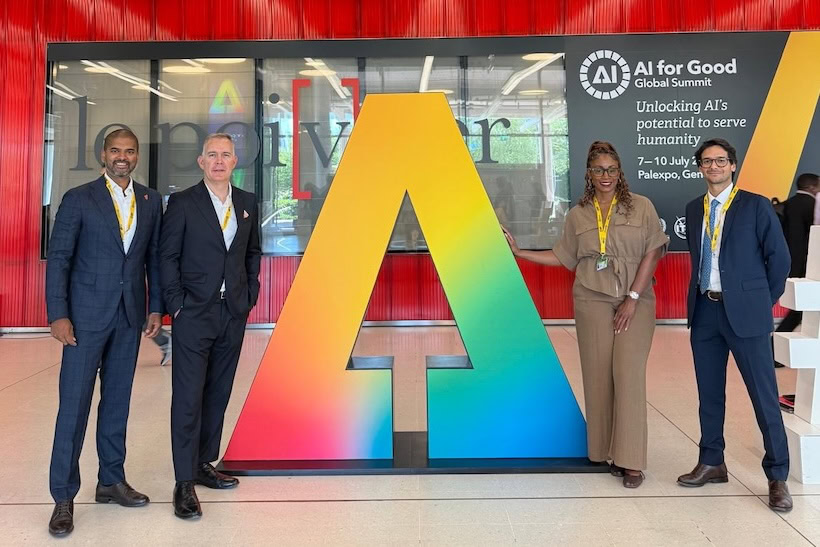
That question was central to the AI for Good Global Summit 2026 in Geneva, Switzerland. Organized by the International Telecommunication Union in partnership with more than 50 UN sister agencies and co-convened with the Government of Switzerland, AI for Good brings together global leaders across business, government, academia and youth to explore how AI can help address major societal challenges and advance responsible innovation.
Genesys was proud to participate in this global dialogue through three sessions focused on the key issues that matter as AI moves deeper into business and society: trust management for agentic AI, sustainable AI, and digital trust and AI infrastructure for all.
Mario Tavares Moyron, chief privacy officer and EU data protection officer at Genesys, joined a panel on “Designing the Trust Management for Agentic AI,” a timely discussion as AI systems move from assisting with individual tasks to taking more autonomous action across workflows.
As agentic AI becomes more autonomous and interconnected, trust depends on clear accountability across the AI value chain. The discussion highlighted the need for interoperable governance, stronger safeguards for transparency and human oversight, and practical standards that enable trusted adoption at scale.
For Genesys, this starts with accountability, transparency, privacy and security embedded into the AI lifecycle. In customer experience, people need confidence that systems are operating as intended, personal data is protected and human oversight remains clear.
A practical trust model for agentic AI should include clear governance over how AI is used, risk-based evaluation before deployment, transparency into AI capabilities and limitations, privacy and security controls by design, and ongoing monitoring to help ensure systems continue to perform as intended.
Bridgette Bell McAdoo, chief sustainability officer at Genesys, participated in a panel on “Building the Next Phase of Sustainable AI,” focused on how organizations can unlock AI’s benefits while responsibly managing its environmental and societal impact.
AI can be a powerful accelerator for sustainability. It can help optimize energy use, reduce waste, and create more efficient systems. But AI also comes with real resource considerations, including energy-intensive data centers, water-dependent cooling, complex supply chains and e-waste. Responsible AI does not require organizations to choose between innovation and sustainability. The two become mutually reinforcing when AI is designed with efficiency, transparency and long-term resilience in mind.
That is why sustainable AI requires a disciplined approach. Standards are essential to giving organizations, policymakers and technology providers a shared center of truth for measuring impact, aligning expectations and advancing responsible practices. Just as important, sustainability should be viewed as an enabler of innovation rather than a constraint. When organizations build with efficiency and accountability from the start, they can scale AI in ways that reduce waste, strengthen resilience and create long-term value.
For Genesys, that approach is grounded in AI principles, including accountability, fairness, governance, security and transparency, to help guide how we build AI systems to support ethical, safe and human-centered outcomes. Our approach also includes building more energy-efficient architectures, using right-sized models, applying model compression where appropriate and identifying alternatives to energy-intensive model training.
This work aligns with the Genesys broader sustainability strategy across Planet, People and Performance. As part of that strategy, Genesys is focused on reducing environmental impact, supporting people and communities, and maintaining the trust, resilience and performance customers expect from Genesys Cloud. Bridgette’s discussion also reinforced that no organization can solve these challenges alone. Collaboration across industry, government, standards bodies and civil society is critical to advancing sustainable AI as a collective responsibility.
Guillaume Lardeux, head of transformation and office of the CEO, participated in high-level roundtable on “Digital Trust and AI Infrastructure for All,” reflecting a broader shift in the global AI conversation. As AI moves from experimentation to enterprise transformation, organizations need more than powerful models. They need trusted infrastructure, practical governance and operating models that turn AI into real outcomes.
The roundtable, which brought together 18 ministers, 24 private sector companies, 12 international organizations and representatives from academia, reinforced that inclusive AI depends on inclusive infrastructure, enabled by open standards, capacity building and shared investment. Discussions on agentic AI reinforced that digital trust is built on identity, delegated consent, accountability and verifiability, and is essential for safe adoption. During the discussion, participants returned to a common theme: interoperable global standards are key to scaling trusted AI across industries and borders.
This builds on a key theme from our recent Davos reflections: AI transformation is not just a technology transformation. It spans people, processes and technology. The organizations we see making significant progress are moving beyond isolated pilots toward redesigned workflows and practical operating models that can scale.
Digital trust is essential to that transition. Organizations need confidence that AI systems are secure, resilient, compliant and aligned with real-world risk. They also need infrastructure that expands responsible AI adoption beyond the largest or most digitally mature enterprises.
The discussions at AI for Good reinforced that AI’s next chapter depends on how effectively organizations apply it responsibly, sustainably and inclusively. For Genesys, that means operationalizing trust through governance, guardrails and oversight; building sustainability into AI strategy; and helping organizations adopt AI with confidence. As AI continues to evolve, we remain committed to helping organizations use it in ways that are trusted, sustainable and human-centered.
 Bimal Mathews
Bimal Mathews is Director of Global Strategic Relations in the Office of the CEO at Genesys, where he leads engagement with global institutions including the World Economic Forum, the United...
Subscribe to our free newsletter and get blog updates in your inbox.