Your Genesys Blog Subscription has been confirmed!
Please add genesys@email.genesys.com to your safe sender list to ensure you receive the weekly blog notifications.
Subscribe to our free newsletter and get blog updates in your inbox
Don't Show This Again.

Countless breakthroughs in customer experience (CX) have been driven by the ambition to deliver faster, more personalized experiences, at scale, while empowering employees to do their best work.
Generative AI accelerated that journey; for example, by making information more accessible and helping automate time-consuming tasks such as knowledge retrieval, interaction summaries and after-call work. But as transformative as generative AI has been in experience orchestration, it primarily excels at providing answers.
Customers, however, typically reach out for more than information. They want to resolve a billing issue, schedule an appointment, update account information or accomplish another task — sometimes one that’s quite complex.
That’s where agentic AI comes in.
Rather than simply generating responses, agentic AI can reason through customer intent, determine the next best action, interact with business systems and other AI agents, and complete tasks on behalf of customers and employees.
In other words, it moves AI from answering questions to driving outcomes. These autonomous AI agents can transform both self- and assisted service, reduce employee effort and help organizations orchestrate what feels to customers like “channel-less” experiences.
The shift is generating significant interest among CX practitioners, with some viewing agentic AI as a catalyst for reimagining experience innovation.
While the technology is still evolving, some organizations are already exploring the possibilities.
Many organizations started their AI journeys with chatbots and virtual assistants. Agentic AI expands what’s possible by their ability to handle increasingly sophisticated interactions and orchestrate entire journeys.
Charles Sturt University set out to completely reshape how it supports and engages its increasingly digital student population. To address its goal of accessibility and availability, CSU introduced a virtual agent, powered by Genesys Cloud AI Guides, to align support with student behavior
“We want to keep the support experience as accessible as possible and remove all the friction from our students’ journeys,” said Michael Buttsworth, Associate Director of Student Experience Service Center at CSU.
The AI Guides-powered agentic virtual agents CSU has implemented so far are delivering more efficient, empathetic interactions for students — even for complex inquiries.
For example, after hours a student can ask the agentic virtual agent about withdrawing from a course. Rather than simply outlining the process, the agent explores what is driving the question. If the student is experiencing financial pressure or competing life commitments, the agent can suggest relevant options, such as support to help manage cost of living pressures, information about scholarships, or reducing study load to better balance work, family and study.
“Students want a conversational bot, and the virtual agents powered by agentic AI are very conversational,” added Paul Drake, Contact Center Systems Manager at CSU.
Utility Warehouse is pursuing a similar vision. The multi-utility company recently introduced agentic AI-powered broadband troubleshooting experiences designed to move initial triage away from human agents and into intelligent digital channels.
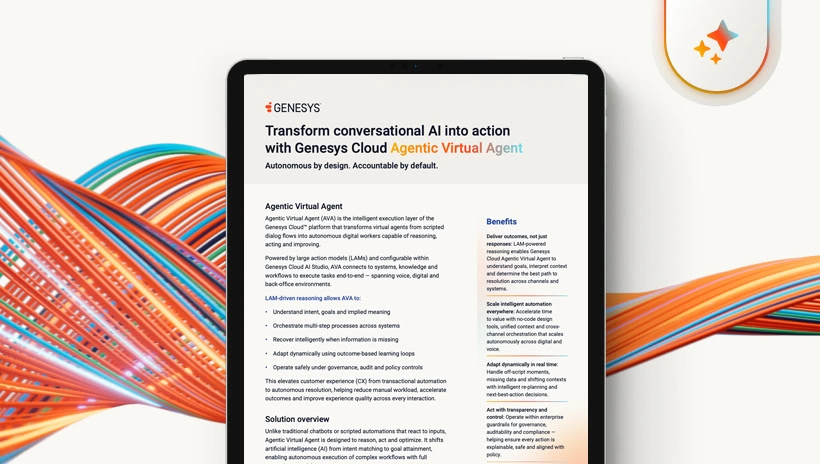
The company is one of the first organizations to go into live production with Genesys Cloud Agentic Virtual Agents (AVA) powered by a Large Action Model (LAM). These autonomous bots resolve issues such as Wi-Fi troubleshooting and mobile top-ups, achieving high containment. A voice-based AVA also automates mobile prepayment journeys, extending intelligent self-service further.
“It’s an extremely positive start and it builds confidence that we can get behind this and put [AVAs] in front of other journeys,” said Kevin Mythen, Product Lead at Utility Warehouse, in the webinar “From answers to action: How leading brands are applying agentic AI in CX.”
And healthcare provider Ascension is exploring agentic virtual agents to support appointment management, eligibility verification, supplier interactions and other transactional experiences. Early results include significant containment rates for targeted use cases.
Wipro offers another example of a practical, thoughtful approach to adopting agentic AI.
It’s currently piloting virtual agents and exploring agentic AI use cases for high-volume scenarios such as password resets and account unlock requests. The company’s goals go beyond simply automating repetitive interactions to creating a scalable self-service foundation. Wipro is targeting approximately 20% automation for selected service scenarios while reducing agent workload associated with routine customer inquiries.
Agentic AI has the potential to be a powerful enabler of self-service. Its underlying attributes — reasoning, collaboration across systems, taking action — could also allow organizations to transform the employee experience.
The future of work isn’t about replacing employees. It’s about removing friction.
Agent assist capabilities, AI-powered knowledge surfacing, automated summaries, and conversational insights are already helping organizations reduce administrative burden and improve consistency, with measurable efficiency gains for employees.
At Ascension, leaders are focused on helping employees spend less time navigating systems and more time engaging meaningfully with patients.
“Let technology do what technology does best and then let the human do what they do best,” said Brian Jones, Senior Specialist at Ascension Technologies, in the Customer Reference Forum “Embracing AI Innovation.”
At Utility Warehouse, AVA is saving agents two to three minutes per call through automated line checks and interaction summarization.
“It makes their interaction simpler,” said Mythen. “It frees up agents for more empathetic conversations.”
The impact goes beyond productivity. When employees spend less time searching for information or documenting interactions, they can focus on empathy, judgment and relationship-building — the uniquely human capabilities customers value most.
“You can’t help but to feel supported, empowered, and appreciated through that,” said Mitchell.
Organizations are finding that the most powerful outcomes occur when autonomous systems and human expertise work together. AI handles speed, scale and consistency. Humans bring empathy, creativity, judgment and trust.
“It’s really about…making sure AI is being efficient and effective, and when necessary, keeping that human in the loop,” said Jones.
That balance may ultimately define the future of customer experience.
Agentic AI isn’t simply another automation technology. It represents a shift toward experiences that are proactive, adaptive and outcome-oriented.
As organizations continue experimenting, piloting and scaling these capabilities, they’re laying the foundation for a future where customers spend less time navigating systems and more time achieving their goals — and where employees are empowered to focus on the moments that matter most.
Discover how Genesys Cloud Agentic Virtual Agent helps leading organizations deliver the next generation of autonomous CX.
 Ginger Conlon
Ginger Conlon is an award-winning content and customer marketing executive who transforms complex technology into strategic storytelling. As director of customer stories at Genesys, she partners across the organization to...
Subscribe to our free newsletter and get blog updates in your inbox.