




Overview
Your messaging channels are live, but are they working as hard as they could be?
For many organizations, the answer is “not quite.” Live chat or asynchronous chat and WhatsApp are deployed, but volumes are lower than they should be. This could be the result of artificial intelligence (AI) not handling as much as it could or the experience not always feeling as connected as customers expect. The channel is on but the potential isn’t fully unlocked.
This guide is designed to help you change that. It’s a practical self-assessment across six areas that determine whether your messaging experience is truly ready or whether there’s untapped value waiting to be found. Work through each section, answer the questions honestly and use the readiness checks to identify where to focus first.
1. Channel coverage assessment
Are you available where your customers want to reach you?
The foundation of any messaging strategy is having the right channels active in the right places. However, “active” doesn’t always mean “accessible.” Being present on a channel your customers aren’t using, while being absent from one they prefer is a common and costly gap.
Ask yourself:
- Which messaging channels do you currently have active?
- Are there channels your customers are actively asking for that aren’t yet live?
- Are your messaging channels easy for customers to find, or are they buried in a footer or a secondary support page?
Customers who can’t easily find your messaging option will default to calling — adding volume to your most expensive channel and delivering a worse experience in the process. Visibility is as important as availability.
Readiness check: Channel coverage scorecard
- Is web messaging/async chat active on your website?
- Is in-app messaging active on your mobile app?
- Is WhatsApp active and configured for customer interactions?
- Are messaging entry points prominent and easy to find?
- Do you have a clear view of which channels your customers prefer?
Assessment
Mostly yes: Strong foundation with time to focus on optimization.
Mostly partially or no: Channel coverage gaps are likely suppressing volume before customers even try to engage. Note that just because a channel can be supported doesn’t mean it should be, and the first three questions here are less important than the last two.
2. Entry point assessment
Can customers find and start a messaging conversation?
Having a messaging channel live is one thing. Making sure customers encounter it at the right moment and feel compelled to use it is another challenge entirely. Entry point placement and proactive engagement are two of the most underleveraged levers in messaging adoption.
Ask yourself:
- Is messaging prominently surfaced on your website and/or mobile app, or does it require customers to go looking for it?
- Are entry points placed at the moments in the customer journey where messaging adds the most value: on product pages, checkout flows, support pages or account management screens?
- Are proactive chat invitations or behavioral triggers configured to engage customers before they abandon a page or pick up the phone instead?
A customer who is struggling with a checkout issue and doesn’t see a messaging option will either call in or leave. A proactive message that appears at exactly that moment, such as “Can I help you complete your order?”, can change the outcome entirely.
Readiness check: Entry point scorecard
- Does messaging surface prominently on your homepage and key pages?
- Are entry points placed at high-intent or high-friction moments in the journey?
- Are proactive chat invitations configured on key pages?
- Are behavioral triggers set up to engage customers showing exit intent?
- Are mobile app messaging entry points as visible as web entry points?
Assessment
Mostly yes: Your discoverability is strong, leaning toward a time to focus on the quality of the experience once customers engage.
Mostly partially or no: Entry point gaps are likely one of the biggest reasons your messaging volume is lower than it should be.
3. AI utilization assessment
Is AI doing enough of the work?
This is where many messaging deployments leave the most value on the table. A virtual agent that handles a narrow set of interactions, or one that was configured and left largely untouched, will never deliver the containment rates and efficiency gains that messaging is capable of.
Ask yourself:
- Do you have a virtual agent or bot configured on your messaging channels?
- Which interaction types are AI currently handling, and which common request types are still being routed directly to live agents?
- How does your containment rate compare to peer organizations of similar size and industry?
- Are there routine requests (balance inquiries, order status updates, appointment scheduling or FAQ responses) that a live agent is handling today, but a virtual agent could handle automatically?
The goal isn’t to replace human agents. It’s to make sure that routine, repeatable interactions are handled automatically while freeing agents to focus on the complex, high-value conversations where human judgment genuinely matters.
Readiness check: AI utilization scorecard
- Is a virtual agent or bot configured on at least one messaging channel?
- Do virtual agents handle your top five most common interaction types?
- Is your containment rate at or above your industry benchmark?
- Have your bot flows been reviewed and updated in the last 90 days?
- Do you have a clear list of interaction types that could be automated but aren’t yet?
Assessment
Mostly yes: Your AI foundation is solid meaning focus should shift toward expanding coverage and improving containment.
Mostly partially or no: AI utilization is likely your biggest opportunity for both cost reduction and experience improvement.
4. Continuity and handoff assessment
Does the experience feel connected across channels and handoffs?
Ninety-five percent of consumers expect their information to carry across channels so they don’t have to repeat themselves. However, 52% of companies still do not pass previously collected information to a representative or human agent during a customer interaction. This gap between what customers expect and what organizations deliver is one of the most damaging experience failures a business can make.
Ask yourself:
- When a customer moves from a virtual agent to a live agent, does the agent receive the full conversation history and context automatically?
- If a customer switches from web messaging to a voice call, does the agent know what the customer was trying to accomplish?
- Are customers ever asked to repeat information they’ve already provided such as their account number, the reason for their contact or what they’ve already tried?
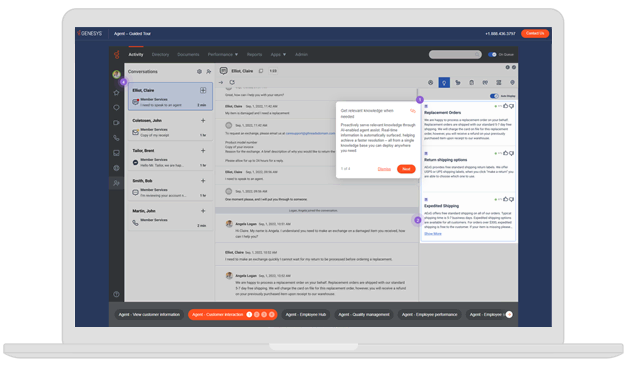
- Is data from your CRM or other systems surfaced to agents during messaging interactions, so they can see the full customer picture without switching tools?
Every time a customer has to repeat themselves, trust erodes. Context continuity isn’t just an operational efficiency; rather, it’s a signal to the customer about whether your organization actually knows them.
Readiness check: Continuity and handoff scorecard
- Is the conversation history automatically passed to live agents during escalations?
- Can agents see the customer’s prior interaction history across channels?
- Is CRM data surfaced to agents within the messaging workspace?
- Are customers never asked to repeat information already provided in the same interaction?
- Do cross-channel handoffs (e.g. messaging to voice) preserve context?
Assessment
Mostly yes: Your continuity foundation is strong, so focus on edge cases and less common handoff scenarios.
Mostly partially or no: Context gaps are likely hurting both customer satisfaction and handle time and should be a near-term priority.
5. Proactive engagement assessment
Are you reaching customers before they reach you?
Reactive messaging, waiting for customers to reach out, captures only a fraction of the opportunity. The organizations seeing the strongest messaging results are using the channel proactively: reaching customers with timely, relevant communications that keep them informed, reduce inbound volume and drive engagement before issues arise.
Ask yourself:
- Are you using proactive messaging to send notifications, reminders or updates? Order confirmations, appointment reminders, shipping alerts or payment confirmations?
- Are outbound messaging campaigns configured for relevant customer journeys: re-engagement, renewals or up-sell opportunities?
- Are behavioral triggers set up to identify and engage high-intent visitors on your website before they drop off or switch to a more expensive channel?
WhatsApp in particular has open rates that can exceed 90% in some studies, dramatically higher than email. If you’re sending important customer communications via email but not via messaging, you’re likely reaching a fraction of the audience you could be.
Readiness check: Proactive engagement scorecard
- Are proactive transactional notifications configured (order, shipping, appointment or payments)?
- Are outbound messaging campaigns active for at least one customer journey?
- Are behavioral triggers set up to engage high-intent or at-risk website visitors?
- Is opt-in management in place to capture and honor customer messaging preferences?
- Is the performance of proactive messaging tracked and reviewed regularly?
Assessment
Mostly yes: Proactive engagement is working so focus on expanding to additional journeys and refining timing and personalization.
Mostly partially or no: Proactive messaging is likely your biggest untapped opportunity for reducing inbound volume and improving customer satisfaction.
6. Measurement and reporting assessment
Do you know how your messaging experience is performing?
You can’t improve what you can’t see. Many organizations have messaging deployed but lack the visibility to know whether it’s performing well, where customers are dropping off or how their results compare to peers. Without that visibility, optimization is guesswork.
Ask yourself:
- Are you tracking key messaging metrics such as volume, containment rate, customer satisfaction and average handle time across all active channels?
- Do you have visibility into where customers abandon messaging interactions or escalate to live agents unexpectedly?
- Are bot flows being reviewed and optimized on a regular cadence, or was the initial configuration largely set and forgotten?
- Do you have access to benchmarking data that lets you compare your performance against organizations of similar size and industry?
Optimization doesn’t require a major initiative. Even small, regular improvements to bot flows like fixing a confusing step, adding a common request type or improving a handoff trigger are things that compound over time into significant gains in containment and customer experience.
Readiness check: Measurement and reporting scorecard
- Is your messaging volume tracked and reviewed monthly across all channels?
- Is your containment rate measured and benchmarked against your industry peers?
- Is customer satisfaction captured for messaging interactions?
- Are drop-off and escalation points visible in your reporting?
- Are bot flows reviewed and updated on at least a quarterly basis?
Assessment
Mostly yes: Your measurement foundation is strong, so focus on acting on what the data is telling you.
Mostly partially or no: Measurement gaps mean you may be missing clear signals about where the experience is breaking down.
Your readiness score and next steps
Tally your responses across all six sections and use the guide below to identify where to focus first.
Scoring guide (per section):
- Mostly “Yes”: Strong foundation to maintain and optimize
- Mix of “Yes” and “Partially”: Good foundation with clear gaps to address
- Mostly “Partially” or “No”: Priority area to address before other improvements
Overall readiness:
- 5–6 sections mostly “Yes”: Your messaging deployment is mature and well-optimized. Focus on advanced use cases, proactive engagement expansion and performance benchmarking.
- 3–4 sections mostly “Yes”: You have a solid foundation with meaningful gaps. Prioritize the sections scoring lowest as they represent your biggest near-term opportunity.
- 0–2 sections mostly “Yes”: Your messaging deployment has significant untapped potential. Start with Channel coverage and AI utilization — getting these right will have the broadest impact on every other area.
Where to go next based on your scores
Low score on AI utilization
Start by auditing your top 10 inbound interaction types and identifying which ones a virtual agent could handle. Even automating two or three high-volume use cases can meaningfully shift your containment rate.
The CX Playbook for the Agentic Era
Low score on Entry points
Review where messaging is surfaced across your website and mobile app. Look for high-traffic, high-friction pages where a proactive invitation could intercept customers before they pick up the phone.
The Five Phases of Digital Engagement
Low score on Continuity and handoff
Audit your escalation flows end-to-end. Identify every point where context is lost and prioritize fixing the highest-volume handoffs first. Bot-to-agent escalations and cross-channel transfers are usually the biggest culprits.
Frequently asked questions about messaging readiness
How do I know if my messaging channels are actually being used by customers?
Start by looking at your conversation volume relative to your overall inbound contact volume. If messaging represents a small fraction of total interactions despite being live for 90 days or more, that’s a signal worth investigating. Common culprits include poor entry point placement, low discoverability and lack of proactive engagement — all of which can be addressed without deploying anything new.
What is a containment rate and what should mine be?
Containment rate is the percentage of messaging interactions fully resolved by a virtual agent without requiring escalation to a live agent. A strong containment rate varies by industry and use case, but most organizations should be targeting 60% or higher for well-defined, high-volume interaction types. In fact, Gartner predicts that by 2029 80% of common customer service issues will be managed autonomously without human intervention from utilizing agentic AI. If yours is significantly below 50%, it’s usually a sign that either the bot isn’t configured to handle enough interaction types or the flows need optimization.
What is proactive messaging and how is it different from reactive messaging?
Reactive messaging waits for the customer to initiate contact. Proactive messaging reaches out first, such as by sending notifications, reminders or updates before the customer needs to ask. Examples include order confirmations, shipping alerts, appointment reminders and payment due date notifications. Proactive messaging reduces inbound volume, improves satisfaction and makes better use of high–volume channels.
What metrics should I be tracking to know if my messaging experience is improving?
The core metrics to track are conversation volume, containment rate, customer satisfaction score, average handle time for agent-assisted interactions and escalation rate. Beyond those, look at entry point engagement rates to understand discoverability, drop-off rates within bot flows to identify friction and proactive message open and response rates if you’re running outbound campaigns.