




Key takeaways
- Conversational intelligence analyzes every interaction across every channel, giving digital banks full visibility into what’s happening across the customer journey, not just a sampled view.
- Conversational intelligence, conversational artificial intelligence (AI) and conversational banking solve different problems in a bank’s contact center — knowing which one you’re evaluating keeps a platform decision from missing the mark.
- Automated QA powered by conversational intelligence lets compliance and quality teams scale coverage across hundreds of thousands of interactions without adding headcount.
- Real-time analysis flags compliance gaps, sentiment shifts and coaching opportunities during the conversation, not after it.
- A native CI platform or standalone tool determines how much operational value the insights actually produce.
Customers interact with their bank more than ever, yet most banks analyze only a fraction of those conversations. Customers call about fraud alerts, dispute charges and ask about loan terms, and too much of that insight disappears. Conversational intelligence (CI) for banking changes that. It captures and analyzes every interaction across every channel, giving your team a complete picture of what happened, what was said and what it means for the customer relationship.
This guide covers how digital banks are deploying AI-powered conversational intelligence to automate quality assurance, improve agent performance in real time and meet compliance requirements at the scale that digital banking demands.
What conversational intelligence covers in banking
Three terms come up often in this space, and they’re worth separating before going further.
Conversational intelligence analyzes recorded and live interactions for insights, quality assurance, sentiment, agent coaching and compliance monitoring.
Conversational AI automates conversations through bots, virtual agents and self-service channels.
Conversational banking is the broader service model describing how customers interact with their bank across digital and human-assisted channels.
Think of them as distinct layers: conversational intelligence is the analytical layer, conversational AI is the automation layer and conversational banking is the delivery model. Each serves a different function and conflating them leads to gaps in how banks evaluate and deploy these capabilities.
Most banking contact centers already have some version of conversational banking in place. What they’re often missing is the analytical layer. That’s the ability to capture what’s actually happening across those interactions and turn it into action.
That analytical layer is also what makes it possible to personalize CX in banking at scale, moving beyond generic service to interactions that reflect what each customer actually needs.
Manual quality assurance covers a fraction of monthly interactions. For banks that need compliance monitoring at scale, that’s not enough coverage.
Speech and text analytics processes every voice call, chat and email through the same engine. Compliance scoring flags interactions where required disclosure language was absent. Sentiment analysis surfaces calls where customer frustration escalated without resolution.
In a banking contact center, conversational intelligence operates across four layers simultaneously:
- Real-time guidance: During a live call or chat, conversational intelligence automates compliance disclosure prompts, next step recommendations and sentiment alerts to the agent’s desktop.
- Post-call analysis: Every interaction is transcribed; scored against quality and compliance metrics; and scored with a full audit trail across voice, chat, email and messaging.
- Automated QA: Interactions where a call required disclosure language are categorized as compliant, or interactions with a negative sentiment are automatically flagged for supervisor review.
- Coaching intelligence: Patterns identified across interactions that might need specific coaching are connected directly to the workforce management system that schedules the coaching sessions.
Purpose-built AI trains on real conversation data, operates within compliance guardrails and improves from your own interaction history. For banks mapping where AI in customer experience creates the most value, the platform it runs on is where the answer starts.
From random samples to automated QA and compliance
The challenge
Fraud affects more than financial losses; it directly impacts the customer experience. According to the McKinsey 2025 Global Payments Report, deepfakes and synthetic fraud are growing rapidly; AI is now used to enhance risk scoring and fraud prevention, as well as to address emerging issues such as deepfakes and synthetic fraud. Understanding how AI in financial services is reshaping fraud response is critical context for any bank evaluating CI platforms today.
The Forrester 2025 Enterprise Fraud Management research confirms that fraudsters are shifting to generative AI-powered tactics, including synthetic identities and deepfake impersonation, making scams more convincing and harder to detect at scale.
The reactive model doesn’t work. Verification processes that add friction to every interaction punish legitimate customers for the behavior of bad actors.
The approach
When a suspicious transaction or account access event is flagged, the platform triggers immediate outreach to the customer through their preferred channel, whether it’s text, voice or in-app message.
When a customer confirms fraud, the interaction routes directly to a specialist agent with full context already transferred. The agent sees the flagged event details, account history and channel preference before the conversation starts. No reverification or re-explanation is required.
Non-responses trigger automatic cross-channel escalation and every step is logged, giving compliance teams the documented audit trail regulators expect.
The outcome
Security Bank, a banking leader in the Philippines, moved away from an outsourced, legacy contact center to the Genesys Cloud CX® offering to achieve the omnichannel capability and compliance coverage its regulated environment demands.
Quality management tools, including speech and text analytics, have allowed Security Bank to enable compliance across interactions. Rather than relying on sampled reviews, every voice call and digital interaction now runs through the same analytics engine, giving Security Bank consistent and full-coverage visibility across its contact center operations.
Agents now handle voice, chat, text, email and social media interactions within a single real-time interface and predictive analytics.
Genesys capability
Genesys Conversational Intelligence analyzes all interactions across voice, chat and email natively within Genesys Cloud CX. Speech and text analytics, sentiment analysis, topic trends and interaction categories run from the same platform with no additional pipeline required. Supervisors work from flagged interaction queues and QA managers gain broad interaction coverage with full audit trail support.
Real-time guidance during live banking conversations
Post-call analysis tells you what happened. Real-time guidance changes what happens next, while the conversation is still live.
What conversational intelligence analyzes
As an interaction unfolds, conversational intelligence analyzes speech patterns, sentiment and keywords in real time.
How conversational intelligence supports QA and compliance
Most QA programs review a sample of calls after the fact. CI gives compliance teams full interaction coverage, monitoring for required disclosures and flagging omissions as they happen rather than after the damage is done.
How conversational intelligence supports real-time agent guidance
When a customer signals frustration or raises a sensitive topic, supervisors see it immediately without manually monitoring every queue.
How conversational intelligence insights connect to coaching, workforce engagement management and journey analytics
Those signals feed directly into coaching and workforce engagement management. Supervisors get a prioritized queue based on actual performance data, and the same interaction data connects to customer journey analytics to surface where the experience is breaking down.
Where conversational AI/virtual agents fit separately
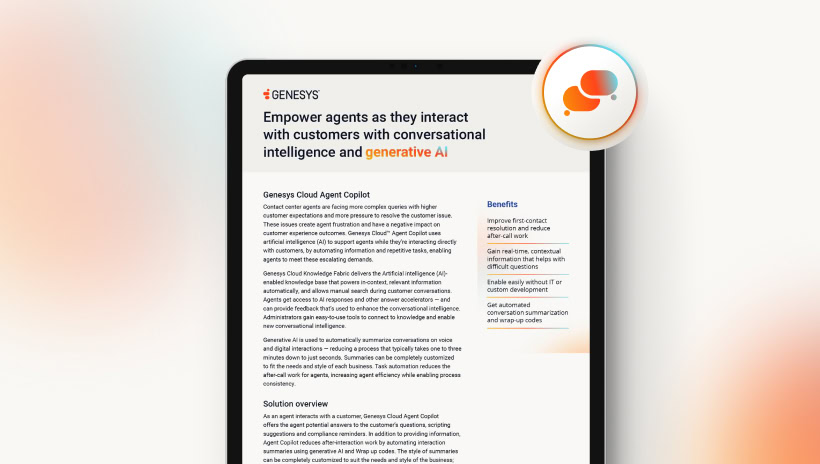
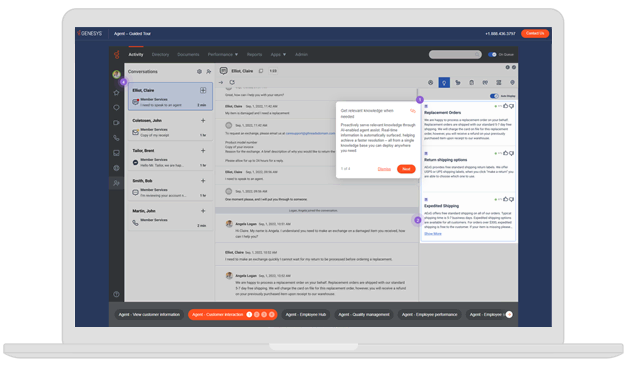
Conversational intelligence analyzes the conversation. Conversational AI acts on it. Virtual agents authenticate customers, connect to core banking systems in real time and resolve routine requests without escalation. Genesys Cloud™ Agent Copilot surfaces compliance language, knowledge articles and next-best actions within the agent desktop during a live call, then generates a post-call summary automatically, eliminating manual wrap-up without sacrificing documentation quality.

Genesys conversational intelligence for banks
The difference between a conversational intelligence tool and a conversational intelligence platform is where the insights go after they are generated. A standalone CI tool produces dashboards. A CI platform whose capabilities share a data layer with the contact center’s routing engine, workforce management system and AI tools produces operational change.
Genesys Conversational Intelligence is not a capability added to Genesys Cloud™. It is a native capability built into the platform, which means the insights it generates are automatically available to every other capability in the system.
Genesys Cloud Agent Copilot
Genesys Cloud Agent Copilot operates during live interactions, providing guidance to agents in real time from the same platform that handles routing, recording and analytics. When the call ends, the platform generates a post-call summary automatically.
Agentic AI
Genesys Agentic AI can help automate action on signals surfaced during interactions. For digital banks managing large volumes of interactions across multiple channels, this capability supports faster response and greater operational consistency than manual review alone.
Workforce engagement management and coaching
Genesys Conversational Intelligence transcribes and analyzes every voice call, chat interaction and email through a single engine, scoring each one against configurable quality and compliance rubrics. Those scores connect directly to coaching: When a supervisor reviews a flagged interaction, the coaching task is created, assigned and tracked in the same Genesys workforce platform without manual export or system switching. Scheduling, forecasting and quality monitoring all draw from the same data layer, showing what is actually happening in the contact center, not an estimate pulled from a separate system.
The gap between what banks know about their customers and what they act on is closing, for the banks that have invested. Conversational intelligence is not a future capability. It is operational today in digital banks, managing hundreds of thousands of monthly interactions, and the outcomes are measurable.

FAQs about conversational intelligence in banking
What is the difference between conversational intelligence and speech analytics in banking?
Speech analytics is a component of conversational intelligence. It transcribes and analyzes voice interactions for topics, sentiment and keywords. Conversational intelligence is broader; it covers voice and digital channels, connects interaction data to quality management, compliance monitoring and agent coaching, and feeds those insights into workforce planning and journey analytics. In banking, the distinction matters because most customer issues don’t stay in one channel.
How does automated QA work in a banking contact center?
Automated quality assurance uses AI to evaluate interactions against a defined rubric without requiring a supervisor to manually review each one. In the Genesys Cloud platform, evaluation forms are prefilled by AI based on what was said during the interaction. Supervisors review and adjust rather than starting from scratch. This lets compliance and quality teams scale coverage across hundreds of thousands of interactions without adding headcount.
Does conversational intelligence work across digital channels?
Yes. CI analyzes voice, chat, email and messaging interactions. For digital banks where customers move between self-service, chat and voice in a single journey, cross-channel analysis is what makes the data actionable. Insight from a chat interaction informs the same coaching queue and compliance review as a voice call.
How long does it take to implement conversational intelligence for a bank?
Implementation timelines vary based on the complexity of your existing environment and the number of channels involved. Banks using a native CI platform like Genesys Cloud typically move faster than those integrating a standalone CI tool into an existing stack because the data layer is already connected. Your implementation team can provide a more specific timeline based on your environment.
What should a bank look for when evaluating CI platforms?
Look for a platform where CI is native, not bolted on. Key capabilities to evaluate include cross-channel coverage; real-time and post-interaction analysis; automated QA with configurable rubrics; compliance monitoring; direct integration with workforce engagement management and coaching workflows; and customer journey analytics. The most important architectural question is whether CI shares a data layer with the rest of the platform. That determines how much operational value the insights actually produce.
What is the difference between conversational intelligence, conversational AI and conversational banking?
Conversational intelligence is the analytical layer. It analyzes recorded and live interactions for quality, compliance, sentiment and coaching insights. Conversational AI is the automation layer. It powers virtual agents, bots and self-service channels. Conversational banking is the delivery model that describes how customers interact with their bank across digital and human-assisted channels. All three are distinct capabilities, and a complete digital banking customer experience strategy requires all three working together.
Next steps: Deploying conversational intelligence in banking
The banks delivering the best customer experience run unified platforms, not collections of individual tools. When AI, analytics, workforce management and channel orchestration share the same data and the same customer record, every capability reinforces the others. When they don’t, context gets lost and the customer journey breaks down.
The first decision is architectural. A standalone conversational intelligence tool adds an analytics layer to your existing stack, which means managing separate data pipelines, manual exports and integration dependencies. A native CI platform means insights flow automatically into routing, coaching, compliance and workforce planning from day one.