






Key takeaways
- The best conversational intelligence tool depends on where intelligence needs to live in your operation, not which platform has the most features.
- CI platforms fall into three categories: real-time guidance; post-call analytics and QA; and end-to-end AI CX suites. Each solves a different operational problem.
- Transcription accuracy and governance are non-negotiable at enterprise scale. If transcription fails across languages and environments, every downstream insight is unreliable.
- Native AI running on a shared data model matters more than feature count. A CI tool that sits outside the core platform creates context gaps that limit AI-driven insights and workforce orchestration.
Not every conversational intelligence (CI) tool solves the same problem. Some help agents in the moment, during a live call. Others analyze conversations after the fact to spot trends and coach support teams at scale. This guide walks you through what each type does well and where it fits.
Some teams need real-time guidance during a live call. Others need post-call analytics and quality assurance at scale. Enterprise contact centers often need both, built into the same platform that handles routing, workforce engagement, compliance and omnichannel context with changing customer needs.
Buy the wrong type of tool and you don’t get bad results. You get results that don’t connect to anything that matters. The right CI architecture doesn’t force you to choose between real-time speed and post-call depth; it delivers both, connected to every workflow that acts on them.
This guide is for customer experience (CX) and contact center leaders who are evaluating conversational intelligence platforms and support tools and need a framework that goes beyond feature comparisons.
Why conversational intelligence is a contact center requirement
According to the 2026 Genesys “State of Customer Experience” report, 48% of companies still don’t automatically pass information from a virtual agent to the human agent who takes over. However, 95% of consumers say keeping context across channels is critical to a good experience. Artificial intelligence (AI) adoption keeps climbing, but for many organizations, aging infrastructure means conversations get harder to manage, not easier. Monitoring customer sentiment, surfacing compliance risk and generating advanced analytics across every channel are capabilities that require a different layer entirely.
More technology isn’t solving the problem. The missing layer is the ability to understand what’s actually happening inside every conversation, in real time and at scale, and use that understanding to improve business outcomes.
Without that visibility, you can’t identify why handle times are climbing, which agent behaviors are driving dissatisfaction or where customer journeys are breaking down. You’re making operational decisions with incomplete evidence.
Conversational intelligence captures, transcribes and analyzes interactions at scale, surfacing the intent and conversation patterns inside every conversation. When connected to a shared data model, those insights continuously inform quality, coaching, workforce planning and operational decisions, transforming conversation data into enterprise-wide action. The tools available today vary widely in what they capture, how they analyze it and where the insights go. The next section explains how to tell them apart.
What makes a high-impact conversational intelligence tool for CX
Not all CI platforms deliver the same value. Before evaluating vendors, define what good looks like for your operation. These are the criteria that separate tools that generate insight from tools that drive outcomes.
Accuracy and calibration
Everything else depends on this. If speech recognition is unreliable, every downstream insight is built on a flawed foundation. Enterprise contact centers span multilingual teams, customer service teams, regional accents and noisy environments. A platform calibrated for one language in controlled conditions will fail at scale. Accuracy is the foundation.
Real-time versus post-call capability
Post-call analytics improves processes over time. Real-time intelligence changes outcomes in the moment. The right balance depends on your operation, but the most impactful deployments deliver both. Look for platforms that deliver both without requiring separate tools.
Channel coverage: Voice, digital and unified view
Customers don’t stay in one channel. A platform that analyzes voice but not chat, email or messaging creates siloed intelligence that can’t follow a customer across their journey. Look for unified analysis across every channel you manage.
Interaction scoring and automated QA
Manual QA reviews a fraction of interactions, introduces evaluator bias and doesn’t scale. Automated scoring evaluates 100% of interactions against consistent criteria, surfaces coaching scorecards and tracks performance trends over time.
Native platform integration versus add-on tools
A CI tool that sits outside your core platform creates integration overhead and context gaps. When conversational intelligence is native to the platform managing routing, workforce engagement and the agent desktop, insights connect directly to the workflows where they matter. Add-on support tools generate reports, while native AI running on a shared data model turns conversation intelligence into actions across routing, workforce orchestration, quality and automation.
AI architecture: Purpose-built for CX versus general LLM
General-purpose AI models aren’t trained on contact center conversations. They don’t understand the operational context, compliance requirements or customer sentiment patterns specific to CX. Purpose-built AI produces more accurate intent detection, more relevant sentiment analysis and scoring, and more trustworthy automation.
Governance and auditability
In regulated industries, you can’t deploy AI you can’t explain. Your conversational intelligence platform needs configurable data retention policies, role-based access controls, security certifications, call monitoring safeguards and explainable scoring decisions. When legal, privacy or risk teams ask why an interaction was flagged, the platform needs to provide a clear answer. Gartner research finds that organizations deploying AI governance platforms are 3.4 times more likely to achieve high effectiveness in AI governance than those that don’t.

Types of conversational intelligence tools: When to use each
The market breaks into three broad categories. Each solves a different problem. Choosing the right type starts with knowing where your operation needs intelligence most.
Real-time guidance platforms
These platforms listen to live conversations and surface guidance as interactions unfold:
- Next-best-action prompts
- Knowledge suggestions
- Escalation alerts
- Compliance cues triggered in the moment
Strengths: Immediate impact on agent performance. Reduces handle time, improves first-contact resolution and supports faster agent ramp-up.
Best suited for: Contact centers with high call volumes, complex products or compliance requirements where in-call guidance and live call monitoring directly affect resolution quality.
Post-call analytics and QA platforms
These platforms analyze recorded interactions after they end. They transcribe conversations, score them against defined criteria, identify trends across large volumes and surface coaching opportunities for supervisors.
Strengths: Full-coverage quality assurance without manual sampling. Identifies systemic issues and generates the evidence for process improvement.
Best suited for: Operations prioritizing workforce development, compliance monitoring and customer experience analytics across voice and digital channels.
End-to-end AI CX suites with native conversational intelligence
This is where CI stops being a reporting layer and becomes an operational system. These platforms build conversational intelligence into the architecture that manages every interaction, not on top of it.
The Genesys Cloud™ platform is the most complete expression of this approach. Conversational intelligence is native to the same platform that powers omnichannel routing, AI-native workforce orchestration, quality, employee engagement, AI automation and the agent desktop. When a conversation is scored, it connects to coaching workflows.
When customer sentiment shifts, routing responds. When a compliance risk surfaces, it appears inside the system your supervisors already use.
Genesys Cloud AI is purpose-built for customer experience and trained on real interaction data, so intent detection, speech analytics and automated QA scoring are calibrated for contact center conversations specifically. That same AI-native architecture connects routing, interaction, workforce and operational data through a shared data model, enabling every insight to drive operational action.
Strengths: Intelligence connected directly to routing, workforce orchestration, compliance and automation through a unified platform.
Best suited for: Enterprise contact centers in regulated industries that need CI as a foundational capability across complex omnichannel environments.
How these tools compare against the key criteria
The evaluation criteria in the previous section don’t apply equally across all three tool types. The table below maps each type against those criteria so you can see exactly where each category delivers, where it partially covers and where gaps appear.
| Criteria | Real-time guidance | Post-call analytics | End-to-end AI CX suites |
| Real-time agent guidance | ✓ | ~ | ✓ |
| Post-call trend analysis | ~ | ✓ | ✓ |
| 100% Automated QA scoring | ~ | ✓ | ✓ |
| Native workforce management integration | × | ~ | ✓ |
| Omnichannel (voice and digital) | ~ | ✓ | ✓ |
| Native compliance recording | × | ~ | ✓ |
| Agentic AI | × | × | ✓ |
Legend:
✓ = Fully native capability
~ = Supported with limitations, add-ons or partial capability
× = Not primary capability
The pattern is clear. Real-time guidance platforms excel where speed matters. Post-call analytics and QA platforms excel where depth and coverage matter. End-to-end AI CX platforms cover both, plus the integration layer that makes insights actionable across your full operation.
For contact centers that need CI as a standalone capability today, types 1 and 2 are faster to deploy. For enterprises that need intelligence connected to routing, workforce engagement, compliance and agentic AI in customer experience, the suite approach is the only architecture that scales.
Conversational intelligence in CX: How Genesys powers organizations to deploy it
Most CI platforms generate insights. What separates the Genesys Cloud platform is that every capability shares the same data model and acts on the same customer profile. Conversational intelligence continuously informs routing, quality, workforce orchestration and automation to improve customer and employee outcomes.
Speech and text analytics
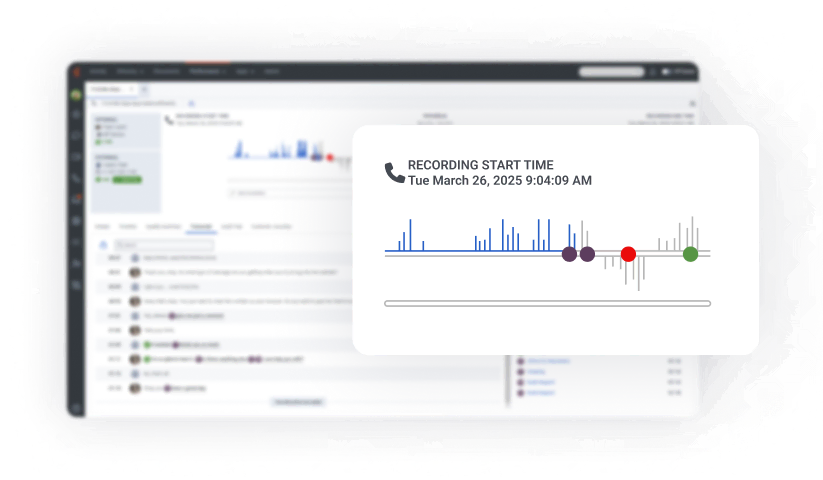
Speech and text analytics captures and scores every interaction across voice and digital channels automatically, giving your teams a deeper understanding of what’s driving customer behavior. Supervisors get full-coverage QA, leaders get operation-wide trend data and compliance teams get the audit trail they need — all from the same platform.
Agent Copilot
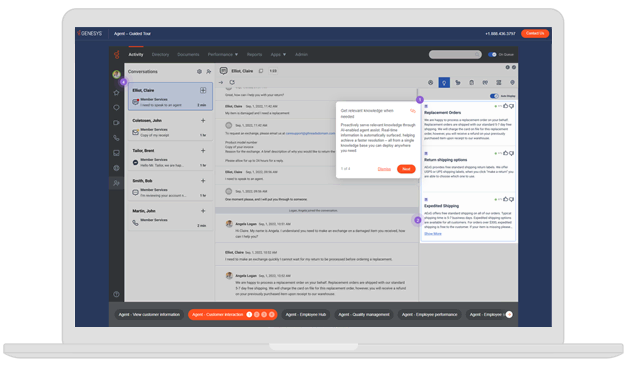
Agent Copilot surfaces real-time guidance during live interactions: relevant knowledge, next-best-action recommendations, automated call summaries and compliance cues as the conversation unfolds. It enables faster resolution, more consistent experiences and shorter agent ramp time.
Agentic AI
Agentic AI understands customer intent, takes action across systems and resolves interactions end-to-end. When escalation is needed, full conversational context transfers to the agent so customers never repeat themselves.
Workforce engagement management
Genesys Cloud Workforce Engagement Management connects conversational intelligence directly to performance development. The platform captures and scores every voice and digital interaction automatically. It gives your teams a deeper understanding of what drives customer behavior. Then, it feeds those interaction scores into coaching workflows automatically. This helps supervisors make informed decisions without manually reviewing calls. Forecasting, capacity planning, scheduling, quality management and performance all use the same native data model. This allows AI-powered workforce orchestration.

Nestlé
Running 40 contact centers across 188 countries, Nestlé needed conversational intelligence embedded in the same platform managing its workforce, not added on separately.
The challenge
Manual QA meant supervisors cherry-picked a fraction of calls for review, and forecasting and workforce planning relied on manual spreadsheets, leaving most interactions unanalyzed and coaching reactive rather than proactive.
The approach
Nestlé deployed Genesys Cloud CX with workforce engagement management, activating speech and text analytics for topic spotting and sentiment analysis across live interactions, and replacing manual QA sampling with automated quality management to evaluate a far broader selection of calls.
The impact
- 83% reduction in IT tickets
- 6x faster time to implementation
- 5 minutes to create schedules (vs. hours before)
- 66% contact center growth absorbed with the same IT headcount
Choosing the best tools for conversational intelligence in CX
Understanding the criteria is step one. Running a structured evaluation process turns that understanding into a defensible decision.
Define your primary use case
Before evaluating a single platform, write one sentence describing the operational problem you’re solving. Agent performance during live calls? Post-call compliance coverage? Unified insight across voice and digital? Your primary use case determines which tool type belongs on your shortlist.
Audit your existing integration requirements
List every system your CI platform needs to connect to: your CRM systems, workforce management tools, telephony infrastructure and QA workflows. Ask each vendor whether those connections are native or require third-party middleware. Integration overhead is where context gets lost and insights stop being actionable.
Ask the evaluation questions during demos
Don’t let vendors set the agenda. Come with specific questions tied to your use case. How does the platform handle multilingual interactions? What does automated QA scoring look like at 100% coverage? Push for live demonstrations against your actual operating conditions, not curated scenarios.
Evaluate against your compliance requirements
Before any platform reaches final consideration, run it through your legal, privacy and risk requirements. Confirm data residency options, retention policies, access controls and how AI scoring decisions are documented. In regulated industries, a platform that can’t satisfy your compliance team isn’t a platform you can deploy.
FAQs about best tools for conversational intelligence in CX
What is the difference between conversational intelligence and conversational AI?
Conversational AI is the technology that powers automated interactions: virtual agents, chatbots and voicebots that handle customer conversations without human involvement. Conversational intelligence analyzes those conversations, and human ones, to surface intent, sentiment, trends and compliance signals. Conversational AI handles interactions; conversational intelligence learns from them.
How do I evaluate conversational intelligence tools for an enterprise contact center?
Start with your primary use case, then assess accuracy across your languages and channels; real-time versus post-call capability; native integration with your existing platform; and compliance controls. Use the criteria in this guide to build your evaluation scorecard before you enter any vendor demo.
Can conversational intelligence tools analyze both voice calls and digital conversations?
It depends on the platform. Some tools focus exclusively on voice. Others cover digital channels including chat, email and messaging. Enterprise contact centers should look for unified analysis across every channel, so intelligence follows the customer journey rather than stopping at the channel boundary.
How long does it typically take to implement a conversational intelligence platform?
Standalone CI tools can go live in weeks. End-to-end AI CX suites take longer during initial setup, but deliver broader value from day one because intelligence is connected to routing, workforce management and compliance workflows from the start. The more native the integration, the shorter the time to measurable outcomes.
How is Genesys Cloud CX different from standalone conversational intelligence tools?
Standalone CI tools sit outside the contact center and generate reports. The Genesys Cloud platform builds conversational intelligence into the same architecture that manages routing, AI-native workforce orchestration, compliance and AI automation through a shared data model. Every insight connects directly to a workflow. That’s the difference between a platform that tells you what happened and one that acts on it.
The right conversational intelligence architecture for your contact center
The right conversational intelligence tool is the one whose architecture matches where your operation needs intelligence to live. That decision runs through your use case, your integration requirements and your compliance environment.
For enterprise contact centers in regulated industries, CI needs to be native to the platform managing every interaction, not bolted on top of it. The Genesys Cloud platform is built for that requirement; it’s the difference between a contact center that reacts to what has already happened and one that acts on what’s happening right now.
The vendor you choose is the one whose architecture matches your operation’s requirements. Use this guide as your evaluation framework. See what that means for the future of AI in customer experience.