Your Genesys Blog Subscription has been confirmed!
Please add genesys@email.genesys.com to your safe sender list to ensure you receive the weekly blog notifications.
Subscribe to our free newsletter and get blog updates in your inbox
Don't Show This Again.
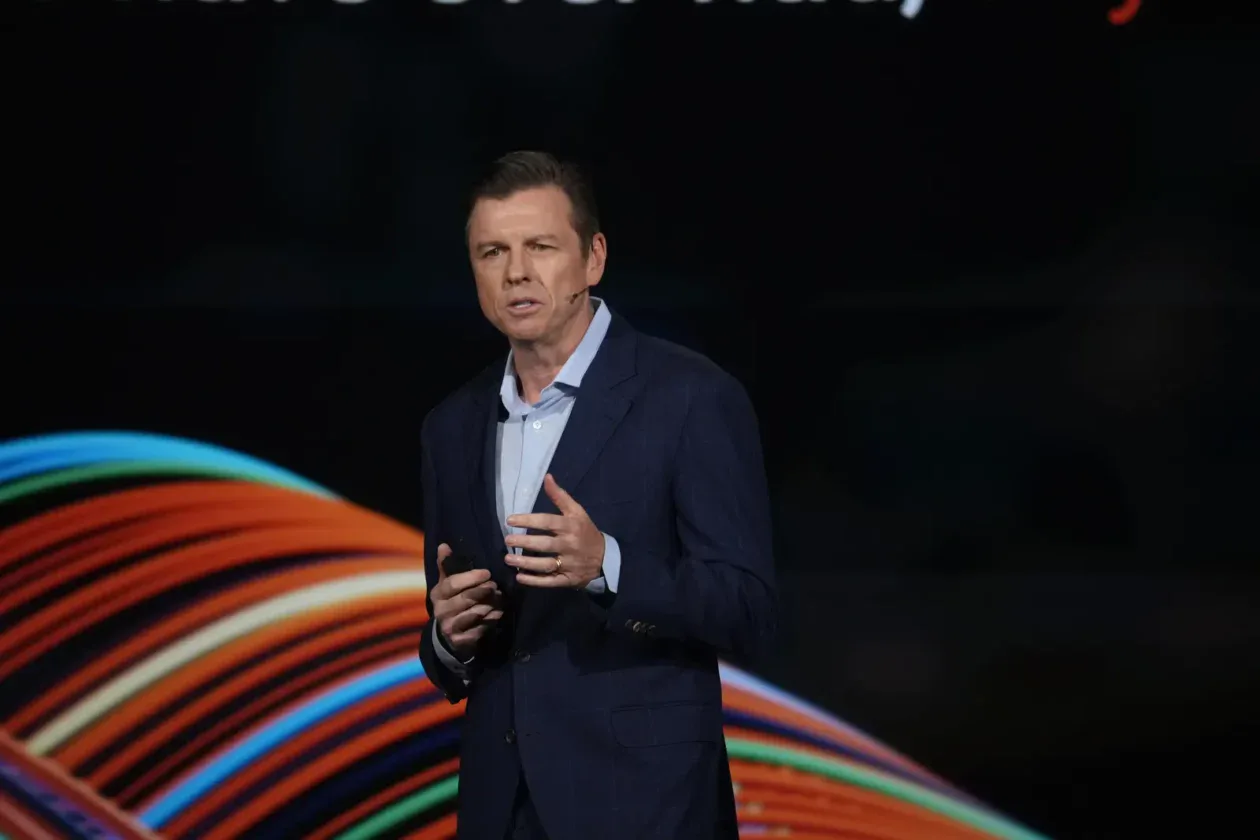
LAS VEGAS – “Most companies don’t have an AI problem. They have an operating model problem.” That’s the message Genesys Chairman and CEO Tony Bates delivered today to a packed audience at Xperience, the company’s annual customer conference. Then he laid out the roadmap to fix it.
When it comes to experience, your biggest competition is no longer in your industry alone. It’s every brand, everywhere, creating better experiences. The AI tools your customers use every day — from their desktop applications to the phones in their pockets — are capable, personal and indispensable. Those same customers have come to expect that their needs are met without any friction or stress. And that’s the kind of experience they now expect from your brand.
Closing that experience gap, Bates argued, is a business imperative, one that will decide who wins in the agentic era and who scrambles to catch up. This, Bates said, is the most consequential shift in customer experience in years, and it demands better experiences, better economics and an operating model built to keep pace.
Experience has become a competitive battleground — and a priority in every boardroom, Bates said, because the competitive bar keeps rising. The State of Customer Experience” report by Genesys found that 92% of consumers surveyed expect every company to match the best experience they’ve ever had, and 85% say poor service has made them spend less or walk away.
“Customers are asking a very reasonable question: if my personal AI can understand me so well, why can’t companies?”
Tony Bates
Chairman and CEO, Genesys
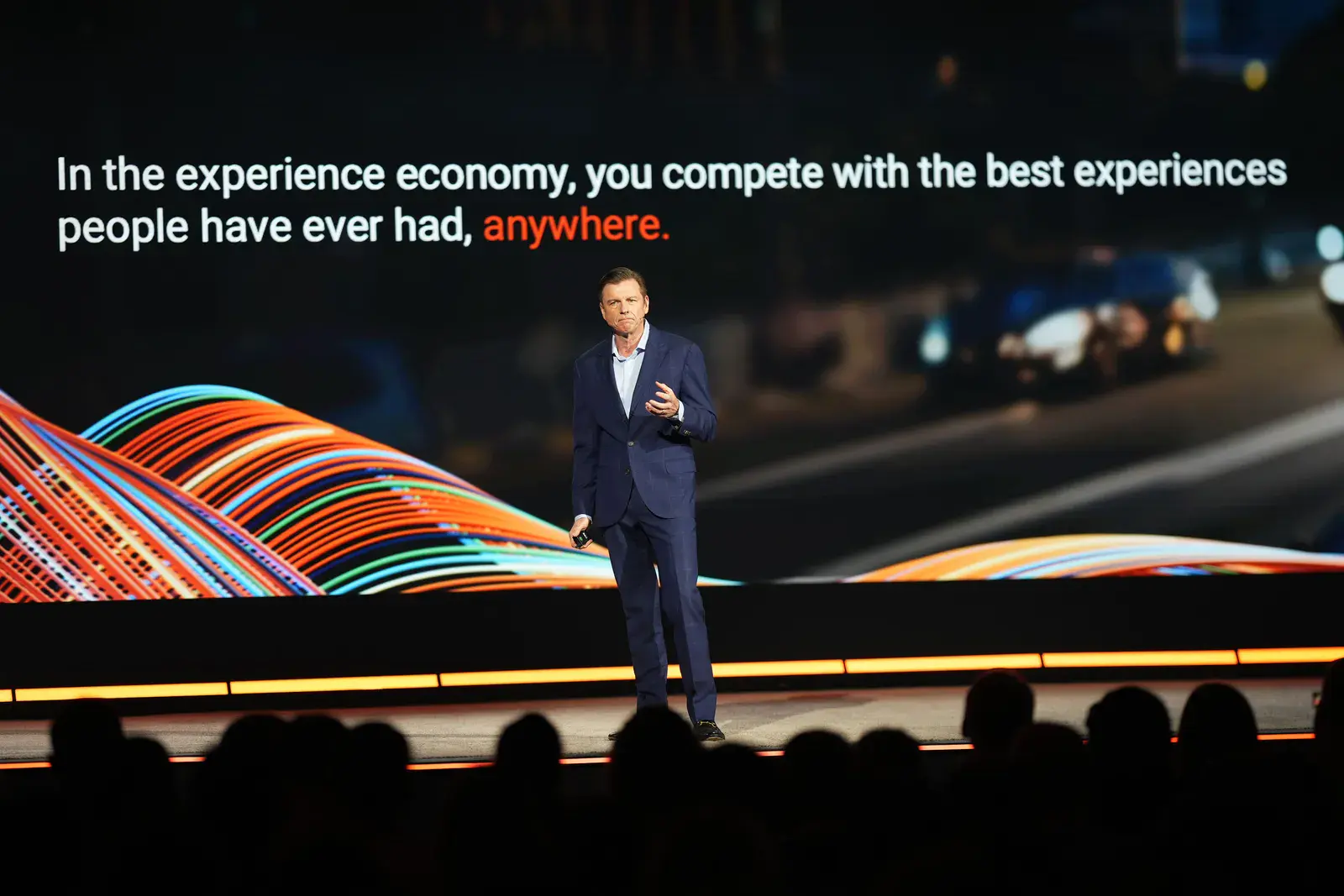
Businesses already have the context to close the gap (purchasing history, service requests, shopping behavior), but the data is often scattered across systems that don’t talk to each other. Bates called that fragmentation a competitive liability. The real question is how to align and activate that context to create the right experience in the right moment, at scale. That’s what agentic orchestration does.
Bates illustrated the idea with a musical demonstration, an orchestra full of musicians whose talent alone doesn’t create a great performance — it takes a conductor coordinating everything in real time.
Now imagine that every listener gets their own version tuned to what they want to hear — the same notes rebalanced in real time. Every listener becomes an audience of one. That’s real-time orchestration based on contextual intelligence.
Your business already has the musicians — people, AI agents, workflows, data and connected systems. It needs a conductor. Agentic orchestration perceives what’s happening, reasons through the best steps and brings everything together to deliver the right outcome for the customer and business in real time.
That leap in capability is a significant milestone. Bates noted that two years after introducing the Levels of Experience Orchestration maturity model, Genesys Cloud has reached Level 4 — full agentic orchestration where AI can perceive, reason, plan, act and optimize continuously. But it’s not the ultimate goal. “Level 4 is not the destination,” Bates said. “It’s just the starting point.”
Most enterprises already have plenty of AI — virtual agents, copilots, and knowledge tools bolted onto a process still designed for humans to execute. Bates was direct: more standalone AI won’t solve the problem. It creates more silos and friction. The fix isn’t more AI. It’s a different operating model.
Until now, the model has been human-centric, even when it’s AI-assisted. People interact with customers, determine their needs and execute the steps, with AI only improving efficiency.
In an agentic operating model, AI determines intent, decides what steps to take and completes many tasks autonomously, sometimes handling an entire interaction. Humans shift toward setting goals, defining boundaries, providing judgment and overseeing the system. They’re still in charge. But AI is an active partner in getting to the outcome. We are in the era of the human + AI workforce.
“I don’t believe most organizations have an AI problem. I think they have an operating model problem. You can’t unlock the full potential of agentic AI by bolting it onto an enterprise that was designed for human-only execution.”
Tony Bates
Chairman and CEO, Genesys
This is where the real transformation happens — and where the businesses that will lead the next decade pull away from the pack. Bates outlined five fundamental elements that are redefined in the shift to an agentic operating model, stressing that they’re interconnected, each one enhancing the others to evolve how organizations operate.
Today, most customer interactions are disconnected. The customer engages; the company responds; the interaction ends. In an agentic operating model, experiences reflect a holistic customer journey, connected across every touchpoint, carrying context, intent and memory forward, so every interaction makes the next one smarter. “The payoff,” Bates says, “isn’t just better service. It’s about creating stronger customer relationships, greater loyalty and more growth for your business.”
Today, most organizations see humans as the workforce and AI as a tool. That shows up in how they manage the two — with separate systems and processes. As AI takes on more responsibility, that separation stops making sense. In an agentic operating model, humans and AI together form a hybrid workforce, with major implications for how work is routed, forecasted and managed, as well as how success is measured.
Traditionally, contact centers manage performance with metrics like average handle time (AHT) and first-contact resolution (FCR). They’re good indicators of efficiency. But they don’t measure what matters most — the economics of the outcomes. In an agentic operating model, cost and revenue per outcome replace traditional efficiency metrics as the main measure of success, continuously optimizing instead of just tracking them.
Getting AI to take action isn’t the hard part. It’s giving AI the freedom to act while knowing it will stay within the boundaries you define. That’s why governance can’t be an afterthought. Permissions, policies and guardrails must be built into the orchestration platform from the beginning. Every action the AI takes must be observable and auditable. And, when necessary, it must escalate to a human instead of failing silently.
“Governance is not the brake on autonomy. It is the license to scale it.”
Tony Bates
Chairmain and CEO, Genesys
We tend to think of transformation as a project with a beginning and an end. But when customer expectations, workforce needs and AI capabilities are constantly evolving, transformation can’t stop. In an agentic operating model, it becomes an adaptive, continuous process. Both the AI and the organization keep learning, adapting and improving while the business runs.
An agentic operating model, Bates said, requires a platform built for it from the ground up, not a collection of point solutions. Genesys Cloud is that platform – an agentic orchestration platform for CX, built as a system of outcomes on contextual intelligence, with four components working together:
This is the infrastructure for an agentic operating model, and it powers these capabilities:
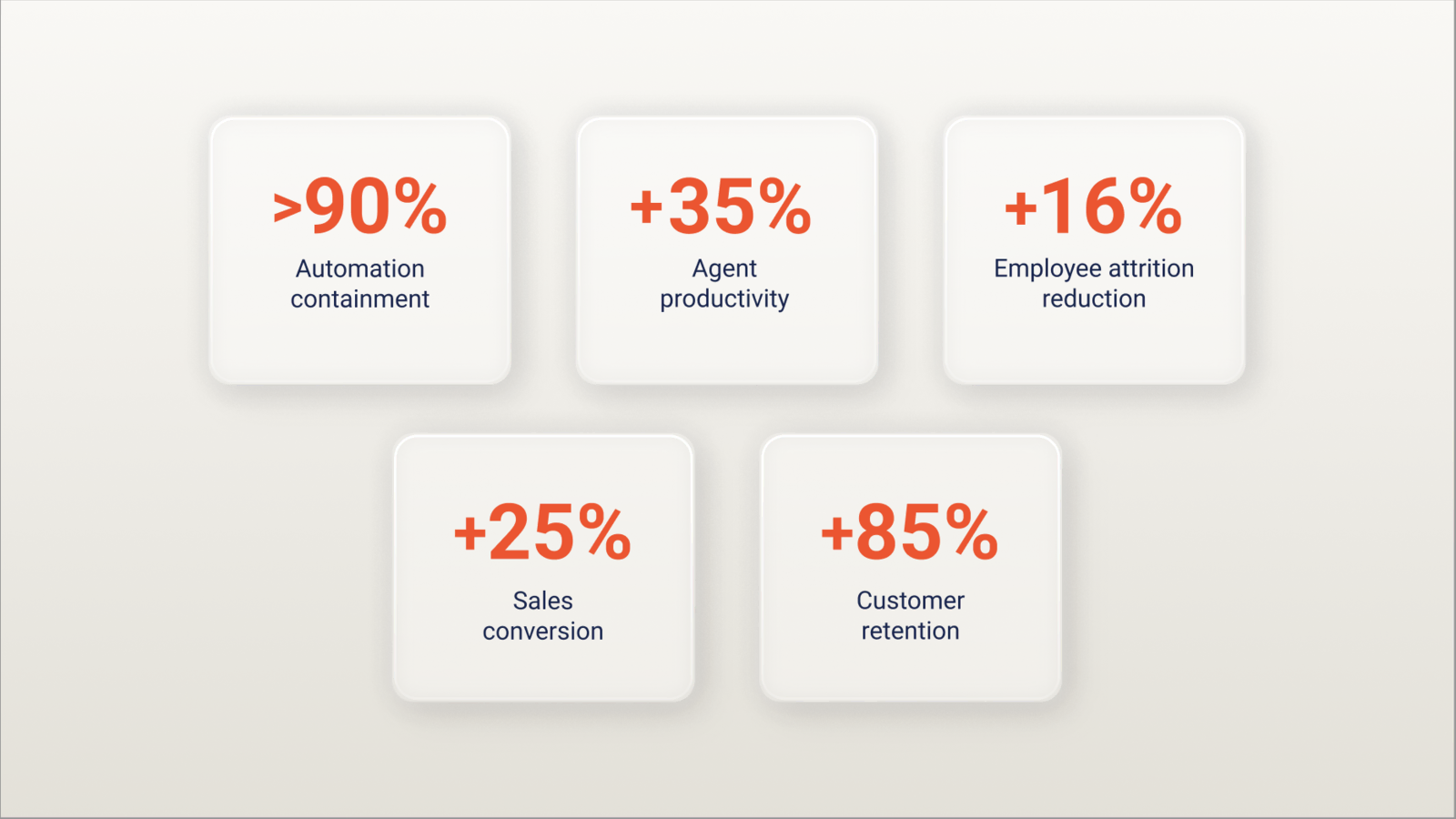
Bates noted that this combination of capabilities is already producing results for Genesys customers.
Bates closed with a simple piece of guidance for a complex transition: think big, start small, scale fast. No organization is going to make the shift to an agentic operating model overnight. There’s no need to. But there’s also no time to wait. Every day that your organization sits on the sidelines, competitors close the gap — and leave you behind.
Many companies are already on their way, using AI to assist employees, automate more interactions and run workflows. Those already on Genesys Cloud are positioned to take the next step. And the next. All the way to delivering seamless experiences with agentic orchestration.
“Every experience should make the next one smarter. Every investment should make the next one easier. Every improvement that you make should compound value for your business.”
Tony Bates
Chairman and CEO, Genesys
Wherever you are in your journey, it’s time to take the next step. Start with one experience and one outcome that matters and move at your own pace. Every step toward an agentic operating model is a step toward leading the next decade of customer experience.
Learn more about how to win in the agentic era.
Xperience 2026 continues this week in Las Vegas with sessions from Genesys teams, partners and customers who are already putting agentic orchestration into practice. On-demand keynote replays will be available at genesys.com/xperience following the event.
A2A interoperability is expected to become generally available in the fourth quarter of the company’s fiscal year (Nov. 1, 2026-Jan. 31-2027).
Forward-Looking Statements
Statements in this blog that are not historical or current facts are forward-looking statements that involve risks and uncertainties. Unless required by law, Genesys undertakes no obligation to update or revise any forward-looking statements to reflect circumstances or events after the date of this blog.
 Genesys
Genesys empowers organizations of all sizes to improve loyalty and business outcomes by creating the best experiences for their customers and employees. Through Genesys Cloud, the AI-Powered Experience Orchestration platform,...
Subscribe to our free newsletter and get blog updates in your inbox.