Your Genesys Blog Subscription has been confirmed!
Please add genesys@email.genesys.com to your safe sender list to ensure you receive the weekly blog notifications.
Subscribe to our free newsletter and get blog updates in your inbox
Don't Show This Again.

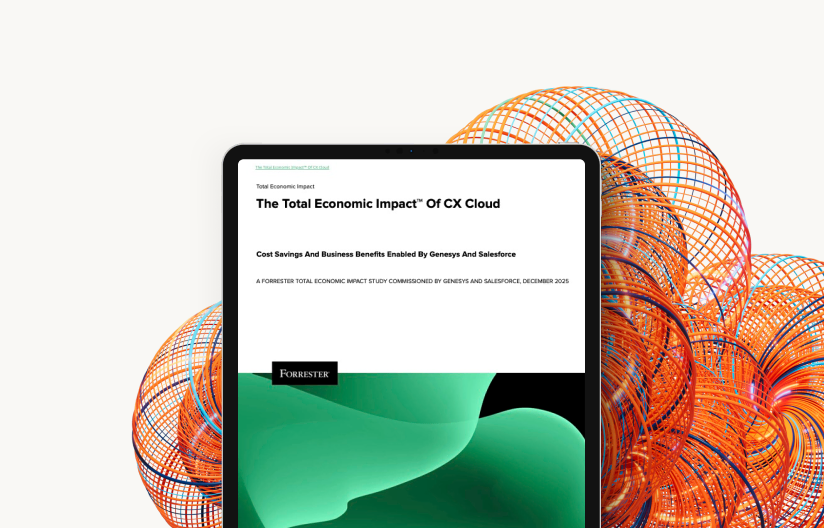
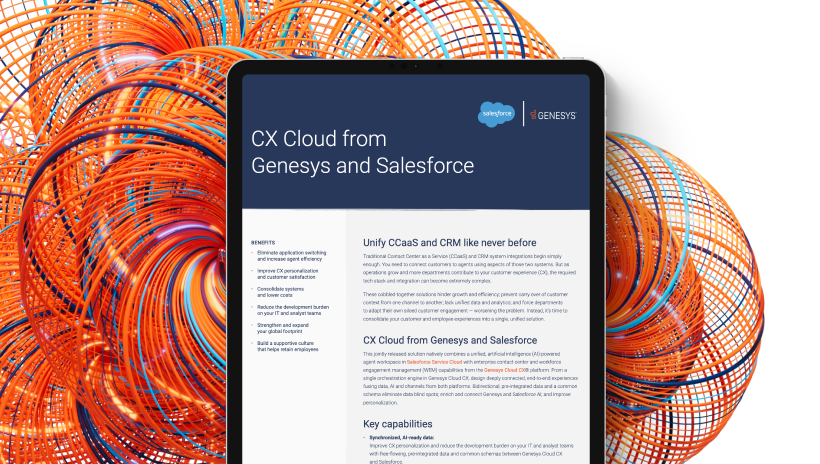
When customer experience and CRM platforms are deeply integrated, the value extends far beyond cost savings or incremental efficiency gains. According to the independent Forrester Consulting study, organizations using CX Cloud from Genesys and Salesforce achieved a 266% ROI; $10.8 million in net present value; and measurable improvements in agent productivity, customer satisfaction and operational agility.
Those results are notable on their own. But they also point to something bigger.
The findings reveal what it takes to prepare for the next era of customer engagement — an era defined by agentic AI; ecosystem-wide intelligence; and continuous orchestration across people, processes and AI agents.
This is no longer just a story about integration. It’s about readiness and future-proofing the enterprise for an AI-driven era of customer engagement.
Agentic AI represents a shift from systems that assist agents to systems that actively participate in customer engagement — anticipating needs, orchestrating workflows and taking action across channels in real time. But agentic capabilities don’t exist in isolation. They depend on a platform foundation that can unify data, context and intelligence across the entire customer journey.
According to “The Forrester Total Economic Impact™ of CX Cloud” study, many organizations are already realizing meaningful value by moving away from fragmented CX and CRM environments toward a single, integrated platform. That integration enables faster access to customer context, reduced handle times, higher self-service completion rates and better agent experiences — all prerequisites for agentic AI to function effectively at scale.
In other words, agentic readiness isn’t something organizations can bolt on later. It’s something they must build into the platform decisions they make today.
The Forrester Total Economic Impact™ of CX Cloud findings quantify the business impact of this approach. Over a three-year period, organizations using CX Cloud from Genesys and Salesforce experienced benefits driven by:
These gains weren’t achieved by adding complexity, they came from simplification — reducing system sprawl; eliminating swivel-chair workflows; and giving agents a unified environment where customer data, guidance and actions are available in context.
That simplification is what agentic ecosystems require. AI agents cannot reason, decide or act effectively when customer data and enterprise knowledge is fragmented or when workflows are stitched together across disconnected tools.
An important implication of The Forrester Total Economic Impact™ of CX Cloud study is that value creation increasingly happens at the ecosystem level. Human agents, AI agents, automation, analytics and AI models all need to operate from the same source of truth and within the same orchestration layer.
The Genesys and Salesforce partnership is designed around this reality. By bringing together engagement, data and intelligence on a shared platform, organizations are better positioned to:
This ecosystem-centric approach allows organizations to focus less on managing integrations and more on designing experiences that evolve over time.
There’s also a broader platform shift underway that reinforces why these decisions matter now. Salesforce has announced the retirement of Open CTI on February 28, 2028. That date represents a clear signal: Legacy integration approaches are giving way to more modern, deeply embedded architectures.
For many organizations, this transition will prompt an inevitable question: Should we simply replace what we have or should we use this moment to rethink our CX foundation?
The Forrester Total Economic Impact™ of CX Cloud findings suggest that customers who take the latter approach stand to gain more than just technical alignment. By moving toward an agentic-ready platform now, organizations can address upcoming architectural changes while also unlocking measurable economic and experience value today.
The real takeaway from The Forrester Total Economic Impact™ of CX Cloud from Genesys and Salesforce study isn’t just the ROI; it’s the validation that platform choices made today directly influence an organization’s ability to adopt agentic AI tomorrow.
Agentic CX doesn’t start with algorithms. It starts with integration, orchestration and a shared understanding of the customer across the enterprise.
Organizations that recognize this early and act on it won’t just be prepared for what’s next. They’ll be positioned to lead.
 Jack Nichols
With over 20 years of technical and leadership experience, Jack Nichols serves as a Vice President of Product Management leading the organizations strategy on developing our platform partner ecosystem. Prior...
Subscribe to our free newsletter and get blog updates in your inbox.
Related capabilities: