Your Genesys Blog Subscription has been confirmed!
Please add genesys@email.genesys.com to your safe sender list to ensure you receive the weekly blog notifications.
Subscribe to our free newsletter and get blog updates in your inbox
Don't Show This Again.

As utilities companies face mounting pressure to modernize, reduce carbon emissions and navigate a rapidly retiring workforce, the opportunity to evolve through artificial intelligence (AI) and cloud-based technologies has never been more urgent or more rewarding.
Global energy transition goals, regulatory shifts and rising consumer expectations are creating a pivotal moment in customer service for utilities. If these providers can’t rise to current challenges, they risk losing niche knowledge within their organization with the attrition of employees. They could also see increased operational and compliance costs as well as customer churn.
The IEA Net Zero Roadmap shows that if the globe is to reach net-zero CO2 emissions by 2050, a transformation of the energy systems and an expansion of the electricity sector is needed. Network digitalization is noted as a main consideration in achieving the transformation. According to the “Future of Energy” report from EY, 93% of power and utilities executives plan to invest in digital technologies over the next five years. And 40% of those surveyed believe that such technologies represent the single largest positive factor in shaping their organization over the next five years.
Consumers also expect more: Respondents to the EY global consumer energy survey say they want flexible, transparent, digitally enabled interactions — and real‑time visibility into energy use and options. This aligns with “The State of Customer Experience” report from Genesys, which shows that organizations surveyed are now competing with any given customer’s best-ever experience.
Consider this: What if your organization could reduce the time to make IVR changes from hours — or even days — to just minutes? What if you could automate dozens of call flows, simplify your tech stack to cut down technical debt, and align these innovations with your carbon neutrality goals? That’s what Eesti Energia accomplished by moving to the Genesys Cloud™ platform.
The energy company created a greener service model with the move from on-premises to cloud, reducing their technology stack and enabling remote work. It also saw increased agent engagement and motivation — a critical benefit as employee retention continues to be an industry-wide challenge.
“In consolidating all our contact centers on one Genesys platform, we created an environmentally friendly resource that countries could share to improve service and motivate advisors,” said Kaido Kabral, Customer Service Solution Expert at Eesti Energia. “Now, many are hybrid workers — lowering carbon dioxide through reduced power consumption and commuting to work. And we’ve retired at least five legacy systems, with more to follow.”
In addition to the benefits Eesti realized, CX leaders can also leverage AI-powered self-service capabilities to evolve from a traditional IVR to large language model (LLM)-powered virtual agents, allowing them to future-proof their customer experience.
Companies that leverage these capabilities can also reduce the number of interactions flowing through to live agents. This allows CX teams to focus on the types of intents that require a human touch or yield the highest value, for example, providing an automated status update on a routine maintenance-related outage for a caller in an impacted postal code. And this all happens while sending an existing customer with multiple properties who’s inquiring about new services to an agent most likely to convert the inquiry into a sale.
As the energy and utilities industry faces a wave of retirements across critical roles, including field experts and system operators, there’s a tangible risk of losing decades of institutional knowledge right when energy transition work is at its peak. According to McKinsey, the surge in demand for new energy infrastructure and clean‑tech projects is coinciding with the planned retirement of many experienced employees. In the US alone, some 400,000 energy sector workers are expected to retire in the next 10 years, creating a talent gap in specialized roles.
Utilities must act now to capture and transfer critical knowledge while modernizing systems to attract next-generation talent, highlights Deloitte in its report on the energy workforce transformation. The report states that utilities with a proactive plan to address skills gaps will be best equipped to manage the transition. The following skills are just some of those being lost:
This loss of skills increases the risk of slower outage resolution, safety risks, higher maintenance costs, less efficient operations, regulatory and compliance penalties, and negative environment impacts — just to name a few. Capturing knowledge in a knowledge base and leveraging AI to surface the right details and next best actions to an agent looking to troubleshoot or schedule field service are two ways to address these challenges.
Other innovative tools are being used to help address these issues. For example, one shared services organization used video-enabled virtual support from a Genesys AppFoundry® Marketplace partner to achieve a 12% increase in fix rates and saved over $1 million US in site visits. By empowering in-field teams with remote expertise, organizations like these can not only improve service delivery but also reduce unnecessary truck rolls and help customers in the moment.
Utilities companies also face many technical challenges, such as growth in the use of distributed energy resources (DER), including solar panels, battery storage, small wind turbines and backup generators; in addition to renewable intermittency; electrification; and load unpredictability. In fact, Deloitte and Utilita report that DER growth could increase to 1,500 GW over the next decade in the US alone. As a result, companies are leveraging AI systems for grid planning, forecasting, state estimation and digital twins. It’s also being used to improve resilience.
However, technology knowledge gaps exist within utilities for leveraging advanced AI tools. To address some of these skill gaps and improve up-skilling of early career personnel, the companies should get creative. Initiating cross‑training, digital twins, pairing seasoned grid engineers with data scientists, creating and maintaining internal documentation, and implementing scenario‑based drills are a few first steps.
Deloitte reports that digital fluency skills are in high-demand and utilities are competing with technology organizations to attract and retain talent. Imagine capturing some of the knowledge and processes your most skilled engineers have today and being able to provide troubleshooting guides for agents to use in real time. Reduce employee effort, where possible, and focus on hiring for necessary skills like data analytics, AI and machine learning, and remote/virtual operations (diagnostics and automation) to enable the transformation to renewable energy and a modernized infrastructure.
OVO Energy has seen strong results from integrating bots into its WhatsApp, web messenger and IVR experiences. “Some bots have complete journeys, like submitting a meter reading,” Lucas Woodward, Senior Software Engineer, at OVO Energy, a leading UK energy provider. The use of these bots in regression testing and automation has sped up deployment and iteration cycles, noted Woodward.
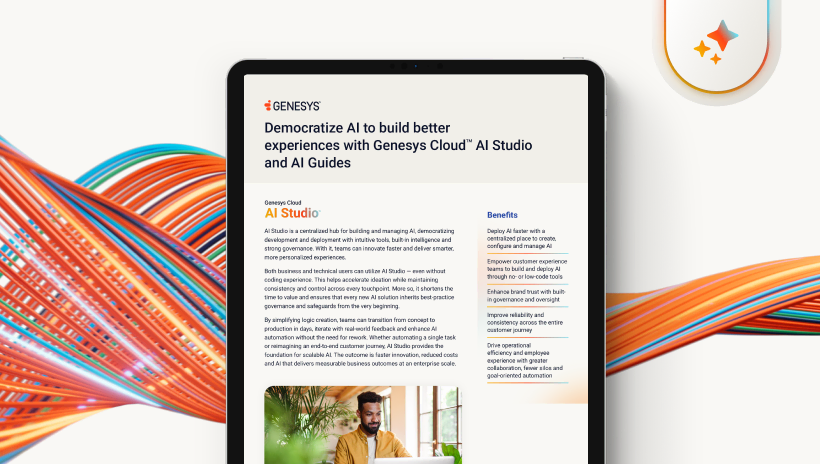
As customer expectations grow and staffing remains tight, taking this self-service from a traditional bot to virtual agents can help utility companies leverage AI-driven assistants. These virtual agents deliver a conversational and personalized self-service experience across both voice and digital channels, freeing up human agents for high-value, complex interactions that require empathy and expertise. This allows teams to scale agents and offers business teams the ability to design these virtual agents using natural language without the need for complex code with Genesys Cloud AI Guides.
This reflects a broader trend in utilities — where bots and virtual agents are no longer just a novelty, but a key part of customer engagement and operational agility.
Utilities can also benefit from a customer experience platform with built-in proactive engagement capabilities that integrate with third-party tools, such as CRM systems, workflow tools and smart meters. For example, a spike in a customer’s energy use could trigger a timely outbound alert, preventing billing disputes before they escalate. This type of intelligent orchestration is critical in a digital-first, data-driven utility landscape.
These proactive messages can expand — sending out leak alerts or outage preparation recommendations. Agentic AI takes this a step further; in addition to being able to reason and plan, agentic AI can act within guardrails on behalf of the customer or front/back-office teams.
Finally, AI-powered workforce planning tools allow for real-time adaptation to unpredictable events, such as those due to weather, outages or market demand. This is critical for managing climate-related volatility like wildfires, extreme temperatures and flooding. With a resilient, scalable, cloud-native platform and real-time planning tools, utility providers can ensure service continuity while optimizing for efficiency and sustainability.
In an era when doing more with less is the new normal, Genesys helps energy and utilities providers thrive — supporting decarbonization and sustainability goals and increasing operational agility. This allows energy and utilities companies to build customer and employee loyalty for continued growth, enable regulatory compliance, and preserve mission-critical expertise for the future.
The “2026 Buyer’s Guide for AI and CX” from Genesys can help you choose the technologies to position you for the future — from artificial intelligence (AI) and automation to cloud platforms, journey management and responsible innovation. Read the guide now to learn what defines future-ready CX platforms and see how leaders are uniting data, systems and people to deliver personalized experiences at scale.
 Lauren Miller
Lauren Miller, Business Value Specialist at Genesys, collaborates with strategic leaders to curate narratives of possibility and orchestrate meaningful experiences for customers and employees. Leveraging a decade of experience, she...
Subscribe to our free newsletter and get blog updates in your inbox.
Related capabilities: