




How a unified CX platform powers modern experiences
Customer experience (CX) no longer happens in one place. Customers move fluidly between voice, live chats, digital messaging and self-service. They expect every interaction will be not only efficient and effective, but also connected, personal and effortless.
Unfortunately, many organizations still rely on fragmented tools to manage customer service and engagement. Each system solves a single problem, but together they create complexity.
Agents lack context. Data stays siloed. Customers repeat themselves. Teams spend more time managing technology than improving experiences.
When systems fall short, the experience breaks, and so does customer trust. A platform-based approach transforms those dynamics.
By unifying customer engagement, internal collaboration, data and AI on a single foundation, organizations can deliver consistent, connected experiences at scale. Contact Center as a Service (CCaaS) plays a vital role in this shift. It can anchor unified solutions that support customer and employee experiences across the enterprise.
Understanding unified solutions in customer experience
Unified solutions centralize customer engagement, internal collaboration, data and intelligence into a single operating model. Rather than treating interactions as isolated events, they connect every touchpoint across the journey.
This approach helps organizations create a unified customer profile. It can align teams around shared context and deliver personal experiences that reflect customer preferences and history.
Why fragmented tools limit customer and employee experiences
Disconnected tools create friction at every stage of the customer journey. Customer information lives in multiple systems and interaction history is incomplete. Disjointed systems lead to disjointed interactions, which instantly frustrate customers and generate negative experiences.
Fragmentation also affects employees. Team members waste time searching for context instead of solving problems. Costs rise as systems overlap and processes multiply.
These challenges limit an organization’s ability to create a unified customer experience and make informed decisions based on real-time insights.
The shift from point solutions to a unified customer experience platform
Point solutions made sense when each tool addressed specific needs in unconnected systems. However, most organizations today deal with a tangled environment of legacy and modern systems, which undermines their ability to innovate, adapt to business changes, maintain continuity and preserve data security.
Cloud-based platforms simplify this landscape. They consolidate capabilities into a shared architecture that scales easily. Instead of a patchwork of stitched-together tools, teams operate from a single platform designed for efficiency, insights and agility.
How CCaaS anchors a unified solution strategy
CCaaS provides the operational core for modern customer service. It combines voice and digital channels, manages routing and orchestration, and connects agents with the tools they need in the moment.
As part of a unified platform, CCaaS does more than handle interactions. It connects customer engagement with workforce engagement management (WEM), analytics, AI and experience orchestration. This foundation supports consistent service and enables personalization at scale.
Unified solutions and CCaaS
Contact Center as a Service is a cloud-based model that delivers core contact center capabilities without on-premises infrastructure. It supports voice, digital channels, routing, reporting and workforce management through a centralized platform.
CCaaS enables organizations to scale quickly, adapt to demand and introduce new capabilities without disruption. It also creates a consistent foundation for customer support across regions and teams.
How unified solutions connect CX, EX, data and AI
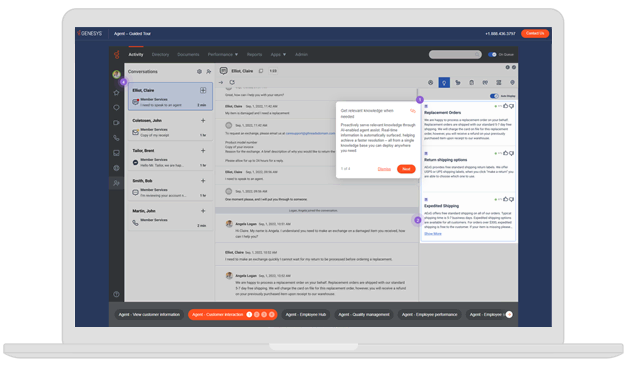
Unified platforms connect customer and employee experience through shared data and workflows. Agents see complete customer information in real time. AI supports decisions when customers interact with your brand, not after.
Moving beyond standalone communication tools
Standalone tools focus on communication, not experiences. They move messages but lack context. They support channels, not journeys.
Unified solutions focus on outcomes. They help organizations increase customer engagement, strengthen customer relationships and support loyal customers through consistent, connected interactions.
Key challenges with disconnected CX technologies
Disconnected technologies create blind spots. This undermines data quality, which makes reporting unreliable.
Teams struggle to deliver personalized service, the organization struggles to scale its CX efforts. And that creates pain points for customers and agents.
How unified solutions support end-to-end experiences
Connecting customer engagement and internal collaboration
Customer engagement doesn’t stop at the contact center. Unified platforms connect frontline teams with back-office experts, supervisors and digital tools.
This reduces handoffs and shortens resolution times. It can also help to improve first-contact resolution (FCR). Employees collaborate seamlessly and customers benefit from a consistent experience.
Role of voice and digital channels in unified solutions
Digital channels support convenience and speed, while voice remains critical for complex issues. Unified platforms treat both as equal parts of the experience.
By orchestrating voice and digital interactions together, organizations maintain a consistent brand presence, meeting customers where they prefer to engage.
How unified platforms reduce complexity
A unified CX platform replaces overlapping systems with shared services. Teams manage fewer integrations, updates happen automatically and governance improves. Organizations can free up resources to focus on improving experiences rather than maintaining infrastructure.
Connecting data, channels and AI on top of a secure and compliant foundation allows enterprises to orchestrate smarter, more efficient outcomes. They can achieve faster time to value, reduce complexity and, ultimately, build customer loyalty.
Key benefits of unified solutions built on CCaaS
Consistent experiences across customer and employee touchpoints
Unified solutions help ensure that every interaction reflects the same customer information, business rules and brand standards. Consistency across channels and journeys builds customer trust.
Employees also benefit from consistent experiences, such as clear workflows and reliable tools. And happier agents can, in turn, deliver positive customer experiences.
Improved agility and faster innovation
A cloud-based unified solution enables organizations to deploy new capabilities without disruption. Teams can experiment, test and adapt quickly.
This agility supports innovation, proactive engagement and personalization, all of which can help organizations keep pace with customer expectations.
With the subscription-based model of a unified CCaaS platform, enterprises can reduce total cost of ownership and minimize downtime. Continuous updates and automation give businesses easy access to new and updated capabilities.
Cost efficiency through platform consolidation
Consolidating the CX tech stack into a single offering helps reduce costs for software licensing, integration and maintenance. Shared infrastructure also improves utilization.
A bolted-together CX ecosystem is more time-consuming to implement and manage. It also requires more resources.
Supporting both growing and global organizations
A single, cloud-native CCaaS platform is built to provide organizations with the flexibility needed to deal with the complexities of modern business. These include remote and hybrid work, fragmented channels, and evolving customer expectations.
Teams can roll out new features without downtime, scale resources instantly during demand spikes and quickly integrate with other systems. They can also add new channels and rapidly update capabilities.
Unified solutions scale easily across regions, languages and teams. They support growth without adding complexity. Global organizations maintain consistent service while adapting to local requirements.
Evaluating unified solutions
Native CCaaS capabilities as the foundation
A strong CCaaS core is an essential foundation for successful CX. That means a unified platform with a set of native capabilities, built on a single codebase, that seamlessly work together.
Native CCaaS capabilities also reduce reliance on third-party integrations and improve performance. The result is a CCaaS platform that is inherently designed to be secure, reliable and agile.
Integration with CRM, HR and business applications
Unified solutions must integrate with existing applications, especially systems such as CRM and workforce engagement management (WEM). These integrations enrich the customer profile, support informed decisions and enhance overall customer satisfaction.
Integrating third-party applications also helps speed time to market. And it can improve efficiency, maximizing the organization’s investments.
Integrating CCaaS with WEM helps streamline capabilities. It also connects schedules, interactions and performance information such as average handle times and transfer ratio.
Built-in AI, analytics and experience orchestration
Today’s experience-driven economy requires data contextualization, optimization and personalization. AI is vital to achieve this, but it won’t work at scale based on a patchwork of point solutions.
Organizations need a unified AI platform built for CX, not just a contact center platform with bolted-on AI functionality.
A unified solution harnesses the full potential of AI with real-time analytics, predictive engagement and experience orchestration:
- AI collects and reviews vast amounts of customer behavioral data and other information.
- Predictive analytics identifies trends, such as the likelihood of a customer’s next action. It then triggers the next-best action in real time.
- Agents anticipate needs, respond proactively and resolve issues more quickly.
With an AI platform built for CX, organizations can deliver orchestrated, end-to-end experiences at scale.
Scalability, extensibility and open APIs
Scalable platforms grow with your business. Extensible architectures support integration and customization without fragmentation. A CCaaS platform based on open APIs enables flexibility without compromising stability, and innovation while maintaining governance.
Open APIs provide cost-effective and efficient extensibility to complementary functionalities from native components and third-party solutions. Look for APIs that support voice systems, billing systems and GDPR compliance.
Unified solutions providers and platform considerations
A unified platform-based approach to customer experiences connects customer interactions, streamlines operations and elevates agent performance. This all combines to deliver seamless, scalable and personalized experiences across every channel.
Point solutions create short-term fixes and solve isolated problems. An integrated platform provides comprehensive functionality that supports an organization’s long-term strategy. This allows them to provide proactive service, real-time decision-making and journey orchestration.
Scalability and flexibility considerations
A cloud-native platform is purpose-built to be more interoperable with other systems, more flexible, and easily integrate with various systems and services. Legacy systems and point solutions limit access to data, slowing decision-making and improvements to customer experiences.
Evaluate how platforms scale. And flexibility matters as customer expectations evolve. Choose solutions that support change without the need to re-architecture.
Reliability, governance and operational ownership
Regulatory compliance is reshaping how CX solutions are built and deployed, particularly in the age of AI. Meeting data protection and privacy obligations in multiple geographies can cause friction that slows down and complicates CX efforts.
Centralized governance simplifies ownership and accountability. Look for vendors that offer strong governance and data privacy, particularly with increased use of AI models and agentic AI.
Reliability underpins trust. Evaluate providers on their ability to meet SLA commitments, maintain global redundancy, and offer public visibility into system status and incident history.
Ecosystem, marketplace and partner support
The future of CX isn’t siloed. It’s orchestrated.
Delivering connected, end-to-end experiences involves the entire enterprise, not siloed tools and fragmented processes. A unified CX platform with native functionalities enables seamless orchestration across every team, touchpoint and system.
A partner ecosystem can help extend and strengthen the value of a unified CX platform. Marketplaces provide prebuilt integrations to help streamline complex workflows, connect data across departments or empower teams with intelligent tools.
The role of CCaaS as the backbone of unified experiences
Customers expect connected experiences. Employees need clarity and context. Unified solutions deliver both.
CCaaS anchors unified CX platforms, connecting channels, data and intelligence in real time. This foundation enables organizations to create consistent, personalized experiences at scale.
Questions
What are unified solutions in customer experience?
Unified solutions connect customer engagement, data, AI and internal collaboration into a single platform that supports end-to-end journeys.
How does CCaaS fit into a unified solution strategy?
CCaaS provides the operational core that supports omnichannel engagement, routing and workforce management.
What is the difference between unified solutions and unified communications?
Unified communications focus on messaging and collaboration. Unified solutions focus on orchestrating experiences across journeys.
What are the benefits of moving from point solutions to a unified platform?
Benefits include reduced complexity, better data quality, faster innovation and more consistent experiences.
How do unified solutions improve both CX and EX?
They give agents complete context, simplify workflows and support real-time decision-making.