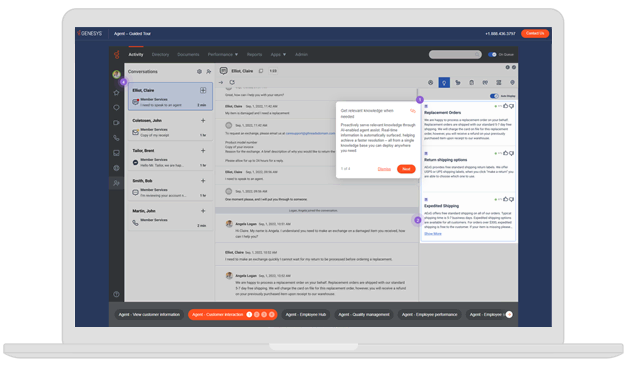
First response time (FRT) — also called time to first response — is the amount of time it takes for an organization to reply to a customer inquiry after it’s received. It’s a key performance metric that measures service efficiency and customer satisfaction across digital, voice and social channels. A shorter first response time signals faster, more attentive customer service.
“Customers’ initial contact with a call center has a strong influence on their perceptions. In your customers’ eyes, choosing to contact your business is an important investment of their time. And how you engage with them shows whether you value their business.”
Ian Felder, Director, Product Marketing, Genesys
First response time use cases for enterprise
Measuring customer service efficiency
Enterprises use first response time as a benchmark for customer support performance. Tracking this metric across channels — including chat, email and social — helps organizations identify bottlenecks in workflows. With real-time analytics and dashboards built into cloud contact center platforms, leaders can monitor agent responsiveness and continuously optimize service delivery.
Reducing first response wait time with automation
Customers expect fast acknowledgment when they reach out. Enterprises use AI-powered customer experience (CX) and chat automation to minimize first response wait time by instantly recognizing and routing incoming requests. Intelligent virtual agents (IVAs) can greet customers, collect context and provide basic answers while escalating complex issues to live agents — ensuring no customer waits unattended.
Improving first response time with intelligent routing
Getting the right issue to the right person saves valuable time. Through predictive routing and customer journey orchestration, enterprises can automatically direct inquiries to the most qualified agent or department. This reduces transfer loops, accelerates resolutions and improves the customer’s overall experience from the very first interaction.
Optimizing workforce management to prevent delays
Staffing gaps or poor scheduling can negatively affect average first response time. With workforce engagement management tools, organizations can forecast demand, schedule more effectively and ensure agent coverage during peak periods. The result is faster replies, higher productivity and more consistent service levels across regions and time zones.
Turning first response into first resolution
Enterprises go beyond measuring FRT by also tracking first response resolution — ensuring the initial contact not only happens quickly but resolves the issue completely. Integrating AI insights, sentiment analysis and real-time guidance helps agents deliver accurate, empathetic answers that reduce repeat contacts and build long-term trust.
Improve your first response time with Genesys Cloud
Delivering fast, personalized responses requires more than speed — it takes orchestration and intelligence. The Genesys Cloud CX® offering combines AI, automation and workforce tools to help enterprises reduce first response time, improve efficiency and deliver exceptional experiences that make every interaction count.
Explore Genesys Cloud CX