




Why machine learning matters for today’s CX leaders
Customers demand faster, smarter and more personalized interactions. And machine learning can help customer experience (CX) teams turn data into efficient, empathetic experiences, at scale and in real time. In this article, we’ll explore what machine learning is (and isn’t), look at how it differs from deep learning, and outline where it can drive real CX value.
The fundamentals of machine learning
To effectively apply machine learning in customer experience, CX teams need a clear understanding of exactly what it is. Machine learning (ML) is the aspect of artificial intelligence (AI) that enables systems to identify patterns in data and improve over time without being explicitly programmed.
This is what powers many of the tools transforming modern CX, from virtual agents to predictive engagement, as well as popular generative AI tools like ChatGPT and other Large Language Models (LLMs). For CX professionals, learning the basics isn’t about becoming a data scientist. It’s about knowing how machine learning works, what it’s capable of and where it fits into your customer journey strategy.
What is machine learning?
Machine learning takes the broad concept of AI and makes it practical. It enables systems to recognize patterns, make predictions and improve with experience by learning from data rather than following fixed rules. For CX teams, this means the ability to automate decisions, personalize engagement and respond to customer behavior in real time. ML doesn’t just replicate human actions; it adapts to changing inputs, making it a powerful tool for modern customer experience strategies.
Machine learning is a subset of AI that enables systems to learn from data. Deep learning takes ML even further by using layered neural networks to solve complex tasks like speech recognition or image analysis with minimal human input.
Why machine learning matters in customer experience
Customer expectations are higher than ever, and machine learning is helping businesses meet them. ML enables real-time adaptation across every touchpoint, whether it’s routing, personalization or proactive service. By continuously learning from interaction data, ML tools can predict needs, reduce friction and deepen engagement.
For CX teams, this means more than automation; it’s about understanding customers on an individualized level and responding with precision. As data volumes grow, traditional rules-based systems can fall short. ML steps in to uncover patterns, segment audiences and recommend next-best actions dynamically. The result: faster, smarter more connected experiences that evolve with your customers.
Transforming customer journeys with data
Machine learning turns raw customer data into actionable insight — predicting intent, optimizing channel handoffs and adjusting journeys in real time to help reduce effort and improve outcomes.
Machine learning in CX environments
Machine learning doesn’t function in isolation; it operates within a structured pipeline tailored to real-world applications. For CX teams, that means using customer interaction data to continuously refine models that enhance experience delivery. From data collection to model deployment, each step shapes how AI adds value to the customer journey.
Core steps in a machine learning pipeline
The ML pipeline in CX includes data ingestion, cleaning, feature engineering, model training and deployment. This structured flow enables consistent iteration and helps CX teams move from raw data to usable insights.
Training, testing and model selection
Models are typically trained on historical data, tested for accuracy and selected based on business goals. For CX, this step ensures predictions are useful, relevant and ready for production environments.
AI vs. machine learning vs. deep learning in CX
Understanding the differences between AI, machine learning and deep learning helps CX teams choose the right tools for the job. While often used interchangeably, each serves distinct functions. AI is the umbrella concept; machine learning brings adaptability and learning from data; and deep learning handles more complex, unstructured tasks.
To go a bit deeper, AI is the broad category of technologies that enable systems to reason, make decisions and support customer interactions. Machine learning refers to statistical models that learn patterns from historical customer experience data and continuously improve predictions. Deep learning, on the other hand, is a specialized branch of machine learning that uses neural networks to understand complex, unstructured CX signals such as audio, text and images.
Practical examples of each in customer experience
AI supports real-time decisioning, such as intent-based routing that directs customers to the right channel or agent based on their needs.
Machine learning predicts outcomes like churn risk by analyzing patterns in historical behavior, such as support frequency or product usage.
Deep learning handles complex, unstructured tasks, for example, detecting customer emotion in voice calls or automatically summarizing long chat transcripts to streamline post-interaction analysis.
Components of AI-driven CX platforms
AI-driven CX platforms bring together multiple technologies to elevate customer engagement and operational efficiency. From interpreting intent to anticipating behavior, each component contributes to a more responsive and personalized experience. These tools help brands act in real time, resolve issues faster and build stronger relationships.
Natural language processing for customer interactions
Natural language processing (NLP) enables systems to understand, interpret and respond to human language across channels. It powers capabilities like voice-activated IVRs and automatic transcription. An even more specialized subset of NLP is called natural language understanding (NLU), which focuses on sentiment analysis and intent recognition — in other words, deciphering the meaning behind a customer’s words.
Predictive analytics for anticipating customer needs
By analyzing historical and real-time data, predictive models forecast customer behavior, such as churn risk or product interest. This allows CX teams to proactively tailor offers, outreach or support actions.
Chatbots and virtual assistants
Conversational AI handles routine inquiries with speed and accuracy. These tools can deflect volume from agents, provide 24/7 support and seamlessly escalate to human agents for more complex issues or sensitive interactions. Chatbots and virtual assistants still require some human intervention.
Personalization through machine learning
Modern CX is built on relevance. ML enables systems to learn from customer behavior and context to deliver the right message, offer or action — at the right time. As preferences shift and journeys evolve, machine learning adapts in real time, allowing businesses to meet each customer with meaningful, personalized experiences at scale.
Adaptive recommendation engines
ML-driven engines can analyze browsing, purchase and interaction history to suggest relevant products or next steps for agents to take. These systems continuously learn from feedback to improve over time, boosting engagement and conversion.
Dynamic content delivery in customer journeys
By using ML, content and messaging can be tailored on the fly based on behavioral signals, channel preference, or customer profile — creating seamless personalized journeys across touchpoints.
Personalizing support at scale
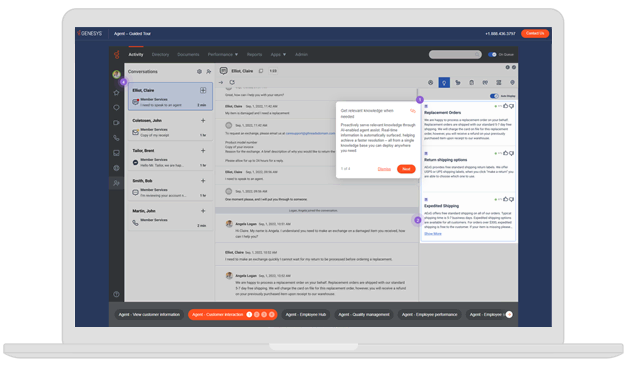
By segmenting users and anticipating intent, ML can also help route inquiries, surface relevant knowledge and customize agent scripts so every support interaction feels tailored, even at enterprise scale.
Measuring the effectiveness of machine learning in CX
To prove the value of machine learning in customer experience, you need more than anecdotal success. Quantifiable metrics and data-backed insights help validate impact, identify areas for optimization and guide future investments. A robust measurement strategy ensures your ML initiatives aren’t just innovative — they’re proving their ROI.
KPIs for CX innovation
Track metrics like resolution time, CSAT, NPS and self-service adoption. Improvements in these KPIs signal how ML is enhancing efficiency and satisfaction.
Analyzing customer feedback and sentiment
Use ML to mine support interactions and surveys for sentiment and trends. Understanding emotional tone reveals what’s working — and what isn’t.
Continuous improvement through data insights
ML thrives on iteration. Feed performance data back into the system to retrain models, fine-tune workflows and unlock new opportunities for value creation.
Common challenges when deploying machine learning
While ML opens new frontiers in CX, it also introduces real-world challenges. From data privacy and bias to integration and change management, CX leaders must address key risks thoughtfully. Success isn’t based just on what ML can do; it’s also about how ethically, responsibly, sustainably and effectively it’s applied. Here are some key considerations to bear in mind:
Data privacy and ethical considerations
Customer trust depends on responsible data use. ML systems must follow data minimization practices, safeguard sensitive information and comply with evolving regulations.
Ensuring model fairness and avoiding bias
Bias can creep in through skewed ML training data or incomplete coverage. Responsible ML requires diverse datasets, equity benchmarks and human oversight.
Overcoming technical and organizational barriers
Deploying ML often demands infrastructure upgrades, cross-team collaboration and change management. Early alignment and clear business goals help to pave the way toward success.
Unlocking enhanced customer experiences with machine learning
After exploring its foundations and applications, it’s clear that machine learning is helping to reshape the CX landscape, enabling smarter, faster and more human-centered experiences. For organizations ready to evolve their customer experience strategy, now is the time to explore what ML can unlock — by using the data they already have and a desire to serve their customers in smarter, more meaningful ways.