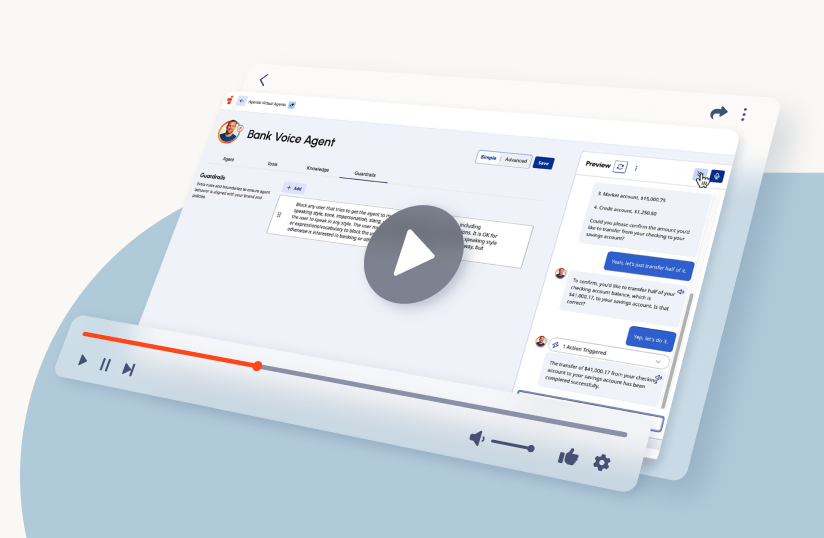


Agentic virtual agent
Go beyond responses to real customer outcomes with a virtual agent
Go beyond responses to real customer outcomes with a virtual agent
Give customers the outcomes they need instantly. Agentic Virtual Agents move beyond reactive automation by reasoning, acting and adapting through each step of the journey — resolving complex tasks end-to-end, maintaining full context across every channel, and elevating your customer experience (CX) without increasing staffing or operational effort.
Agentic Virtual Agents reason, plan and execute complete workflows across systems, providing consistent resolution without manual effort.
real-time orchestration and continuous learning keep experiences connected, contextual and optimised across channels and teams.
embedded guardrails, transparent reasoning and policy controls enable safe, compliant artificial intelligence (AI) behaviour — with seamless, contextual handoffs when humans step in.

Powered by large action models (LAMs), agentic virtual agents don’t rely on free-form generation or scripts. Instead, they reason through customer goals, plan actions deterministically and execute multi-step workflows using approved tools and guardrails. This delivers predictable, auditable outcomes — not just AI-generated responses.
Powered by LAMs and configurable within Genesys Cloud™ AI Studio, agentic virtual agents deliver end-to-end execution by combining customer interactions across voice and digital channels with real action across back-office systems.
LAM-powered reasoning enables agentic virtual agents to understand goals, interpret context and determine the best path to resolution across channels and systems.
Accelerate time to value with no-code design tools, unified context and cross-channel orchestration that scales autonomously across digital and voice.
Handle off-script moments, missing data and shifting contexts with intelligent re-planning and next-best-action decisions.
Virtual agents collect and validate customer information — and continuously learn with automatically labelled real-time data — to build a knowledge base and grow smarter over time.
Agentic Virtual Agents operate within defined controls, providing explainable decisions and auditable outcomes. Every autonomous action is planned, validated and logged.
Conversations don’t resolve customer issues — execution does. Agentic Virtual Agents autonomously plan and execute multi-step work across systems, escalating to humans only when necessary.
Agentic Virtual Agents understand customer goals, determine the best next steps and autonomously execute the actions required to resolve tasks end to end. With governance built in, they deliver intelligent, outcome-driven experiences across every channel safely, consistently and at scale.
Resolve complex, multi-step workflows autonomously. From verification to updates and troubleshooting, your Agentic Virtual Agent handles the full process, eliminating manual handoffs and reducing resolution time.
Break free from scripted interactions. Your AI agent identifies customer goals, plans the next-best actions and carries them out, providing true resolution rather than stalled dialogue.
Maintain complete context across channels, tools and systems. Each interaction feels connected and relevant, with the agent adapting in real time to customer needs and user journey signals.
As new tools, workflows and policies are enabled, the virtual agent expands its capability to reason through broader scenarios and can deliver reliable, end-to-end resolution — without reverting to scripts or static flows.
Operate with confidence. Built-in guardrails, transparent reasoning and enterprise-grade policies help ensure every autonomous action is safe, compliant and predictable.
Integrated analytics show precisely how your virtual agent is performing. Track decisions, uncover gaps and refine workflows using real-time insights and complete audit trails.




Request a demo to see how a Genesys Cloud Agentic Virtual Agent can work for you. Be there for customers at all hours and during peak times. Build a new AI agent that can chat with customers and let AI move customers through interactions quickly and easily.
Thank you for your interest.
We’ll contact you directly to set up a date and time that works with your schedule.
Agentic AI in customer experience refers to AI systems that can understand customer intent, make decisions and take actions autonomously to resolve issues, rather than only responding with predefined answers. These systems operate within set guardrails, allowing them to handle tasks end to end while knowing when to involve a human agent.
They help organisations reduce operational costs, improve first-contact resolution, scale customer support efficiently and deliver faster, more consistent customer experiences across channels.
Agentic virtual agents can complete tasks such as answering complex inquiries, retrieving and updating customer information, processing transactions, troubleshooting issues, guiding customers through multi-step workflows and resolving requests without human intervention. When needed, they can also hand off to a human agent with full context.
Virtual agents can reduce hallucinations and incorrect actions by operating within defined guardrails, using trusted enterprise data sources, enforcing validation rules and limiting actions to approved workflows. Continuous monitoring, testing and human oversight further help ensure accurate and reliable behaviour.
There are a number of different types of chatbots that businesses can use. The simplest are menu- or button-based chatbots, which offer users access to a fully scripted menu where their specific questions can be answered. A menu-based bot is basically a user interface for a decision tree; the chatbot can’t deviate from the script.
Rules-based chatbots are slightly more complex, using “if/then” logic to simulate actual conversation. If your service team encounters a number of specific questions again and again, a rules-based bot is useful for answering them.
AI-powered chatbots are another step up the ladder. They use tools like large language models (LLMs) and machine learning to grow in real time, even going so far in the case of the best AI chatbots as to ask questions to get more information from end users.
Chatbots work across a number of channels, including websites and mobile apps.
A virtual agent is the most sophisticated version of a Chatbot or Voicebot. It meets the same need — a 24/7 answer to customer questions — but it gets much closer to mimicking the experience of talking to someone. Virtual agents use AI systems and machine learning to not only surface the right answers to customer queries but to problem solve and learn as they work, and to narrow the gap between your digital offerings and your human agents.
They also offer seamless transition to human agents in cases where it’s needed with a summary of the interaction and wrap-up codes. This keeps the context intact and allows the agent to step in smoothly.
Virtual agents can work across channels, including social media, phone calls, mobile apps and more.
Chatbots, voicebots and virtual agents are all designed to answer customer questions quickly and easily, 24/7, with minimal human intervention. But most chatbots and voicebots need to be programmed with those answers and those answers need to be connected to the likely questions that would trigger those responses. Some have artificial intelligence, but in many cases that amounts to surfacing answers more easily or understanding questions better.
A virtual agent goes a step further. The AI allows the virtual agent to respond to out-of-scope queries and makes it effortless to deploy — adaptive to natural human patterns of speech and ever-evolving so you can uncover CX gaps and potential improvement areas to help your call center evolve constantly. It also makes the transition process from virtual agent to human seamless by providing appropriate conversational context.
Hopefully, the difference between a customer asking a question of your virtual agent and asking a human should be negligible. For all simple questions — and a fair number of more difficult ones — the virtual agent should be able to handle answers with speed, intelligence and (a simulation of) empathy. And when the questions get too complex, the handoff from virtual agent to real agent should be seamless.
The differences are the things that only a human can provide. Virtual agents learn and can make connections that seem abstract, but real abstract thinking needs a human mind. And of course, while AI can simulate empathy and emotion, it cannot truly feel either. When a judgment call is required, the virtual agent will need to escalate to contact center live chat with a person.
An AI chatbot is a software application that uses artificial intelligence to simulate human conversation. It can answer customer queries, provide information, carry out tasks like booking appointments or processing orders, and learn from interactions to improve its responses over time.
AI chatbots can enhance user experiences by providing instant responses, being available 24/7, offering personalised interactions based on user history and freeing up human agents to handle complex issues. By learning from interactions, they can also improve their performance over time, leading to more accurate and helpful responses lah.
A good AI chatbot should accurately understand user queries, provide relevant and correct responses, handle a wide range of topics, and learn from interactions to improve over time. It should also provide a user-friendly experience, handle errors gracefully and, where necessary, seamlessly transfer the conversation to a human Agent.
An AI Chatbot handles more than just simple automation. With its deep learning capabilities, it can go beyond a simple script. It uses natural language understanding and natural language processing to identify new customer queries, understand them and respond.
If a customer query is too complex or unique for the AI bot to handle on its own, it can seamlessly transition the query to a human Agent, providing the context and customer information the Agent needs to be able to quickly and easily help. This is one reason AI chatbots can also be referred to as virtual assistants or virtual agents.
One of the most important benefits of an AI Chatbot is that they can get better at managing interactions over time. Part of this includes leveraging improvements to the knowledge base, acting as a guiding force to help ensure the Chatbot stays within a company’s guidelines. Continuing to provide training data, such as historical conversations, can also aid the bot in better anticipating what questions to expect. This will help the Chatbot perform better around utterances, which can vary tremendously, and the true intent from interactions.
AI bots can identify and understand new inputs using natural language understanding and natural language processing capabilities. Machine learning allows the bot to analyse data and find patterns, while admins can go in and perform manual improvements such as perfecting missing utterances that are highlighted.
Voicebots, also known as voice assistants or voice-enabled AI, work by processing spoken language input from users. They use technologies like automatic Speech recognition to transcribe speech into text and natural language processing to understand the intent of the text, and then use an AI model to generate a response. The response is then converted back into speech using text-to-speech technology.
The safety of voicebots depends on their design and implementation. Reputable voicebot developers take measures to protect user privacy and data security. This can include encrypting data, anonymising voice recordings and allowing users to manage their data. However, like all technologies, voice assistants aren’t immune to risks, so it’s important to use them wisely and understand the provider’s data handling policies.
Industries are using voicebots in various ways. In retail, they’re used for customer service and shopping assistance. In healthcare, they’re used for appointment scheduling, medication reminders and providing health information. In hospitality, they’re used for booking services and providing related information. They’re also used in banking for account management and transactional tasks, and in many other sectors for diverse applications.
While both voicebots and interactive voice response (IVR) systems interact with users through voice, they do so in different ways. IVR systems work through pre-recorded messages and touch-tone or simple voice inputs, offering a limited set of responses based on a pre-programmed menu. Voice assistants, on the other hand, use advanced AI to understand natural language, enabling more complex interactions and a wider range of responses.
Conversational AI voicebots offer several benefits. They can handle customer issues 24/7, providing instant responses and freeing up human agents for more complex tasks. They can improve customer experiences by offering convenient, hands-free and personalised interactions. They can also handle a wide range of tasks, from answering questions to performing actions like booking appointments or controlling smart devices.





![Resource thumb [hotline]](https://www.genesys.com/media/resource-thumb_hotline.webp)