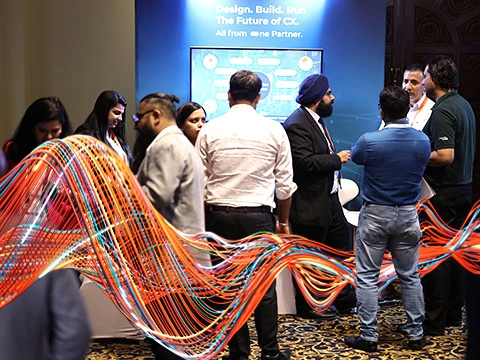
The Genesys Customer Experience (CX) Tour 2026 was a massive hit. Spanning three days and three cities, the event brought together hundreds of CX practitioners, IT leaders, artificial intelligence(AI) builders, and their customers to discuss how AI is shaping the future of customer experience.  

From Olympic gold medallist Abhinav Bindra talking about failing well to cricket commentator Harsha Bhogle dissecting how champions manage success, Wipro’s Sidharth Mukherjee breaking down a billion-dollar CX practice with unusual specificity, and Tata Play’s CIO talking about cost as a legitimate driver of cloud migration – the Genesys CX Tour 2026 was packed with a lot of information and insight.  

Here are the top five takeaways from the tour:  

Takeaway 1: AI Has Moved Beyond Automation to Autonomy

Aditya Garg, Head of Solutions Consulting at Genesys, discussed how AI is no longer about automation, but rather about autonomy.

  • The shift from traditional bots to autonomous, goal-driven AI: Unlike traditional bots that handle defined tasks, agentic AI takes a goal and determines the best course of action to achieve it.
  • Agentic AI can reason, decide, and act within guardrails: The concern most operations leaders have about agentic AI is its ability to work in ways they can’t see or control. Agentic frameworks that build governance into the architecture itself can enable organisations to have visibility into exactly what the AI did and why.
  • The evolution toward level 5 experience orchestration: Raja Lakshmipathy, Vice President and Managing Director, Genesys India, pointed out that the contact centre industry took roughly 40 years to move from Level 0 to Level 2. The move from Level 2 to Level 5, which involves universal experience orchestration across complex scenarios such as dispute resolution, is a near-term planning reality.
  • Trust, governance, and security are key to successful AI deployment: Multiple sessions across the tour discussed governance and security as top constraints to AI deployment. Aditya Garg noted that many AI point solutions route customer data through external hyperscalers, creating both security exposure and response lag. Opting for platforms that deliver AI capabilities from regional cloud infrastructure can address these concerns while improving trust.

Takeaway 2: Experience Orchestration Is the New Competitive Advantage

Individual AI tools produce individual improvements. But these siloed tools don’t hold the customer journey together from first contact to resolution. That’s what orchestration addresses: customer interactions that move across a website widget, WhatsApp, and a voice call have context preserved completely at each handoff – without the customer having to repeat a single piece of information.

  • Connecting journeys across channels, teams, and systems: Predictive engagement platforms monitor digital behaviour in real time to identify when a customer is losing confidence or abandoning a task, and it intervenes before that moment becomes a dropped interaction.
  • Predictive routing goes beyond finding an available agent: When a call escalates from a virtual agent to a human agent, most systems identify whoever is free. Predictive routing evaluates a customer’s intent interaction history and assigns an agent who is best suited for that customer.
  • Journey management makes the invisible visible: Aditya Garg demonstrated the Genesys journey management, which offers operational intelligence that CX and operations teams can act on directly, without additional analysis work.

Takeaway 3: Employee Experience Directly Impacts Customer Experience

Sidharth Mukherjee of Wipro shared how CX depends a lot on the agent who delivers it. If the agent interacting with the customer must toggle between five screens or operates without real-time support, the customer feels the gap.

  • AI is just as important for employee experience: AI plays a huge role in identifying and removing friction from agent and employee workflows. The right investment in EX yields CX outcomes that pure customer-facing automation cannot replicate.
  • Real-time guidance replaces post-call review: Voice quality analysers shift from a post-mortem function to a live system that monitors customer sentiment and tone. Agents receive relevant guidance via copilots while the conversation is still happening, rather than discovering what went wrong only after the customer has already left.
  • Knowledge graphs handle what linear workflows can’t: Knowledge graphs are the third critical ingredient, alongside MCP and agent-to-agent collaboration. Mapping the full arc of an employee’s or customer’s journey requires a relational data structure and is exactly where CX either builds loyalty or loses it.
  • Systems of intelligence replace systems of record: Organisations have been building infrastructure to store interaction data. But platforms like Genesys Cloud CX enable systems that use data to drive the next action in real-time. For agents, this means less searching, fewer screens, and more time spent on the actual problem the customer needs solved.

Takeaway 4: Real Business Value Comes from Transformation, Not Technology Adoption

Vijay Sharma of Tata Play discussed how technology adoption cannot alone deliver business value. Real impact comes when organisations transform their processes, people, and ways of working to achieve measurable outcomes.

  • Genesys customer success model: The Genesys advisory model begins with a full analysis of the current environment, building a personalised plan using native platform capabilities and establishing blueprints before a single build begins. The goal is to minimise risk, reduce time to value, and avoid the pattern of organisations rebuilding their legacy problems inside a new platform.
  • Advisory-led transformation prevents platform-shaped legacy problems: Customer success teams see a pattern regularly: organisations that migrate to a new platform and immediately recreate the workflows they had before. Embracing an advisory model can help interrupt that pattern, using the Envision and Define phases to surface what the organisation actually needs rather than what it currently has.
  • AI investment must connect to customer journeys and business outcomes: Dr. Lakshmanan Ramanathan of Infosys BPM described a discipline his team is testing: seven days to prove a use case works, followed by a 90-day window to demonstrate measurable ROI. If neither threshold is met, the initiative gets retired.

Takeaway 5: High CX Performance Needs a Human-Centred Mindset

Sports persons like Abhinav Bindra, Rohan Bopanna, and Harsha Bhogle shared how many organisations end up chasing the output of technology projects, but witness the actual process falling apart:

  • Shifting from outcome-first to process-first: When Bindra failed to win a medal in Athens, he rebuilt his preparation entirely around the quality of daily work. For organisations deploying AI, they must build steady, repeatable routines for testing, evaluation, and revision, instead of treating every rollout like one isolated moment.
  • Process over outcomes as an operational discipline: Bindra’s preparation for Beijing 2008 included neurofeedback training, flotation tanks, and special forces conditioning. Organisations that build the same level of rigor into AI implementation cycles produce more durable results than those that optimise for launch speed.
  • Balancing performance with human well-being: Bindra’s most candid moment came when he described his greatest career regret as a lack of balance, and the cost of nurturing the athlete at the expense of the human. For CX organisations, the parallel is an AI transformation that optimises so aggressively for efficiency metrics that it degrades the experience of the people doing the work, creating the EX-problems that then surface as CX failures.

Crafting the Next Level of Experience

The Genesys CX Tour India 2026 spanned three cities and five themes but focused on one consistent direction: as AI becomes autonomous, customer and employee journeys must be orchestrated end-to-end.

Organisations that rethink how work gets done, where accountability sits, and what success looks like for the people on both sides of every interaction are the ones that will carve the future of customer experience.


Missed the sessions live? Watch the recordings: https://www.genesys.com/en-sg/events/cx-tour-india-2026

FAQs

What is agentic AI in customer experience?

Agentic AI refers to systems that autonomously reason, plan, and act to reach specific customer experience goals within defined governance guardrails.

How does Genesys Cloud support employee experience?

Genesys Cloud provides agent co-pilots, real-time knowledge assistance, and automated summarisation tools that reduce friction and improve frontline productivity.

What is Level 5 Experience Orchestration?

Level 5 represents universal AI orchestration where autonomous agents handle complex scenarios like negotiations and dispute resolution across the full customer journey.