Your Genesys Blog Subscription has been confirmed!
Please add genesys@email.genesys.com to your safe sender list to ensure you receive the weekly blog notifications.
Subscribe to our free newsletter and get blog updates in your inbox
Don't Show This Again.
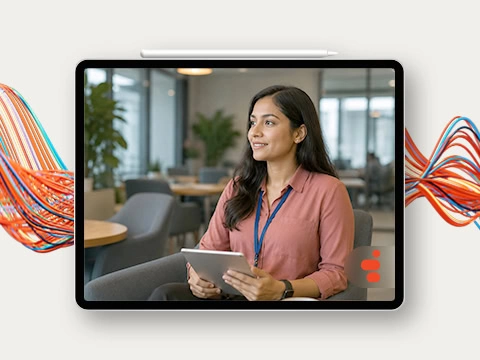
Customers in India are not comparing their bank to another bank anymore. They are comparing their banking experience to their last digital experience: a UPI transfer, a food delivery update, and a WhatsApp message. That is the benchmark BFSI organizations are now being measured against, and most of them are not meeting it.
A primary research study by Dun & Bradstreet and Genesys, covering 104 senior leaders across banking, insurance, NBFCs, FinTech, and wealth management, puts this problem in precise terms. Customer Experience (CX) intent across India’s BFSI sector is strong, but execution is structurally constrained. Here’s why the gap between the two is not closing and what BFSI leaders can do.
Customer expectations from BFSI companies are evolving:
72% of BFSI leaders report that customers now expect instant resolution
60% say transparency expectations have risen significantly
54% identify proactive engagement as a basic customer expectation
But speed, transparency, and proactive engagement are no longer features that earn loyalty. Legacy service architectures are no longer capable of meeting these advancing expectations.
Organizations are connecting CX outcomes to revenue and retention in ways they were not doing a few years ago.
41% of BFSI leaders describe CX as a board-level priority
38% see CX as a key revenue growth engine
38% frame it as a trust and differentiation lever
When you look at the operational picture, it’s a different reality. Only 36% of organizations are actively reimagining their backend workflows to reflect the CX priorities their leadership has set. Better conversations are not translating into faster resolutions, because approval chains, handoff protocols, and back-end processes that drive resolution speed haven’t been redesigned to reflect the ambition at the top.
Frontline investment is real and showing up in individual interactions:
01
69% of organizations are giving agents real-time customer context at the point of interaction
02
68% are automating repetitive tasks
03
57% have deployed AI-assisted suggestions and next-best actions
However, despite these advances, data unification and omnichannel journey orchestration rank at 37% and 33%, respectively. At the same time, 69% of BFSI leaders identify data quality and fragmentation as their primary modernization barrier. Legacy core and CRM integration follows at 53%.
AI adoption across India’s BFSI sector is accelerating, but the frameworks designed to oversee and control that deployment are falling significantly behind the pace of implementation.
The future CX model runs automation and human judgment together, with each handling what it does best.
The capabilities leaders believe will most differentiate CX organizations over the next two to three years are:
Proactive, predictive service at 32%
Trust, security, and transparency at 20%
AI-augmented human agents at 19%
The findings point to three strategic imperatives that address the layers of the problem surface-level CX programs consistently miss. Organizations that act on all three will move faster from intent to execution than those that continue investing in the interaction layer alone.
Global BFSI Success Story:
Visa partnered with Genesys to modernise its customer experience using a unified, AI-powered platform. The implementation helps Visa handle 106M+ disputes annually, support 340+ financial institutions, and deliver high-impact moments for consumers globally. Read the case study → https://www.genesys.com/en-sg/customer-stories/visa
Bridging the distance between CX intent and CX execution requires addressing the structural, data, and governance foundations. Genesys Cloud brings together AI-powered automation, omnichannel journey orchestration, workforce engagement management, and unified customer data into a single platform built for exactly this challenge.
For BFSI organizations navigating legacy constraints, fragmented data, and rising regulatory expectations, Genesys provides the infrastructure that connects the interaction layer to the operational layer, so that better conversations lead to faster, more reliable resolutions for customers.
The 2026 BFSI CX Reality Check: India Edition
Download Now! → https://www.genesys.com/en-sg/resources/bfsi-cx-reality-check-report
The gap between board-level CX intent and the operational architecture required to deliver consistent outcomes at enterprise scale.
Only 10% of BFSI leaders are confident in well-governed AI deployment, meaning most are scaling AI use cases faster than the compliance frameworks designed to manage them.
74% of NBFC leaders cite data quality and fragmentation as their primary CX modernization barrier.
 Genesys
Genesys® empowers more than 8,000 organizations worldwide to create the best customer and employee experiences. Genesys Cloud™ is the Agentic Orchestration Platform that securely connects people, systems, data and AI...
Subscribe to our free newsletter and get the Genesys blog updates in your inbox.