Your Genesys Blog Subscription has been confirmed!
Please add genesys@email.genesys.com to your safe sender list to ensure you receive the weekly blog notifications.
Subscribe to our free newsletter and get blog updates in your inbox
Don't Show This Again.
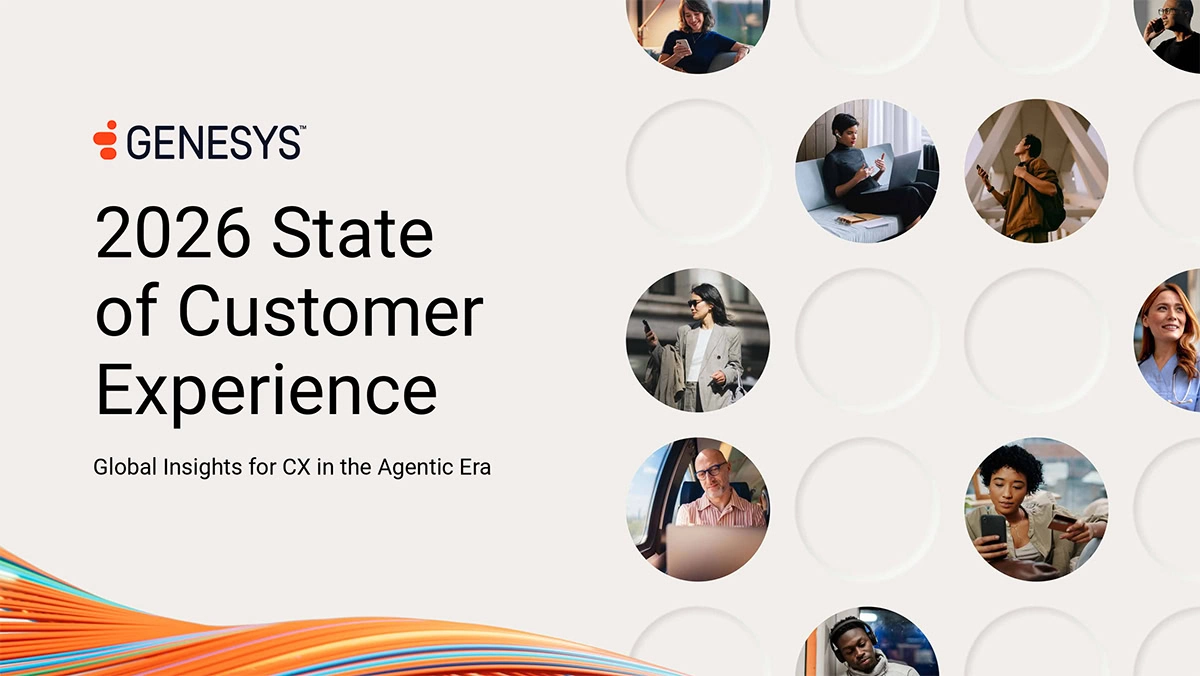
Artificial intelligence (AI) is reshaping customer experience (CX) around the world. But in the UK and Ireland, the shift is taking place against a distinctive backdrop: economic pressure, high consumer expectations, heightened trust expectations and a growing need to prove measurable business value.
Those pressures are reflected in the fifth edition of “The State of Customer Experience” report by Genesys, based on global surveys of 5,811 consumers and 1,560 CX and business leaders. The research shows that consumers still expect organisations to deliver experiences on par with the best they’ve ever had. In the UK and Ireland, that expectation remains high even as consumers are more cautious about AI-powered customer service than the global average.
That creates a clear mandate for regional CX leaders: Improve speed, efficiency and productivity without weakening the human connection that builds trust and loyalty. AI cannot simply reduce cost. It must help organisations deliver better outcomes for customers, employees and the business.
In the UK and Ireland, that challenge is especially relevant because organisations are balancing pressure to prove measurable value with access to a growing base of AI expertise and innovation, supported in part by the Genesys AI centre of excellence in Galway.
The past several years have placed pressure on both households and organisations. Inflation, rising costs and changing spending habits have made consumers more value-conscious. But they have not lowered their expectations for the experiences brands deliver.
In the UK and Ireland, 93% of consumers say they expect every organisation to deliver an experience on par with the best they’ve ever had, slightly above the global figure of 92% (CQ300). And 91% say a company is only as good as its customer service, in line with the global average (CQ300).
That matters because CX is no longer just a support function. It is becoming a primary driver of loyalty, trust and growth. Customers may be more selective about where they spend, but they are not lowering the bar for service. They still want issues resolved quickly, context to carry across channels and organisations to respect their time.
For organisations in banking, utilities, retail, travel and the public sector, this raises the stakes. In the experience economy, customers compare every interaction with the best experiences they have anywhere. That makes CX a commercial priority, not just an operational one.
The UK and Ireland show a more cautious consumer attitude toward AI-powered CX. Fifty-nine percent of consumers in the region believe AI will improve the quality and speed of customer service over the next two to three years, compared with 76% globally (CQ300). Thirty-four percent say they feel more positive about AI-powered customer service than they did two years ago, compared with 50% globally (CQ190). And 28% say they feel more negative, compared with 19% globally (CQ190).
This does not suggest rejection of AI. It suggests a higher bar for trust. Consumers want AI to be useful, transparent and easy to escalate when human help is needed. Ninety-three percent of UK and Ireland consumers say they have a right to know when they are interacting with a bot or AI, and 93% say they value efficient customer service as much as being treated empathetically (CQ300).
The generational picture adds an important nuance. Across the global sample, 82% of millennials, 80% of Gen Z consumers and 73% of Gen X consumers believe AI will improve the quality and speed of customer service over the next two to three years, compared with 60% of baby boomers (CQ300, by generation). For UK and Ireland organisations, AI expectations will continue to rise, even in a more cautious market.
The implication is clear: AI cannot simply be deployed. It must be designed around transparency, governance and effective human handoff.
Economic pressure is also changing how organisations think about CX investment. Business cases need to be defensible, with clear evidence that CX improvements can reduce cost, improve productivity and strengthen customer loyalty. That makes measurable value central to AI adoption, especially as leaders look for investments that can improve both operational performance and the customer experience.
That is reflected in the data. Increasing customer value and loyalty is the top strategic priority for CX leaders in the UK and Ireland, cited by 37% (PQ180). Reducing cost to serve follows closely at 36%, above the global figure of 29% (PQ180).
This is where AI changes the equation. Historically, organisations often had to balance efficiency and experience quality because skilled human agents were the scarce resource. AI creates an opportunity to ease that constraint. Routine interactions can be automated, agents can be supported with real-time context and supervisors can spend less time on manual work and more time improving performance.
The goal is not to replace human engagement. It is to apply the right capability to the right task: AI where it improves speed and consistency, and humans where judgement, empathy and accountability matter most.
That is especially important in sectors where trust is fundamental. Customers want efficient service, but they also want confidence that the organisation understands the situation, respects the context and can take responsibility for the outcome. This is already visible in cases such as those of Virgin Airlines and HSBC, where AI-powered capabilities are reducing handle time, improving customer effort scores, increasing containment and giving employees more time to focus on higher-value work.
For UK and Ireland organisations, the challenge is not whether AI is relevant. It is whether AI can be connected to the operating model in a way that produces consistent value.
CX leaders in the region are especially focused on proving AI impact. Fifty-three percent cite demonstrating AI value or return on investment as a technology challenge, compared with 42% globally (PQ220). Forty-two percent cite moving AI from pilots to scale, compared with 37% globally (PQ220). And 44% cite balancing automation and experience quality as an operational challenge, compared with 37% globally (PQ230).
These barriers point to the practical work required to move beyond traditional contact centre models. Organisations need to look at the end-to-end customer journey, not the technology stack as a set of disconnected capabilities. That means connecting data, channels, workflows and systems so AI can support the entire journey, not just isolated interactions.
Today, that foundation is still uneven. Forty-seven percent of UK and Ireland organisations automatically provide previously collected customer information to agents, below the global average of 52% (PQ320). Twenty-eight percent say they are delivering extremely personalised customer service, compared with 35% globally (PQ100). And only 18% say they are significantly minimising customer effort, compared with 24% globally (PQ90).
That gap matters. Customers do not experience a technology stack. They experience whether the organisation understands them, remembers what has already happened and helps them reach a resolution without unnecessary effort.
Looking ahead, CX leaders in the UK and Ireland expect significant change. Ninety percent expect AI will be pervasive throughout the CX function and workflows within three years, and 88% expect AI agents will be fully integrated into the workforce alongside human agents (PQ250).
At the same time, leaders in the region are more cautious than the global average about fully autonomous orchestration. Seventy-two percent expect autonomous AI agents to orchestrate CX within three years, compared with 82% globally (PQ250).
That difference reinforces the regional theme. The UK and Ireland opportunity is not AI for its own sake. It is intentional experience orchestration: using AI where it makes sense and humans where they matter most.
The handoff between AI and human agents is critical. Routine issues should be resolved quickly and efficiently. Complex, emotional or high-value conversations should benefit from human expertise. And when customers move between AI and human support, the experience should feel connected rather than fragmented.
The organisations that lead over the next two years will be those that stop treating CX as a set of disconnected service capabilities. They will look across the full customer journey and use AI, data, platforms and people to orchestrate outcome-driven experiences that are efficient, empathetic and clearly tied to business value.
The “State of Customer Experience 2026” report explores these shifts in depth,
including how consumer expectations are changing, where CX leaders are investing,
why AI readiness remains a challenge and how regional trends differ across global markets.
For CX leaders in the UK and Ireland, the findings point to a clear conclusion: AI can help organisations improve productivity and customer loyalty at the same time, but only if it is implemented with trust, governance and human engagement at the core.
Download the full report to explore both the global and regional findings, and learn how
today’s CX leaders are preparing for the agentic era of customer experience.
 Stuart Templeton
Stuart Templeton is vice president, EMEA North at Genesys, leading go-to-market strategy across the UK, Ireland and Nordics. He previously held leadership roles at Ironclad, Slack and Salesforce.
Subscribe to our free newsletter and get the Genesys blog updates in your inbox.