


Experience orchestration
Coordinate end-to-end journeys that customers love, reducing operational costs and building customer loyalty
Coordinate end-to-end journeys that customers love, reducing operational costs and building customer loyalty
Experience orchestration (EO) is the process of identifying and creating the ideal end-to-end journey for each customer, improving both their experience and your business outcomes.
Businesses can coordinate data, systems, channels and roles to create more effective, efficient, and emotionally intelligent experiences. Together, these technologies can reshape the ways businesses deliver both customer and employee experiences, unlocking new levels of automation, augmentation, personalisation and optimisation.

There are a number of different levels of experience orchestration sophistication that an organisation can have, ranging from purely manual customer interactions to full agentic orchestration. And Genesys is uniquely suited to help your organisations move up these levels.
These indicate on a continuum where an organisation’s experience orchestration sophistication lies, from “none” to “fully agentic.”
The levels of experience orchestration is a model that enables your business to understand where different areas of the business are and determine not only where they should be, but also how to mature operations, technology, and more to meet your business needs. Not every business needs to reach Level 5 in all phases of the business – assess your needs and see how best to meet them.
Genesys is uniquely positioned to partner with your business as you determine your experience orchestration maturity levels across your business. We’ll support you as you progress through the levels of experience orchestration to reach where you need to be to optimise your customer experience (CX).
A customer’s brand experience is a journey from awareness of your brand to purchase and beyond. Optimised journeys create the ideal customer experience. Here’s how experience orchestration helps deliver the optimal experience.
With artificial intelligence (AI), your business can use historical customer data to predict what new customers are going to want and need and automatically provide them with the next-best action at the right time. By understanding context and intent, this helps onboard new customers and turn them into loyal customers faster.
Experience orchestration smooths out the purchasing and payment process. It uses AI to examine customer actions and reveal the best possible buyer’s journey based on customer intent. Now, it can guide customers seamlessly as they learn about products and services, shop for solutions that will solve their needs, and purchase and pay. Let's say your customer needs to make a payment. AI examines customer actions and can coordinate across systems to guide the customer seamlessly through the process – making it personalised from the first moment through the process to completion.
Providing more accurate, helpful, and rapid support to customers positively impacts brand perception and customer loyalty, and an orchestrated customer experience helps to do just that. AI tools enhance the experience both by allowing customers to more easily self-serve and by enhancing your agents’ ability to help them achieve their desired outcomes. If your customer needs to talk to a human agent, AI pulls over relevant context and AI tools enhance the agent's ability to service the customer faster. And, by orchestrating front and back office workflows, the customer’s issue is resolved quickly the first time.
The right AI-powered capabilities help pinpoint the moments customers abandon their cart. This data enables the business to identify when someone is at risk and take steps to help, building loyalty rather than losing a customer forever. By understanding the data across the customer lifecycle, you can orchestrate the moments that matter across the experience to deliver the best outcome. And you can easily spot gaps to address customers at risk before they leave, letting you continuously optimise to drive loyalty and growth.


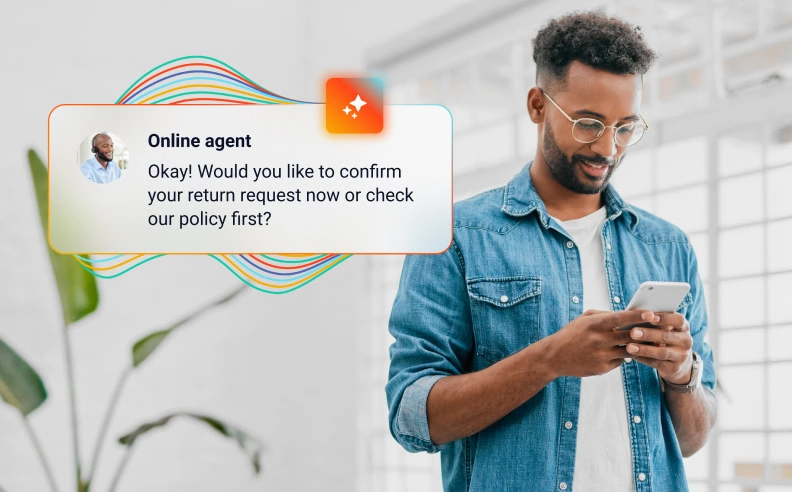
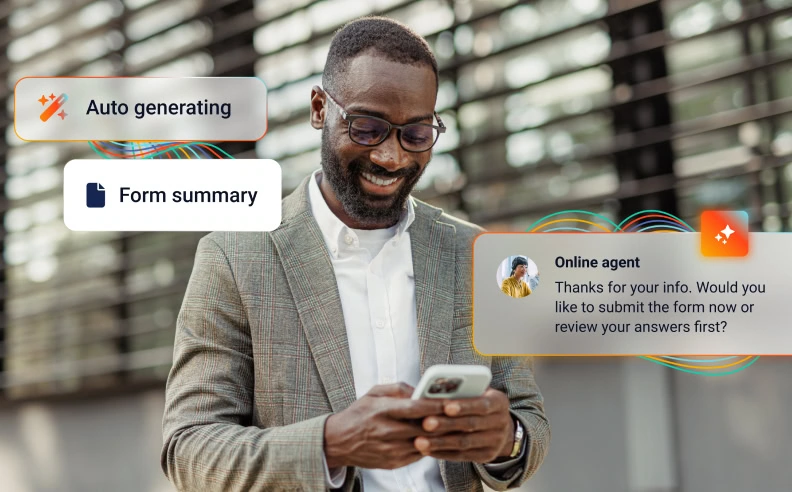
AI-powered journey orchestration transforms the ways in which people interact with your business. And it does more than just support customers and employees – it enhances your profit margin.
With the help of AI, you can observe changes in customer behaviour as they occur and adjust journeys to align with new goals and needs. This way your customers will never receive an outdated experience and you can outpace your competitors. This will enhance your customer satisfaction and Net Promoter Score as experiences improve and customers are delighted by their support experience.
Experience orchestration delivers the seamless, personalised, and contextual experience that today’s customer expects across every touchpoint. Cultivate loyal customers by offering each one precisely what they require, when they need it, without any obstacles.
Experience orchestration improves employee journeys, as well. Better and more accessible data make it easier for service agents to help customers in need, improving the day-to-day employee experience as well as overall employee satisfaction. This data-driven support improves average handling time (AHT) as efficiencies within your customer service setup build.
Don’t just guess at which customer journey will be best for your bottom line – get the information to know. Holistic real-time, contextual data gives business leaders the insights they need to be able to build experiences that customers will love and will drive business results. Organising around a customer-centric design philosophy increases customer retention, preserving and improving your existing revenue and preventing expenditures on replacing customers as they churn.
Generative, predictive, and conversational AI deliver insights right when they’re needed. Virtual agents contain call volume, reduce average handling time, and improve service – keeping employees focused on interactions that make a business impact. This increases first-contact resolution, as intent-driven context allows agents to serve customers faster and provide the right assistance more accurately.
No matter where your customer’s experience starts – on social media, phone or website – you can orchestrate it with the Genesys Cloud™ platform. Coordinate every step of every experience and get quick customer resolutions whilst creating moments that matter.
Reach out to us today and learn how Genesys can help you achieve true customer experience orchestration.
Thank you for your interest.
We’ll contact you directly to set up a date and time that works with your schedule.
An effective customer journey orchestration platform must be compatible with your systems of record, like CRM, ERP, and operations systems. It must also bring together your systems of engagement like websites, social media, and bots.
With these components, it can draw data from every interaction a customer has with your brand. That customer journey analytics data is brought into an AI-infused orchestration engine that processes it through machine learning, workflow builders, and more. The data is then routed and pushed through the right engagement services to optimise the customer’s experience.
AI underpins experience orchestration by automating workflows and processes, augmenting your workforce to upskill and make them more productive, personalise every moment with contextual, real-time understanding, and optimise with AI analytics to draw out key insights to improve experiences to build loyalty and deliver business value.
When it comes to Genesys Cloud AI, it’s natively built within the platform, making it easier to use and faster to apply across a wide set of CX use cases. Genesys Cloud AI is fine-tuned for CX and configurable for your business. With built-in governance and compliance, you can apply AI without risk.
CX orchestration requires data from all available sources, including, but not limited to, your CRM, ERP, operations systems, websites, social media platforms and AI agents. An experience orchestration engine takes in all that data and uses AI to determine what the best next action is for that individual, based on the situation and context. It all relies on having a full view of data, and on being able to analyse and interpret the data well.
Yes. Eighty-six per cent of consumers say a company is only as good as its service, and 31% of consumers say they stopped doing business with a company after a negative customer experience. Customers expect their experiences to be personalised and when they encounter roadblocks, they’re more than willing to buy elsewhere. On the other hand, providing customers with exactly what they need, when they need it, practically guarantees higher satisfaction. And satisfaction promotes loyalty.
Customer journey mapping helps visualise, measure, and monitor the journeys that customers take as they seek to achieve a goal, allowing you to better optimise business performance as you work to make those customer goals easier to achieve. As an analytics and measurement function, it serves as a key part of the experience orchestration process. Experience orchestration builds in artificial intelligence to allow a business to use the aggregated data to design and automate the journey to improve outcomes for the customer and your business alike.
A number of key performance indicators can help determine whether experience orchestration efforts are successful. Customer satisfaction and loyalty scores, such as retention rate, indicate whether customers are receiving what they require from their interactions with your brand. Employee efficiency increases that stem from increased empowerment can be measured using average handle time, customer ratings, and even employee resourcing metrics.
And finally, examine whether business needs are being met – operating costs dropping and revenue increasing are trailing indicators of an improved experience.
A number of potential obstacles stand between a business and a successful experience orchestration implementation. The complexity of evolving to the cloud from an on-premises solution, if necessary, and the complexity of cloud application consolidation can be risks to manage as you begin. Integrating all data sources into a single platform for AI analysis and management can, depending on the platform, be difficult; as can obtaining visibility into every interaction and journey across your entire experience ecosystem.
The efficiency and effectiveness of the implementation process itself determines how quickly benefits will be realised. And finally, considering the importance of AI throughout the experience orchestration process, its impact depends on proper implementation and management.